By necessity, pharma embraces, or wraps itself in, failure. It is where we measure the difficulty of intervening in the biological complexity of health or illness, so it is perhaps unsurprising that our intended consequences are continually humbled by the unintended.
The word ‘failure’ is both overused and under-challenged in pharma. At first glance, it seems such an obvious concept – “We tried, but didn’t succeed.”
But the simple notion of failure sits behind our common understanding of success rates in drug development, and how difficult (and therefore expensive) it is to even get one medicine to market. That ratio is at the core of industry demands to “protect our innovation.” If we launch only 40-50 new medicines per year in the current system, just imagine what might happen if we start to lower the reward, the thinking goes.
The word “attrition” is used as if losses are inevitable, massive, and unpredictable. However, if your waiter drops 4 of the 5 plates he is bringing to your table, but is able to load the cost of all 5 onto the bill for the appetizer that does make it, it might be reasonable to ask what incentive there would be to improve his carrying skills.
At first glance, the analogy falls down – these dishes have already made it into the waiter’s hands, rather than failing in development. But what if our waiter decided just to leave them there under the kitchen hot lamps, because, well, it just isn’t worth it to bring them to you? (Oh and, by the way, you’re still paying the big check regardless.)
On that note, here’s something interesting in the figures from the most expensive phase of drug R&D – discontinuations in late-stage, phase 3 clinical trials. In the 10 years from 2008 to 2017, 420 pharma phase III trials cited “termination, suspension, or withdrawal” (another 350 gave “unspecified or other” as their toe tag for their would-be drugs).
Fully one third of the “failures” were for low trial recruitment and completion rates. More than one in 4 (27%) failed for lack of efficacy – the drug worked no better than placebo, or a comparator treatment (that’s more than twice the number that failed for adverse events or side effects). Those ultimately doomed plates that made it to the waiter’s hands? 51 of the terminations were for “Business/Strategic Decision.” (These data can of course hide a great deal of “definition” murk, so I am using them directionally, rather than as numerically accurate.)
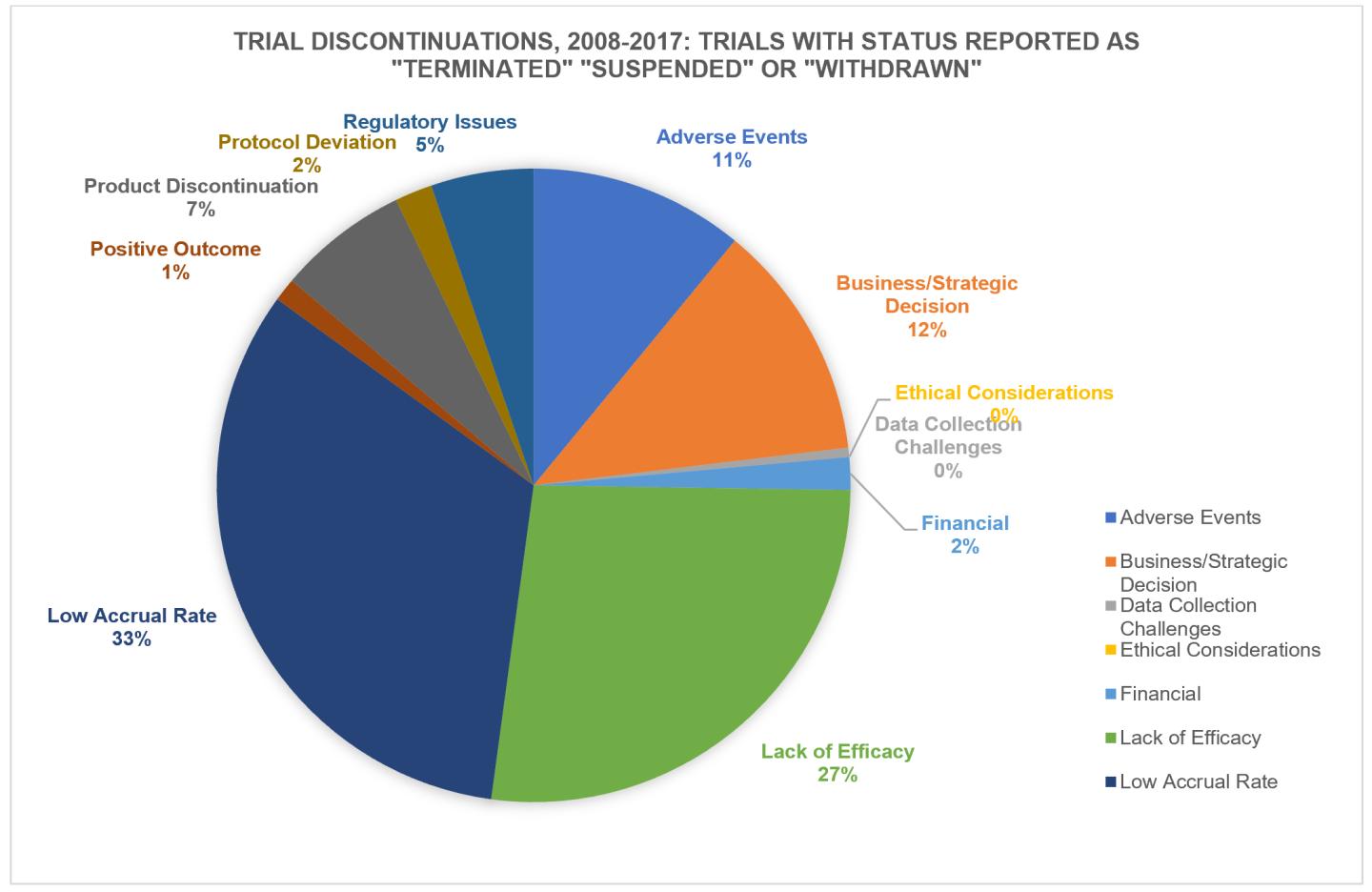
When so many studies “fail” for their ability to recruit patients, we of course might wonder why. The reasons are legion, from over-promising by hard-tendering contract research organizations (the third-party firms hired to do the major leg work for many pharma companies), to lack of a true unmet medical need, to difficulty getting patients to trial sites, or possibly a study that would put a control group at a disadvantage.
(By the way, there’s another unintended consequence: We’re conditioned to look for pure “signals” of a drug’s potential efficacy, but we need to recognize that can be at odds with how prescribing works in the real world – doing no harm to real, live patients).
One thing to take away, however, is not the failure, but the opportunity. We’ve no reason to believe that these medicines are ineffective, or unsafe – just unproven.
The failure rate associated with an experimental treatment’s efficacy is staggering. There is a consequence of using early phases of R&D just to look for the tiniest signal that a drug might work: Companies are still using massive phase III programs just to find out if their drugs work well enough. We have to be careful what we wish for. It is, of course, possible to have a 0% failure rate for efficacy in phase III, by only conducting “easy” studies. None of us need that.
Equally, a 0% success rate would be disastrous for all of us. However, like judging Michael Phelps by his ability to dive, let’s acknowledge that a drug that “fails” a phase III study could equally ask, “Did the study fail a good drug?” That is, could a different question asked of the same drug have yielded a different answer?
That then makes the category of “Business/ Strategic Decision” an appealing one , for those of us who wish that the industry would get more medicines to patients (and thereby get them there faster and more cost-effectively). Note that this category is separate from financial reasons, where “failure for lack of money” would sit. No, these are products shelved because the company has decided there’s less value coming back from the drug than the marketing and opportunity cost of developing it (sunk cost and/or ongoing commitments, for example the cost of marketing. While we’re discussing that broader notion of value, this category, let’s be clear, does also include drugs that may provide value to the patient.
There may be many reasons an asset doesn’t fit strategically – a decision to move a company portfolio in a certain direction, or out of a particular therapeutic area, for example. It could be that more than one candidate worked, and a choice had to be made as to which would be the one taken forward.
In either case, these kinds of drugs could potentially be useful medicines. If shelved to make way for another medicine in the portfolio, we’re left wondering – was there a different way that this medicine could have been studied, or could still be? This history of pharma’s successes includes many medicines that had “false fails” in their development (more, perhaps than any of our prediction-based scientists would like to acknowledge).
Among the reasons that a perfectly good medicine might “fail for business plan” is that the company might have a cut-off for a business case that the asset doesn’t clear. Let’s say, for example, that a company won’t progress an asset that can’t be forecast to return $1 billion per year. Unfortunately, even the most optimistic estimates of revenue forecasting in pre-launch suggest it is usually wrong (and wrong equally in both directions). So, that $1 billion figure seems an odd number to rely upon to nix a drug. It may be the best and only one we have, but let’s focus on what matters – many of these medicines have wrongly been estimated to have no forward value: They “failed” a false test.
Or, perhaps, the drug is expected to perform less well than a competitor that’s already out there. Well, phase III data are rarely useful enough to draw such a conclusion – because they are rarely head-to-head with the effective standard of care, and registrational studies are unfortunately still not set up to answer questions about such drugs’ comparative effectiveness versus others.
So, for all the reasons a drug might “fail for business plan,” there are a host of reasons to believe that a body with different interests might make a different decision. As we know, two similar-looking but different companies might well have taken different decisions, not least because forecasts are remarkably subjective – the team or the individual producing those forecasts might produce a different forecast in a different environment (or with different senior management pressures).
A company with lighter appetites, or a different approach to portfolio positioning, may progress more products that happily sit on market together. An organization with less of a financial motive, of course, may regard this landfill site as, instead, being full of recyclable material.
There was a fascinating line in the Peter Attia podcast with Rick Rubin, discussing the history Rubin had experienced, in hoping a major might let artists move between stables, for their own sake: ‘Columbia has a policy: they’d rather see these works die than see someone else have success with them…’
If a product fails “for business plan,” it is legitimate to ask the question about who else should have access to that drug, to arrive at a different conclusion about its strategic value, and potentially to launch a medicine that may not have satisfied its original company that worked on it – but which still might meet patients’ needs.
Mike Rea is the CEO of IDEA Pharma, and Eneida Pollozi is a strategy consultant at the company.