• Home
  • Latest
  • Fortune 500
  • Finance
  • Tech
  • Leadership
  • Lifestyle
  • Rankings
  • Multimedia

Trendingnow

1

After forcing workers back to the office, Goldman Sachs and JPMorgan Chase are now letting their staff work remotely—but only for the World Cup

2

Markets tumble worldwide as Fed resets expectations: $400 billion wiped off SpaceX stock

3

Current price of oil as of June 23, 2026

1

After forcing workers back to the office, Goldman Sachs and JPMorgan Chase are now letting their staff work remotely—but only for the World Cup

2

Markets tumble worldwide as Fed resets expectations: $400 billion wiped off SpaceX stock

3

Current price of oil as of June 23, 2026
CommentarySaudi Arabia

Why Trump Could Try to Stop More 9/11 Lawsuits Against Saudi Arabia

By
Michael C. Hudson
Michael C. Hudson
and
Bethany Cianciolo
Bethany Cianciolo
Down Arrow Button Icon
By
Michael C. Hudson
Michael C. Hudson
and
Bethany Cianciolo
Bethany Cianciolo
Down Arrow Button Icon
April 3, 2017, 4:24 PM ET
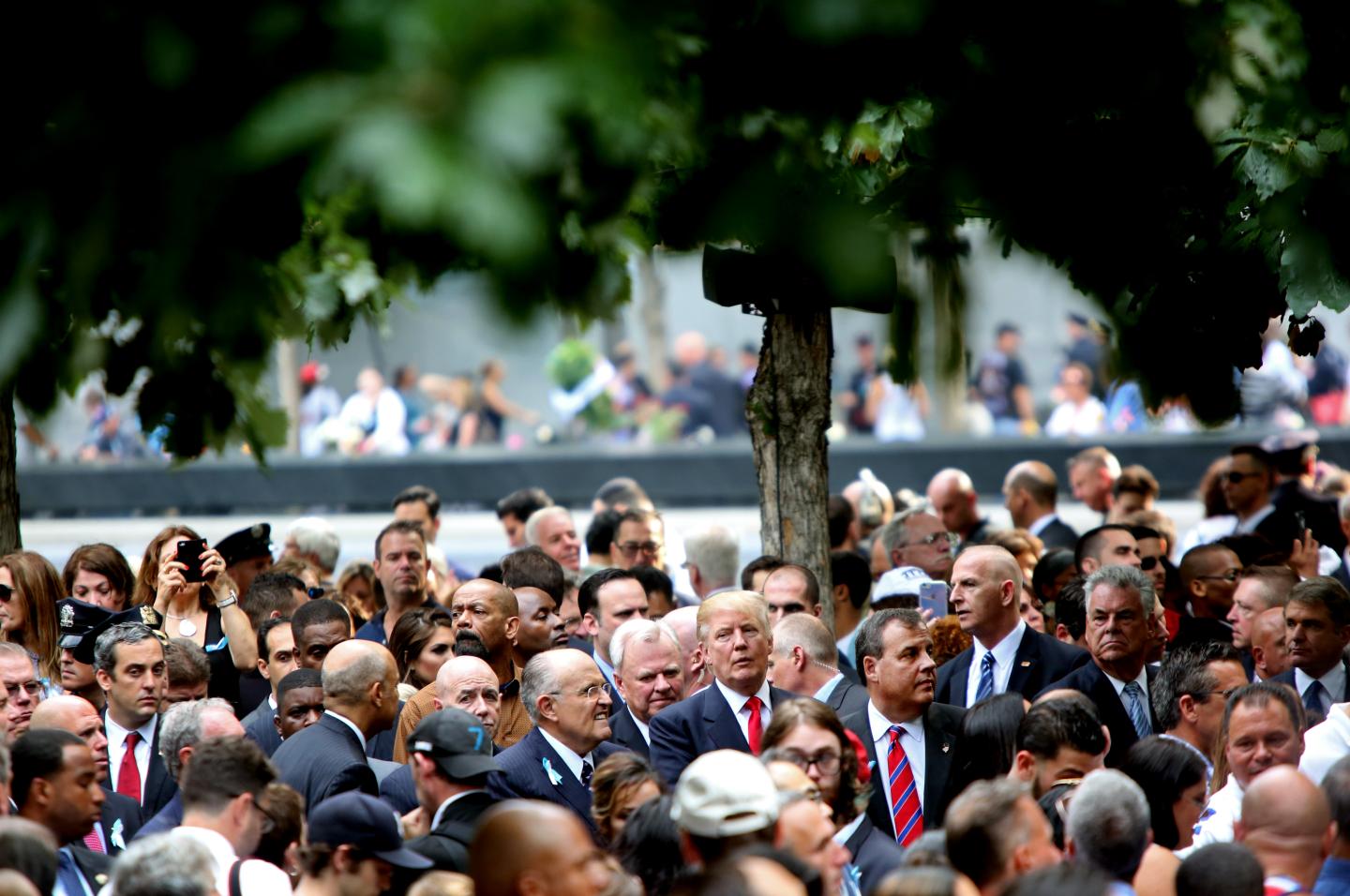
MANHATTAN, NY - SEPTEMBER 11: (L-R) Former New York City Mayor
MANHATTAN, NY - SEPTEMBER 11: (L-R) Former New York City Mayor Rudy Giuliani, U.S. Presidential candidate Donald Trump, and New Jersey Governor Chris Christie talk in the World Trade Center 9/11 Memorial in Manhattan, NY, on September 11, 2016, the 15th anniversary of the terrorist attacks that destroyed the twin World Trade Center towers in 2001. (Photo by Yana Paskova/For The Washington Post via Getty Images)Yana Paskova—The Washington Post/Getty Images
Add Fortune on Google for similar content.

Now that relatives of the victims of the September 11th attacks have filed their lawsuit in New York, alleging that the government of Saudi Arabia and related Saudi charities gave material support to the mostly Saudi attackers, the Trump administration faces a new complication in its efforts to fashion a U.S. strategy for the volatile Middle East. But the U.S. should be wary of aligning too closely with any particular regional player.

During the presidential campaign, Donald Trump harshly criticized President Obama for his veto of JASTA, the Justice Against Sponsors of Terrorism Act, which allows friends and family of 9/11 victims to sue the Saudi Arabian government. Congress overwhelmingly overrode the veto, and now Saudi Arabian officials say they’re expecting Trump to repeal the law—assuming he now sees the wisdom of a friendlier alliance with the Kingdom. But will the famously erratic and unpredictable president actually do so?

Like so many other issues facing the president, who prefers simplicity, this one is also “complicated.” Trump sees “Islamic terrorism” as the major security problem, but is Saudi Arabia really part of the problem? Of course, the Saudi government has declared its opposition to ISIS, Al-Qaeda, and other Islamist organizations—and yet, there is the considerable circumstantial evidence that Saudi non-governmental groups (like charities and schools), or even quasi-governmental organizations, have provided ideological and/or financial encouragement to extremist groups—as the JASTA lawsuit alleges.

Last month, Mohammad bin Salman, the Kingdom’s deputy crown prince, dropped by the White House and stayed for a formal lunch with the president. Not only is the 31 year old King Salman’s son, but he’s become the driving force for change in the Kingdom—ruffling a lot of royal feathers along the way.

Saudi accounts of the meeting were almost euphoric: There was now to be a “reset” in the fraught U.S.-Saudi relationship of the last administration, when President Obama was pursuing a deal with Iran to limit its nuclear activities. The Saudi rulers seemed not to be bothered by the Trump campaign’s Islamophobic rhetoric and his use of “Islamic terrorism” (the same might not be said for many ordinary Saudis). In addition, the Saudis are dangling a substantial financial carrot—promises of major investments in the U.S., which would be music to the ears of politicians and businesspeople craving massive infrastructure development.

The JASTA plaintiffs obviously want Trump to continue to offer his support for the lawsuit, while the Saudis want him to repeal JASTA (which is beyond the president’s constitutional powers). Do the benefits of ideological consistency—reiterating a position that has broad congressional and popular support—outweigh the costs of Saudi unhappiness, including the withdrawal of those financial carrots? On the other hand, do the benefits of cozying back up with the Saudis come at a serious price in terms of domestic support?

My guess is that Trump will invest more political and military capital in the Saudi regime and downplay further endorsement of the JASTA cause. This is not to say that the administration is entirely happy with its Arabian partner—Saudi Arabia is no Great Britain, and by all accounts, there was no sign of an emerging “bromance” between Trump and the prince at their lunch (he apparently doesn’t exude the charm of Vladimir Putin). Still, given the messy reality of the Middle East, the Trump administration has likely concluded that a constructive relationship with the Kingdom’s rulers must take priority over qualms it might feel over the “support for terrorism” charge, domestic human rights issues, and Saudi policies in the region—notably the war in Yemen.

As a global power, the U.S. has many interests throughout the Middle East, and they may not always align with Saudi Arabia’s. And some observers caution that the stability of the regime itself under Prince Mohammad bin Salman may be in question, given its domestic burdens (a substantial budget deficit, cutbacks on many perks enjoyed by Saudi citizens, below-par oil prices, and youth unemployment) as well as external burdens (the costs of running the Yemen war without much success). The inexperienced but impetuous young Saudi leadership unwisely embarked on a military campaign to deal with the rise of the Yemeni Houthis, with disastrous human results: Many thousands of Yemenis have been killed or injured in Saudi airstrikes (supported to a degree by U.S. military advisors), widespread food shortages have led to near famine conditions, and buildings and infrastructure have been destroyed.

The U.S. under Obama offered limited support in the fight against Yemeni rebels from the North, tempered with concerns over the human costs. Trump, on the other hand, is increasing military aid for Saudi Arabia and ramping up U.S. strikes against Al-Qaeda in Yemen. All of this is generating anger amongst Yemeni, Arab, and Muslim public opinion against America. Yemen, in many ways, is the Afghanistan of the Middle East: Does Washington really want to enter into another unwinnable war?

And then there’s Iran. For the Saudis, it’s difficult to know whether Iran or ISIS is the greater threat, and perhaps this is also true of the Americans. The Saudis worry about Iran’s ability to agitate beleaguered Shiite populations in eastern Saudi Arabia (where the oil is), Bahrain, Kuwait, and the UAE. And they really worry about Iran’s influence over Iraq. The U.S., too, has had a rough relationship with Iran—it supported Saddam Hussein’s Iraq in its eight-year war against Iran, and it was a member of George W. Bush’s “axis of evil.” But Washington under Obama recognized that Iran, by virtue of its size, weight, location, and power, must be dealt with carefully.


Under Trump, even with his singular focus on the military, Washington surely does not want to become embroiled in a war with Iran, considering its ongoing military involvements in Afghanistan, Iraq, Syria, Somalia, and now Yemen. Indeed, in Iraq, the U.S. and Iran are “frenemies” in the campaign against ISIS, and in Syria, Washington reluctantly recognizes that Iran will have to be part of a political solution. Even though Trump has condemned the Iran nuclear deal, it is in America’s interest to keep the lines open to Teheran, however annoying that may be to the Saudis.

Most Middle East analysts agree that the region’s various conflicts can only be effectively addressed through diplomacy and political initiatives rather than strictly military means. As still the world’s only global superpower, the U.S. should be initiating and leading efforts at political solutions to the region’s multiple and interactive conflicts.

Michael C. Hudson is Seif Ghobash professor of Arab studies and international relations, Emeritus, at Georgetown University and non-resident fellow of Issam Fares Institute for policy studies and international affairs at American University of Beirut.

About the Authors
By Michael C. Hudson
See full bioRight Arrow Button Icon
By Bethany Cianciolo
See full bioRight Arrow Button Icon
Add Fortune on Google for similar content.

Latest in Commentary

Finance
Lorem ipsum dolor sit amet, consectetur adipiscing elit, sed do eiusmod tempor incididunt ut labore et dolore magna aliqua. Ut enim ad minim veniam
By Fortune Editors
October 20, 2025
Finance
Lorem ipsum dolor sit amet, consectetur adipiscing elit, sed do eiusmod tempor incididunt ut labore et dolore magna aliqua. Ut enim ad minim veniam
By Fortune Editors
October 20, 2025
Finance
Lorem ipsum dolor sit amet, consectetur adipiscing elit, sed do eiusmod tempor incididunt ut labore et dolore magna aliqua. Ut enim ad minim veniam
By Fortune Editors
October 20, 2025
Finance
Lorem ipsum dolor sit amet, consectetur adipiscing elit, sed do eiusmod tempor incididunt ut labore et dolore magna aliqua. Ut enim ad minim veniam
By Fortune Editors
October 20, 2025
Finance
Lorem ipsum dolor sit amet, consectetur adipiscing elit, sed do eiusmod tempor incididunt ut labore et dolore magna aliqua. Ut enim ad minim veniam
By Fortune Editors
October 20, 2025
Finance
Lorem ipsum dolor sit amet, consectetur adipiscing elit, sed do eiusmod tempor incididunt ut labore et dolore magna aliqua. Ut enim ad minim veniam
By Fortune Editors
October 20, 2025

Most Popular

Finance
Lorem ipsum dolor sit amet, consectetur adipiscing elit, sed do eiusmod tempor incididunt ut labore et dolore magna aliqua. Ut enim ad minim veniam
By Fortune Editors
October 20, 2025
Finance
Lorem ipsum dolor sit amet, consectetur adipiscing elit, sed do eiusmod tempor incididunt ut labore et dolore magna aliqua. Ut enim ad minim veniam
By Fortune Editors
October 20, 2025
Finance
Lorem ipsum dolor sit amet, consectetur adipiscing elit, sed do eiusmod tempor incididunt ut labore et dolore magna aliqua. Ut enim ad minim veniam
By Fortune Editors
October 20, 2025
Finance
Lorem ipsum dolor sit amet, consectetur adipiscing elit, sed do eiusmod tempor incididunt ut labore et dolore magna aliqua. Ut enim ad minim veniam
By Fortune Editors
October 20, 2025
Finance
Lorem ipsum dolor sit amet, consectetur adipiscing elit, sed do eiusmod tempor incididunt ut labore et dolore magna aliqua. Ut enim ad minim veniam
By Fortune Editors
October 20, 2025
Finance
Lorem ipsum dolor sit amet, consectetur adipiscing elit, sed do eiusmod tempor incididunt ut labore et dolore magna aliqua. Ut enim ad minim veniam
By Fortune Editors
October 20, 2025
Fortune Secondary Logo
Rankings
  • 100 Best Companies
  • Fortune 500
  • Global 500
  • Fortune 500 Europe
  • Most Powerful Women
  • World's Most Admired Companies
  • See All Rankings
  • Lists Calendar
Sections
  • Finance
  • Fortune Crypto
  • Features
  • Leadership
  • Health
  • Commentary
  • Success
  • Retail
  • Mpw
  • Tech
  • Lifestyle
  • CEO Initiative
  • Asia
  • Politics
  • Conferences
  • Europe
  • Newsletters
  • Personal Finance
  • Environment
  • Magazine
  • Education
Customer Support
  • Frequently Asked Questions
  • Customer Service Portal
  • Privacy Policy
  • Terms Of Use
  • Single Issues For Purchase
  • International Print
Commercial Services
  • Advertising
  • Fortune Brand Studio
  • Fortune Analytics
  • Fortune Conferences
  • Business Development
  • Group Subscriptions
About Us
  • About Us
  • Press Center
  • Work At Fortune
  • Terms And Conditions
  • Site Map
  • About Us
  • Press Center
  • Work At Fortune
  • Terms And Conditions
  • Site Map
  • Facebook icon
  • Twitter icon
  • LinkedIn icon
  • Instagram icon
  • Pinterest icon

Latest in Commentary

mg
CommentaryHealth
The ‘tech neck’ time bomb: why 43 million young Americans could cripple U.S. health care within a generation
By Michael GerlingJune 24, 2026
32 seconds ago
sb
Commentaryclimate change
The climate policy triangle: why leaders can no longer choose between growth, security and sustainability
By Sebastian BuckupJune 23, 2026
14 hours ago
brett
CommentaryManagement
Middle managers aren’t going extinct—they’re evolving into something more powerful
By Brett HurtJune 23, 2026
23 hours ago
ravi
CommentaryAI agents
Yale School of Management: surveillance pricing is just the beginning. AI agents will be the real test of corporate trust
By Ravi Dhar and Jon IwataJune 23, 2026
1 day ago
elon
CommentaryElon Musk
Elon Musk’s trillion dollars aren’t real — and that’s the point
By Douglas P. McCormickJune 23, 2026
1 day ago
gen z
CommentaryCareers
Gen Z: if you want to succeed at work, you need to start friction-maxxing
By Michelle SobelJune 23, 2026
1 day ago

Most Popular

After forcing workers back to the office, Goldman Sachs and JPMorgan Chase are now letting their staff work remotely—but only for the World Cup
Success
After forcing workers back to the office, Goldman Sachs and JPMorgan Chase are now letting their staff work remotely—but only for the World Cup
By Orianna Rosa RoyleJune 23, 2026
23 hours ago
Markets tumble worldwide as Fed resets expectations: $400 billion wiped off SpaceX stock
Banking
Markets tumble worldwide as Fed resets expectations: $400 billion wiped off SpaceX stock
By Jim EdwardsJune 23, 2026
1 day ago
Current price of oil as of June 23, 2026
Personal Finance
Current price of oil as of June 23, 2026
By Joseph HostetlerJune 23, 2026
23 hours ago
Meet the 2 men putting New York's $300 billion pension fund in play for the first time in 20 years
Investing
Meet the 2 men putting New York's $300 billion pension fund in play for the first time in 20 years
By Nick LichtenbergJune 22, 2026
2 days ago
Texas and Charlotte used to build huge McMansions—now they're copying the California design tricks they once mocked
Real Estate
Texas and Charlotte used to build huge McMansions—now they're copying the California design tricks they once mocked
By Sydney LakeJune 22, 2026
2 days ago
Former U.S. Secret Service agent says bringing your authentic self to work stifles teamwork: 'You don’t get high performers, you get sloppiness'
Success
Former U.S. Secret Service agent says bringing your authentic self to work stifles teamwork: 'You don’t get high performers, you get sloppiness'
By Sydney LakeJune 21, 2026
3 days ago

© 2026 Fortune Media IP Limited. All Rights Reserved. Use of this site constitutes acceptance of our Terms of Use and Privacy Policy | CA Notice at Collection and Privacy Notice | Do Not Sell/Share My Personal Information
FORTUNE is a trademark of Fortune Media IP Limited, registered in the U.S. and other countries. FORTUNE may receive compensation for some links to products and services on this website. Offers may be subject to change without notice.