• Home
  • Latest
  • Fortune 500
  • Finance
  • Tech
  • Leadership
  • Lifestyle
  • Rankings
  • Multimedia
Commentary

Republicans’ Health Care Bill Is America’s Best Chance to End Obamacare

By
Sally C. Pipes
Sally C. Pipes
and
Bethany Cianciolo
Bethany Cianciolo
Down Arrow Button Icon
By
Sally C. Pipes
Sally C. Pipes
and
Bethany Cianciolo
Bethany Cianciolo
Down Arrow Button Icon
March 8, 2017, 2:53 PM ET
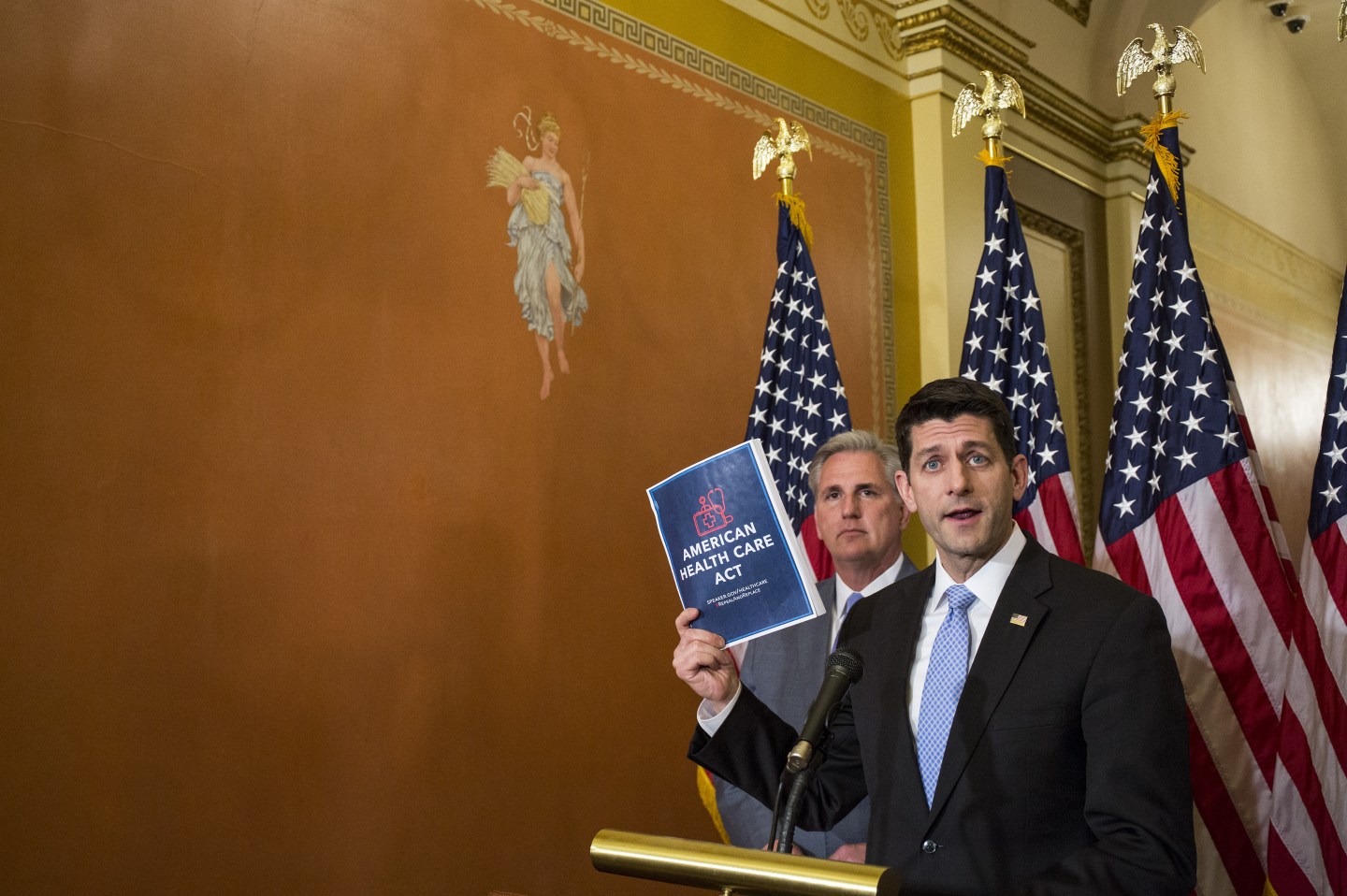
House Speaker Paul Ryan Holds News Conference On American Health Care Act
U.S. House Speaker Paul Ryan, a Republican from Wisconsin, center, holds up a copy of the American Health Care Act while speaking as House Majority Leader Kevin McCarthy, a Republican from California, left, listens during a news conference at the Capitol Building in Washington, D.C., U.S., on Tuesday, March 7, 2017. Ryan's new bill to replace Obamacare is being savaged by early bad reviews from a wide range of conservatives, with one Republican senator declaring it "dead on arrival" in the Senate -- if it can make it through the House. Photographer: Zach Gibson/Bloomberg via Getty ImagesPhotograph by Bloomberg via Getty Images

The most noteworthy thing about the House Republican leadership’s new American Health Care Act is that a lot of Republicans appear to be unhappy with it.

It leaves in place some of Obamacare’s most destructive provisions. For instance, the reform allows children to stay on their parents’ plans until 26, and requires private plans to cover certain essential benefits. But the bill also takes several steps toward creating a market-based health care system capable of expanding access to quality, affordable care.

Several parts of the American Health Care Act deserve applause. For instance, the bill would immediately end the individual mandate requiring Americans to purchase coverage or else pay a tax penalty of $695 or 2.5% of income—whichever is greater. It would also scrap the mandate requiring employers with 50 or more full-time workers to offer coverage.

By bolstering Health Savings Accounts, the measure would empower Americans to spend more of their health care dollars as they see fit. HSAs allow individuals to put aside money, tax-free, to cover out-of-pocket medical expenses. Starting next year, the act would increase the maximum individual HSA contribution from $3,400 to $6,550, and the top family contribution from $6,750 to $13,000.

The bill would also roll back Obamacare’s complex system of income-based insurance subsidies and replace them with more straightforward, age-based, refundable tax credits. An individual who does not get coverage through work or another public program would receive the credit once a month to help cover premiums for any health insurance policy he chooses—not just those available on Obamacare’s exchanges.

The new credits would increase by $500 for each decade of age—from $2,000 annually for Americans under 30, to $3,000 for those between 40 and 50, to $4,000 for those 60 and older. If a person selects a policy that costs less than his credit, he could deposit the remainder in an HSA.

The credits aren’t perfect. They’d decrease by $100 for every $1,000 of income above $75,000 for individuals and above $150,000 for families. Not only is this scheme overly complicated—it’ll require the IRS to verify people’s incomes in order to determine eligibility. That’s barely an improvement over the Obamacare status quo.

The GOP bill would help to drive down premiums and deductibles for the young by loosening its “community rating” rules. Obamacare prohibited insurers from charging older patients more than three times what they charged younger ones; the American Health Care Act would increase that ratio to 5:1.

In so doing, the bill would end an unfair arrangement that shifts insurance costs from older, sicker Americans to younger, healthier ones. Older Americans may see their premiums rise, but they’d also receive more generous tax credits than younger people. And by attracting more young people into the insurance pool, this reform would stabilize the adverse-selection “death spiral” plaguing Obamacare’s exchanges.

The act would further bring down premiums by repealing Obamacare’s many taxes, including its multibillion-dollar levies on health insurers, medical device manufacturers, and pharmaceuticals—which have been passed onto consumers for years.

However, the American Health Care Act is also a far cry from full-scale repeal and replacement of Obamacare. It would preserve many of Obamacare’s “essential health benefits,” like free coverage of preventive care and addiction treatment. Each of these mandates increases the cost of a policy. These mandates also undermine consumer choice; surely, some people would forego coverage of certain “essential” benefits in exchange for lower premiums.

The act also maintains the unlimited tax exclusion for employer-sponsored health plans. This tax break essentially subsidizes employer-based coverage by excluding the value of health benefits from employees’ taxable income.

Since those purchasing coverage in the individual market enjoy no such tax break, the policy has helped entrench a system in which coverage is tied to employment. And it’s contributed to the runaway growth of health costs. After all, a dollar of taxed wages is worth less than a dollar of untaxed health benefits. Americans have put those generous health benefits to use, driving up demand for health care and thus its price.

The GOP bill would also preserve Obamacare’s expansion of Medicaid to childless adults making up to 138% of the poverty level until the end of 2019. Thereafter, anyone who was in the program thanks to Obamacare’s expansion of eligibility could stay in.

The only saving grace for the bill’s treatment of Medicaid is that it begins to transform the program’s funding formula from an open-ended federal commitment into a “per capita allotment” system, wherein states receive a set amount of federal funding for each Medicaid enrollee.


This reform would put significant pressure on states to rein in Medicaid’s out-of-control costs—instead of rewarding them for spending increases, as the current system does. And it would give states the flexibility to manage their programs in order to meet the unique needs of their populations.

Unfortunately, that per-capita allotment will be based on the Obamacare era’s artificially high levels of Medicaid spending.

Since its release Monday evening, the bill has taken a beating—from Republicans. But the members of the GOP, moderates and conservatives alike, have to remember that a repeal-and-replace effort that devolves into infighting will just leave Obamacare in place.

The American Health Care Act is Republicans’ imperfect first crack at a replacement plan. It won’t be their last.

Sally C. Pipes is president, CEO, and Thomas W. Smith Fellow in Health Care Policy at the Pacific Research Institute. Her latest book is The Way Out of Obamacare (Encounter 2016).


About the Authors
By Sally C. Pipes
See full bioRight Arrow Button Icon
By Bethany Cianciolo
See full bioRight Arrow Button Icon

Latest in Commentary

Finance
Lorem ipsum dolor sit amet, consectetur adipiscing elit, sed do eiusmod tempor incididunt ut labore et dolore magna aliqua. Ut enim ad minim veniam
By Fortune Editors
October 20, 2025
Finance
Lorem ipsum dolor sit amet, consectetur adipiscing elit, sed do eiusmod tempor incididunt ut labore et dolore magna aliqua. Ut enim ad minim veniam
By Fortune Editors
October 20, 2025
Finance
Lorem ipsum dolor sit amet, consectetur adipiscing elit, sed do eiusmod tempor incididunt ut labore et dolore magna aliqua. Ut enim ad minim veniam
By Fortune Editors
October 20, 2025
Finance
Lorem ipsum dolor sit amet, consectetur adipiscing elit, sed do eiusmod tempor incididunt ut labore et dolore magna aliqua. Ut enim ad minim veniam
By Fortune Editors
October 20, 2025
Finance
Lorem ipsum dolor sit amet, consectetur adipiscing elit, sed do eiusmod tempor incididunt ut labore et dolore magna aliqua. Ut enim ad minim veniam
By Fortune Editors
October 20, 2025
Finance
Lorem ipsum dolor sit amet, consectetur adipiscing elit, sed do eiusmod tempor incididunt ut labore et dolore magna aliqua. Ut enim ad minim veniam
By Fortune Editors
October 20, 2025

Most Popular

Finance
Lorem ipsum dolor sit amet, consectetur adipiscing elit, sed do eiusmod tempor incididunt ut labore et dolore magna aliqua. Ut enim ad minim veniam
By Fortune Editors
October 20, 2025
Finance
Lorem ipsum dolor sit amet, consectetur adipiscing elit, sed do eiusmod tempor incididunt ut labore et dolore magna aliqua. Ut enim ad minim veniam
By Fortune Editors
October 20, 2025
Finance
Lorem ipsum dolor sit amet, consectetur adipiscing elit, sed do eiusmod tempor incididunt ut labore et dolore magna aliqua. Ut enim ad minim veniam
By Fortune Editors
October 20, 2025
Finance
Lorem ipsum dolor sit amet, consectetur adipiscing elit, sed do eiusmod tempor incididunt ut labore et dolore magna aliqua. Ut enim ad minim veniam
By Fortune Editors
October 20, 2025
Finance
Lorem ipsum dolor sit amet, consectetur adipiscing elit, sed do eiusmod tempor incididunt ut labore et dolore magna aliqua. Ut enim ad minim veniam
By Fortune Editors
October 20, 2025
Finance
Lorem ipsum dolor sit amet, consectetur adipiscing elit, sed do eiusmod tempor incididunt ut labore et dolore magna aliqua. Ut enim ad minim veniam
By Fortune Editors
October 20, 2025
Fortune Secondary Logo
Rankings
  • 100 Best Companies
  • Fortune 500
  • Global 500
  • Fortune 500 Europe
  • Most Powerful Women
  • Future 50
  • World’s Most Admired Companies
  • See All Rankings
Sections
  • Finance
  • Fortune Crypto
  • Features
  • Leadership
  • Health
  • Commentary
  • Success
  • Retail
  • Mpw
  • Tech
  • Lifestyle
  • CEO Initiative
  • Asia
  • Politics
  • Conferences
  • Europe
  • Newsletters
  • Personal Finance
  • Environment
  • Magazine
  • Education
Customer Support
  • Frequently Asked Questions
  • Customer Service Portal
  • Privacy Policy
  • Terms Of Use
  • Single Issues For Purchase
  • International Print
Commercial Services
  • Advertising
  • Fortune Brand Studio
  • Fortune Analytics
  • Fortune Conferences
  • Business Development
  • Group Subscriptions
About Us
  • About Us
  • Editorial Calendar
  • Press Center
  • Work At Fortune
  • Diversity And Inclusion
  • Terms And Conditions
  • Site Map
  • About Us
  • Editorial Calendar
  • Press Center
  • Work At Fortune
  • Diversity And Inclusion
  • Terms And Conditions
  • Site Map
  • Facebook icon
  • Twitter icon
  • LinkedIn icon
  • Instagram icon
  • Pinterest icon

Latest in Commentary

kennnedy
CommentaryDrugs
America is handing its mRNA lead to China—and RFK Jr. is to blame
By Jeff CollerMarch 26, 2026
20 hours ago
jerry
CommentaryEducation
The college degree isn’t dead. But the wrong kind could cost you $2 million
By Jerry BalentineMarch 26, 2026
21 hours ago
trump
CommentaryMarkets
We’re no longer in a bull or bear market. We’re in a Trump market — and here’s how to navigate it
By Jeffrey Sonnenfeld and Steven TianMarch 26, 2026
21 hours ago
EuropeLetter from London
Rishi Sunak is giving advice to CEOs on AI. Here are his golden rules
By Kamal AhmedMarch 25, 2026
2 days ago
retirement
CommentaryRetirement
Our retirement system gets a C-plus; policymakers have an opportunity to make it A grade
By Chris MahoneyMarch 25, 2026
2 days ago
david-f
CommentaryVenture Capital
Europe has survived 3 energy shocks in 4 years. The only way out is to stop buying power from its enemies
By David FrykmanMarch 25, 2026
2 days ago

Most Popular

C-Suite
'I didn’t want anybody shooting me': Five Guys CEO gave away $1.5 million bonus to employees over botched BOGO burger birthday celebration
By Fortune EditorsMarch 25, 2026
1 day ago
Environment
Vail Resorts CEO says it’s time to think beyond the $1,000 ski pass that helped build the empire
By Fortune EditorsMarch 26, 2026
1 day ago
Success
Palantir’s billionaire CEO says only two kinds of people will succeed in the AI era: trade workers — ‘or you’re neurodivergent’
By Fortune EditorsMarch 24, 2026
3 days ago
Commentary
The Treasury just declared the U.S. insolvent. The media missed it
By Fortune EditorsMarch 23, 2026
4 days ago
Personal Finance
Current price of gold as of March 25, 2026
By Fortune EditorsMarch 25, 2026
2 days ago
Economy
Social Security insolvency: How a six-figure cap to flatten benefits for the ultrawealthy could buy the program 7 critical years
By Fortune EditorsMarch 26, 2026
24 hours ago

© 2026 Fortune Media IP Limited. All Rights Reserved. Use of this site constitutes acceptance of our Terms of Use and Privacy Policy | CA Notice at Collection and Privacy Notice | Do Not Sell/Share My Personal Information
FORTUNE is a trademark of Fortune Media IP Limited, registered in the U.S. and other countries. FORTUNE may receive compensation for some links to products and services on this website. Offers may be subject to change without notice.