
• Home
  • Latest
  • Fortune 500
  • Finance
  • Tech
  • Leadership
  • Lifestyle
  • Rankings
  • Multimedia

Trendingnow

1

After forcing workers back to the office, Goldman Sachs and JPMorgan Chase are now letting their staff work remotely—but only for the World Cup

2

Markets tumble worldwide as Fed resets expectations: $400 billion wiped off SpaceX stock

3

Current price of oil as of June 23, 2026

1

After forcing workers back to the office, Goldman Sachs and JPMorgan Chase are now letting their staff work remotely—but only for the World Cup

2

Markets tumble worldwide as Fed resets expectations: $400 billion wiped off SpaceX stock

3

Current price of oil as of June 23, 2026
Finance

Here’s Why the Next Apple Might Not Be a Public Company

By
Chris Matthews
Chris Matthews
Down Arrow Button Icon
By
Chris Matthews
Chris Matthews
Down Arrow Button Icon
November 30, 2016, 6:00 AM ET
A trader works at a vacant post on the floor of the New York
Bloomberg Bloomberg via Getty Images
Add Fortune on Google for similar content.

Apple, and other large public companies like it, may be an endangered species. Or at least their ownership structure might be. Indeed, some economists are starting to imagine a future where even the most valuable companies in America, like Apple, say so long to public markets.

That’s the subject of a National Bureau of Economic Research working paper published by this week by well-known economists Kathleen Kahle of the University of Arizona and Rene M. Stulz of the Ohio State University.

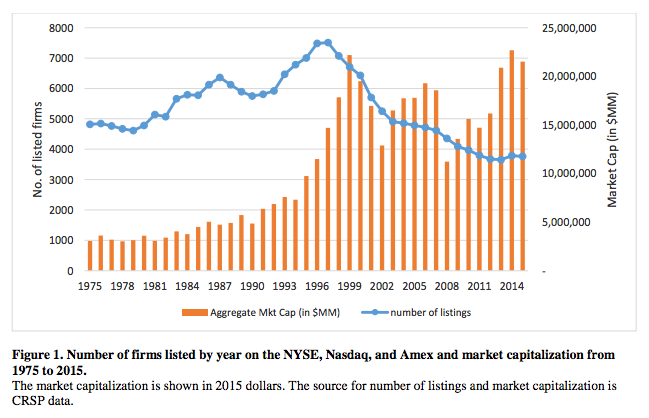
The changing nature of the American public corporation shares some similarities with changes that have affected the American worker over the past 40 years. For one, not only is the the number of public corporations on the decline, there is a growing inequality in the economic fortunes of those that remain:
screen-shot-2016-11-29-at-4-36-06-pm

As you can see from the above chart, the absolute number of public corporations has been on the decline for decades, while the total market capitalization of those left remain near all-time highs.

But what the economists in the study found is that it’s not just that there is more wealth concentrated in the remaining public companies. More importantly, the wealth among public companies is concentrated as well. “In 2015, 35 corporations account for half the assets of public corporations and 30 account for half the net income,” the authors write. “In contrast, in 1975, these numbers were 94 and 109.”

Another striking change: In 1980, institutional ownership of public firms averaged 17.7%. Today it’s over 50%. Lastly, public firms are aging rapidly, with the average age rising from 12.2 years in 1995 to 18.5 years today. This reflects the increasing unwillingness of new firms to go public, and this trend has very important effects on the overall nature of public firms. For one, older firms are less innovative than newer firms.

Why does this all matter?

Back in May, Fortune published an investigation of just why newer companies are eschewing going public concluding that because the modern economy is less capital intensive, and because capital is so easily available today, companies feel no need to put up with the extra regulation and scrutiny that come with being publicly listed. The argument was also floated that this might not be an entirely bad thing, as “One of the enduring drawbacks of public ownership is the so-called agency problem, the misalignment of owners and managers.” According to this theory, “Top executives at big public companies typically own only tiny stakes and are tempted to enrich themselves in all manner of ways that may harm the other shareholders, whose ownership is often so diffuse that they can’t discipline the managers. That problem doesn’t arise in private firms, where the majority owners are usually either the managers themselves or members of a powerful board of directors.”

But this theory has a big problem. And it is one that anyone following the behavior of public companies in the past few years should know: Buybacks. Public firms have been increasingly giving earnings back to shareholders. Since 1975, the weighted average of total payouts—in the form of both dividends and share buybacks—has risen from 27.1% of income to 47% today. If public corporate executives weren’t following the best interest of shareholders, they’d likely be using this money to invest in perks or pet projects, not returning it to their bosses.

All of this points to a loss of the sense of purpose of being a public company in the modern economy. “As a whole, public firms appear to lack ambition, proper incentives, or opportunities. They are returning capital to investors and hoarding cash rather than raising funds to invest more,” Kahle and Stulz write.

Public corporate America is shrinking, and that’s not just a problem for business leaders, but one for all of us who think that the economy benefits from the transparency and access to opportunity that robust public markets create. And that goes not just for investors but for investors but for workers and for voters, as well. A more private economy creates more inequality and inequity, not just in public markets, and financial markets, but outside of them as well.

About the Author
By Chris Matthews
See full bioRight Arrow Button Icon
Add Fortune on Google for similar content.

Latest in Finance

Finance
Lorem ipsum dolor sit amet, consectetur adipiscing elit, sed do eiusmod tempor incididunt ut labore et dolore magna aliqua. Ut enim ad minim veniam
By Fortune Editors
October 20, 2025
Finance
Lorem ipsum dolor sit amet, consectetur adipiscing elit, sed do eiusmod tempor incididunt ut labore et dolore magna aliqua. Ut enim ad minim veniam
By Fortune Editors
October 20, 2025
Finance
Lorem ipsum dolor sit amet, consectetur adipiscing elit, sed do eiusmod tempor incididunt ut labore et dolore magna aliqua. Ut enim ad minim veniam
By Fortune Editors
October 20, 2025
Finance
Lorem ipsum dolor sit amet, consectetur adipiscing elit, sed do eiusmod tempor incididunt ut labore et dolore magna aliqua. Ut enim ad minim veniam
By Fortune Editors
October 20, 2025
Finance
Lorem ipsum dolor sit amet, consectetur adipiscing elit, sed do eiusmod tempor incididunt ut labore et dolore magna aliqua. Ut enim ad minim veniam
By Fortune Editors
October 20, 2025
Finance
Lorem ipsum dolor sit amet, consectetur adipiscing elit, sed do eiusmod tempor incididunt ut labore et dolore magna aliqua. Ut enim ad minim veniam
By Fortune Editors
October 20, 2025

Most Popular

Finance
Lorem ipsum dolor sit amet, consectetur adipiscing elit, sed do eiusmod tempor incididunt ut labore et dolore magna aliqua. Ut enim ad minim veniam
By Fortune Editors
October 20, 2025
Finance
Lorem ipsum dolor sit amet, consectetur adipiscing elit, sed do eiusmod tempor incididunt ut labore et dolore magna aliqua. Ut enim ad minim veniam
By Fortune Editors
October 20, 2025
Finance
Lorem ipsum dolor sit amet, consectetur adipiscing elit, sed do eiusmod tempor incididunt ut labore et dolore magna aliqua. Ut enim ad minim veniam
By Fortune Editors
October 20, 2025
Finance
Lorem ipsum dolor sit amet, consectetur adipiscing elit, sed do eiusmod tempor incididunt ut labore et dolore magna aliqua. Ut enim ad minim veniam
By Fortune Editors
October 20, 2025
Finance
Lorem ipsum dolor sit amet, consectetur adipiscing elit, sed do eiusmod tempor incididunt ut labore et dolore magna aliqua. Ut enim ad minim veniam
By Fortune Editors
October 20, 2025
Finance
Lorem ipsum dolor sit amet, consectetur adipiscing elit, sed do eiusmod tempor incididunt ut labore et dolore magna aliqua. Ut enim ad minim veniam
By Fortune Editors
October 20, 2025
Fortune Secondary Logo
Rankings
  • 100 Best Companies
  • Fortune 500
  • Global 500
  • Fortune 500 Europe
  • Most Powerful Women
  • World's Most Admired Companies
  • See All Rankings
  • Lists Calendar
Sections
  • Finance
  • Fortune Crypto
  • Features
  • Leadership
  • Health
  • Commentary
  • Success
  • Retail
  • Mpw
  • Tech
  • Lifestyle
  • CEO Initiative
  • Asia
  • Politics
  • Conferences
  • Europe
  • Newsletters
  • Personal Finance
  • Environment
  • Magazine
  • Education
Customer Support
  • Frequently Asked Questions
  • Customer Service Portal
  • Privacy Policy
  • Terms Of Use
  • Single Issues For Purchase
  • International Print
Commercial Services
  • Advertising
  • Fortune Brand Studio
  • Fortune Analytics
  • Fortune Conferences
  • Business Development
  • Group Subscriptions
About Us
  • About Us
  • Press Center
  • Work At Fortune
  • Terms And Conditions
  • Site Map
  • About Us
  • Press Center
  • Work At Fortune
  • Terms And Conditions
  • Site Map
  • Facebook icon
  • Twitter icon
  • LinkedIn icon
  • Instagram icon
  • Pinterest icon

Latest in Finance

Sarah Youngwood, EVP and CFO at Nasdaq.
C-SuiteFinance
Inside Nasdaq CFO Sarah Youngwood’s AI playbook
By Sheryl EstradaJune 24, 2026
14 minutes ago
Top CD rates today, June 24, 2026: Lock in up to up to 4.40%
Personal FinanceCertificates of Deposit (CDs)
Top CD rates today, June 24, 2026: Lock in up to up to 4.40%
By Glen Luke FlanaganJune 24, 2026
43 minutes ago
Today’s top high-yield savings rates: Up to 5.00% on June 24, 2026
Personal FinanceSavings accounts
Today’s top high-yield savings rates: Up to 5.00% on June 24, 2026
By Glen Luke FlanaganJune 24, 2026
43 minutes ago
You can ignore Trump’s threats to leave NATO: Pimco says they’re a ‘paper tiger’
EconomyMarkets
You can ignore Trump’s threats to leave NATO: Pimco says they’re a ‘paper tiger’
By Jim EdwardsJune 24, 2026
1 hour ago
Current refi mortgage rates report for June 24, 2026
Personal FinanceReal Estate
Current refi mortgage rates report for June 24, 2026
By Glen Luke FlanaganJune 24, 2026
4 hours ago
Current ARM mortgage rates report for June 24, 2026
Personal FinanceReal Estate
Current ARM mortgage rates report for June 24, 2026
By Glen Luke FlanaganJune 24, 2026
4 hours ago

Most Popular

After forcing workers back to the office, Goldman Sachs and JPMorgan Chase are now letting their staff work remotely—but only for the World Cup
Success
After forcing workers back to the office, Goldman Sachs and JPMorgan Chase are now letting their staff work remotely—but only for the World Cup
By Orianna Rosa RoyleJune 23, 2026
22 hours ago
Markets tumble worldwide as Fed resets expectations: $400 billion wiped off SpaceX stock
Banking
Markets tumble worldwide as Fed resets expectations: $400 billion wiped off SpaceX stock
By Jim EdwardsJune 23, 2026
1 day ago
Current price of oil as of June 23, 2026
Personal Finance
Current price of oil as of June 23, 2026
By Joseph HostetlerJune 23, 2026
22 hours ago
Meet the 2 men putting New York's $300 billion pension fund in play for the first time in 20 years
Investing
Meet the 2 men putting New York's $300 billion pension fund in play for the first time in 20 years
By Nick LichtenbergJune 22, 2026
2 days ago
Former U.S. Secret Service agent says bringing your authentic self to work stifles teamwork: 'You don’t get high performers, you get sloppiness'
Success
Former U.S. Secret Service agent says bringing your authentic self to work stifles teamwork: 'You don’t get high performers, you get sloppiness'
By Sydney LakeJune 21, 2026
3 days ago
Texas and Charlotte used to build huge McMansions—now they're copying the California design tricks they once mocked
Real Estate
Texas and Charlotte used to build huge McMansions—now they're copying the California design tricks they once mocked
By Sydney LakeJune 22, 2026
2 days ago

© 2026 Fortune Media IP Limited. All Rights Reserved. Use of this site constitutes acceptance of our Terms of Use and Privacy Policy | CA Notice at Collection and Privacy Notice | Do Not Sell/Share My Personal Information
FORTUNE is a trademark of Fortune Media IP Limited, registered in the U.S. and other countries. FORTUNE may receive compensation for some links to products and services on this website. Offers may be subject to change without notice.