• Home
  • Latest
  • Fortune 500
  • Finance
  • Tech
  • Leadership
  • Lifestyle
  • Rankings
  • Multimedia

Trendingnow

1

After forcing workers back to the office, Goldman Sachs and JPMorgan Chase are now letting their staff work remotely—but only for the World Cup

2

The Pentagon said Iran War costs $29 billion, but the real cost is closer to $200 billion—and counting

3

Current price of oil as of June 23, 2026

1

After forcing workers back to the office, Goldman Sachs and JPMorgan Chase are now letting their staff work remotely—but only for the World Cup

2

The Pentagon said Iran War costs $29 billion, but the real cost is closer to $200 billion—and counting

3

Current price of oil as of June 23, 2026
Tech

Here’s One Reason Why Facebook and Twitter Aren’t Good for News

By
Mathew Ingram
Mathew Ingram
Down Arrow Button Icon
By
Mathew Ingram
Mathew Ingram
Down Arrow Button Icon
November 29, 2016, 5:49 PM ET
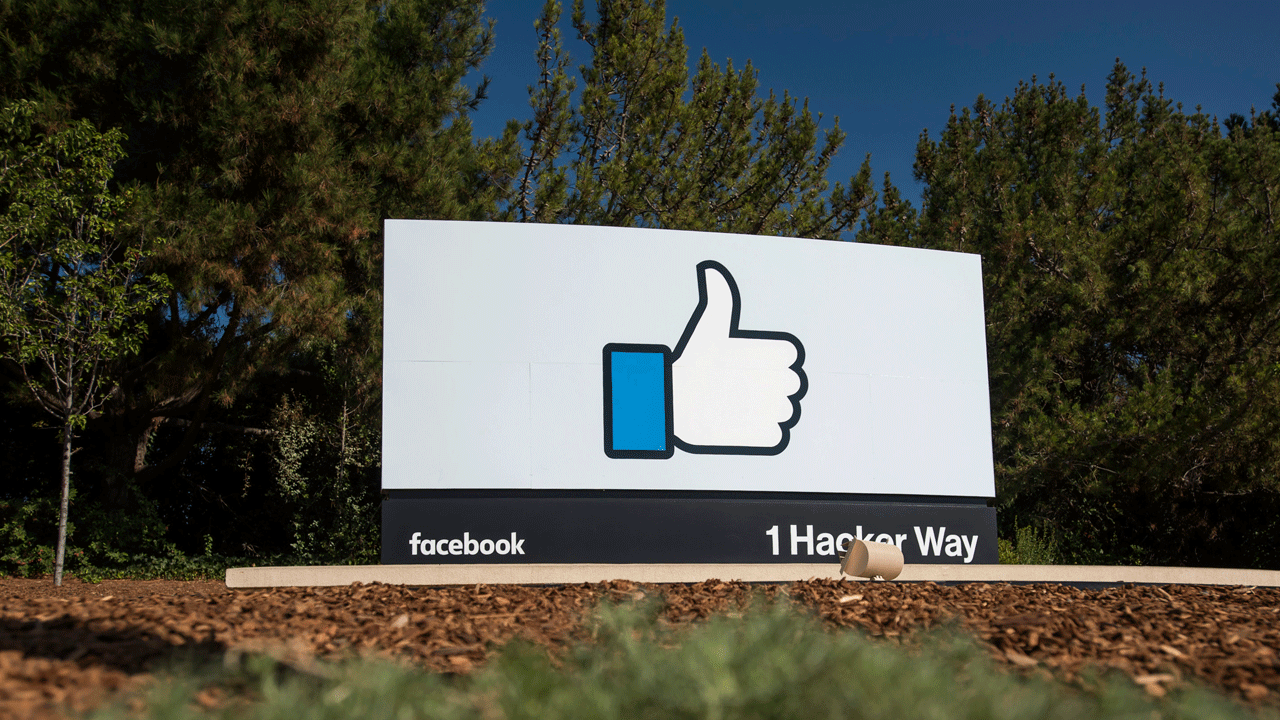
Photograph by Getty Images
Add Fortune on Google for similar content.

There’s plenty of blame to go around when it comes to the problem of fake news, and some of it quite rightly falls on social networks such as Facebook and Twitter. It’s not that these platforms don’t care about the truth, however. The problem goes deeper than that. It’s more of a structural problem, and it doesn’t come with an easy solution.

Social networks like Facebook and Twitter started out primarily as ways to connect with friends and other people with similar interests, and they did so by making it easy to share bits of text, along with hyperlinks to other content worth reading on the web.

Eventually, however, text gave way to photos, with both Twitter and Facebook revamping their news feeds or streams to allow for larger pictures. Then came video—both in the form of video clips (many of which auto-play because advertisers like it that way) and animated GIFs. Hyperlinks, which social networks noticed were rarely clicked on anyway, started to become less important.

Facebook has said that in the next few years, the vast majority of users’ news feed will be made up of video. It has spent tens of millions of dollars getting media outlets like the New York Times to produce more and more video clips that it can publish. And Twitter has also worked hard to become a live-streaming hub for sports and TV-style content.

Get Data Sheet, Fortune’s technology newsletter.

Thus, over time, both Facebook and Twitter have come to look less like social networks and more like television. And not necessarily just the good parts of television, but also the bad parts—like the part that values easy-to-consume entertainment over facts.

Iranian blogger Hossein Derakshan, who was imprisoned for six years by the Iranian government, has written eloquently about the impact of this transformation, because he didn’t see the gradual changes occur—he stepped out of prison in 2014 and was struck by how different things seemed, how blogging was dead and Facebook was a giant.

One of those changes was the death of the hyperlink and the open web, which Derakshan wrote about on Medium. But another was the growing primacy of television-style content and the decline of text. And the impact of that, he says, is potentially dangerous in a number of ways.

The main reason to be concerned, Derakshan says, is that television—as sociologist Neil Postman warned in his 1985 book Amusing Ourselves to Death—tends to favor emotion over thought, and that makes it a great tool for demagogues like Donald Trump. What matters isn’t the facts, it’s how the fake facts or misinformation makes you feel.

Like TV, it now increasingly entertains us, and even more so than television it amplifies our existing beliefs and habits. It makes us feel more than think, and it comforts more than challenges. The result is a deeply fragmented society, driven by emotions, and radicalized by lack of contact and challenge from outside.

Postman said that a TV-centered environment is ripe for the spread of disinformation. But disinformation doesn’t necessarily mean fake news, he said. Instead, it means “misleading information — misplaced, irrelevant, fragmented or superficial information — information that creates the illusion of knowing something.”

The social web exacerbates this problem, both because it favors short bursts of content, in many cases without links, and because it is also an emotional medium. And algorithm-driven personalization on networks like Facebook increases the filter-bubble effect. Says Derakshan:

Social media uses algorithms to encourage comfort and complaisance, since its entire business model is built upon maximizing the time users spend inside of it. The outcome is a proliferation of emotions, a radicalization of those emotions, and a fragmented society.

BuzzFeed founder Jonah Peretti, who has spent years studying the way that content works online and why people share certain things and not others, says that posts or updates get shared because they trigger a strong emotion in the reader—fear, hate, love, etc. Very few people (apart from journalists perhaps) share things because they are accurate.

Sociologists note that networks like Facebook work in part by making people feel part of a tribe or group—not just family or friend groups, but ideological groups as well. And that means content gets shared not because it’s true, but because it confirms a person’s membership in a group.

Watch Trump Lay Out His 100-Day Plan:

Since they are desperate both for readers/viewers and for advertising revenue, many media outlets have played into this emotion-first environment by relying on clickbait and trumped-up scandals, essentially adopting all the worst aspects of cable television. And that in turn has reduced the amount of trust that would-be readers have in those outlets.

The combination of these factors has arguably helped create the post truth media landscape we currently find ourselves in. And Donald Trump was able to take advantage of that environment more effectively than anyone in recent memory.

The more the media fact-checked Trump’s every claim, the more his fans and supporters dismissed these outlets as biased, and instead focused on the news sources that catered to their existing beliefs. Facebook’s emphasis on friends and family, combined with its preference for emotional content, makes it a powerful engine for confirmation bias.

Is there any way out of this situation? Derakshan recommends that users try to confuse the Facebook algorithm by liking things they don’t actually like, in an attempt to broaden the range of content they get. And he also wants Facebook—or even third parties with plug-ins—to add new buttons to the social network, such as “agree/disagree” or “trust/suspect.”

In the long run, if we don’t want everything to turn into short-form cable television, perhaps all we can do is try to be a bit more discriminating in our own choices, and hope that others will follow. If enough people do so, maybe social networks will have to adapt to those demands and change the way they operate.

About the Author
By Mathew Ingram
See full bioRight Arrow Button Icon
Add Fortune on Google for similar content.

Latest in Tech

Finance
Lorem ipsum dolor sit amet, consectetur adipiscing elit, sed do eiusmod tempor incididunt ut labore et dolore magna aliqua. Ut enim ad minim veniam
By Fortune Editors
October 20, 2025
Finance
Lorem ipsum dolor sit amet, consectetur adipiscing elit, sed do eiusmod tempor incididunt ut labore et dolore magna aliqua. Ut enim ad minim veniam
By Fortune Editors
October 20, 2025
Finance
Lorem ipsum dolor sit amet, consectetur adipiscing elit, sed do eiusmod tempor incididunt ut labore et dolore magna aliqua. Ut enim ad minim veniam
By Fortune Editors
October 20, 2025
Finance
Lorem ipsum dolor sit amet, consectetur adipiscing elit, sed do eiusmod tempor incididunt ut labore et dolore magna aliqua. Ut enim ad minim veniam
By Fortune Editors
October 20, 2025
Finance
Lorem ipsum dolor sit amet, consectetur adipiscing elit, sed do eiusmod tempor incididunt ut labore et dolore magna aliqua. Ut enim ad minim veniam
By Fortune Editors
October 20, 2025
Finance
Lorem ipsum dolor sit amet, consectetur adipiscing elit, sed do eiusmod tempor incididunt ut labore et dolore magna aliqua. Ut enim ad minim veniam
By Fortune Editors
October 20, 2025

Most Popular

Finance
Lorem ipsum dolor sit amet, consectetur adipiscing elit, sed do eiusmod tempor incididunt ut labore et dolore magna aliqua. Ut enim ad minim veniam
By Fortune Editors
October 20, 2025
Finance
Lorem ipsum dolor sit amet, consectetur adipiscing elit, sed do eiusmod tempor incididunt ut labore et dolore magna aliqua. Ut enim ad minim veniam
By Fortune Editors
October 20, 2025
Finance
Lorem ipsum dolor sit amet, consectetur adipiscing elit, sed do eiusmod tempor incididunt ut labore et dolore magna aliqua. Ut enim ad minim veniam
By Fortune Editors
October 20, 2025
Finance
Lorem ipsum dolor sit amet, consectetur adipiscing elit, sed do eiusmod tempor incididunt ut labore et dolore magna aliqua. Ut enim ad minim veniam
By Fortune Editors
October 20, 2025
Finance
Lorem ipsum dolor sit amet, consectetur adipiscing elit, sed do eiusmod tempor incididunt ut labore et dolore magna aliqua. Ut enim ad minim veniam
By Fortune Editors
October 20, 2025
Finance
Lorem ipsum dolor sit amet, consectetur adipiscing elit, sed do eiusmod tempor incididunt ut labore et dolore magna aliqua. Ut enim ad minim veniam
By Fortune Editors
October 20, 2025
Fortune Secondary Logo
Rankings
  • 100 Best Companies
  • Fortune 500
  • Global 500
  • Fortune 500 Europe
  • Most Powerful Women
  • World's Most Admired Companies
  • See All Rankings
  • Lists Calendar
Sections
  • Finance
  • Fortune Crypto
  • Features
  • Leadership
  • Health
  • Commentary
  • Success
  • Retail
  • Mpw
  • Tech
  • Lifestyle
  • CEO Initiative
  • Asia
  • Politics
  • Conferences
  • Europe
  • Newsletters
  • Personal Finance
  • Environment
  • Magazine
  • Education
Customer Support
  • Frequently Asked Questions
  • Customer Service Portal
  • Privacy Policy
  • Terms Of Use
  • Single Issues For Purchase
  • International Print
Commercial Services
  • Advertising
  • Fortune Brand Studio
  • Fortune Analytics
  • Fortune Conferences
  • Business Development
  • Group Subscriptions
About Us
  • About Us
  • Press Center
  • Work At Fortune
  • Terms And Conditions
  • Site Map
  • About Us
  • Press Center
  • Work At Fortune
  • Terms And Conditions
  • Site Map
  • Facebook icon
  • Twitter icon
  • LinkedIn icon
  • Instagram icon
  • Pinterest icon

Latest in Tech

Institute's Global Conference at the Beverly Hilton Hotel,on May 6, 2024 in Beverly Hills, California.
RetailSpaceX
Elon Musk was the world’s first trillionaire for 12 days
By Eva RoytburgJune 24, 2026
11 minutes ago
President Donald Trump pictured in September 2025 signing an executive order that overhauled the H-1B visa program.
EconomyImmigration
Trump’s international student crackdown kicked off a domino effect that could shave nearly $500 billion off the economy
By Tristan BoveJune 24, 2026
2 hours ago
How Home Depot is rebuilding retailing with AI
NewslettersCIO Intelligence
How Home Depot is rebuilding retailing with AI
By John KellJune 24, 2026
3 hours ago
bob
AIbooks
Robert Wright sees an ‘earthquake’ coming from AI that goes far beyond jobs: ‘cultural, political, personal, family, psychological’
By Nick LichtenbergJune 24, 2026
3 hours ago
A man wearing a red and black jacket and a red hat walks down a hallway lined with servers.
InnovationChina
For the first time since 2017, it’s China, not the U.S., that has the world’s most powerful supercomputer
By The Associated PressJune 24, 2026
4 hours ago
Jack Schlossberg, Kennedy scion and sardonic social media star, loses in bid for New York state assembly
PoliticsPolitics
Jack Schlossberg, Kennedy scion and sardonic social media star, loses in bid for New York state assembly
By The Associated Press, Danny Peltz and Anthony IzaguirreJune 24, 2026
5 hours ago

Most Popular

After forcing workers back to the office, Goldman Sachs and JPMorgan Chase are now letting their staff work remotely—but only for the World Cup
Success
After forcing workers back to the office, Goldman Sachs and JPMorgan Chase are now letting their staff work remotely—but only for the World Cup
By Orianna Rosa RoyleJune 23, 2026
1 day ago
The Pentagon said Iran War costs $29 billion, but the real cost is closer to $200 billion—and counting
Economy
The Pentagon said Iran War costs $29 billion, but the real cost is closer to $200 billion—and counting
By Jacqueline MunisJune 24, 2026
13 hours ago
Current price of oil as of June 23, 2026
Personal Finance
Current price of oil as of June 23, 2026
By Joseph HostetlerJune 23, 2026
1 day ago
Current price of gold as of June 23, 2026
Personal Finance
Current price of gold as of June 23, 2026
By Danny BakstJune 23, 2026
1 day ago
Texas and Charlotte used to build huge McMansions—now they're copying the California design tricks they once mocked
Real Estate
Texas and Charlotte used to build huge McMansions—now they're copying the California design tricks they once mocked
By Sydney LakeJune 22, 2026
2 days ago
Markets tumble worldwide as Fed resets expectations: $400 billion wiped off SpaceX stock
Banking
Markets tumble worldwide as Fed resets expectations: $400 billion wiped off SpaceX stock
By Jim EdwardsJune 23, 2026
1 day ago

© 2026 Fortune Media IP Limited. All Rights Reserved. Use of this site constitutes acceptance of our Terms of Use and Privacy Policy | CA Notice at Collection and Privacy Notice | Do Not Sell/Share My Personal Information
FORTUNE is a trademark of Fortune Media IP Limited, registered in the U.S. and other countries. FORTUNE may receive compensation for some links to products and services on this website. Offers may be subject to change without notice.