
That race remains one of our most vexing national issues – from bias in the sharing economy, to the lack of diversity in the executive ranks to the violence that plays out daily between communities and the police – comes as no surprise to Pulitzer Prize-winning journalist Isabel Wilkerson. “There is a direct line between our history and the headlines you see today,” she says. “And nothing will improve until we address that history.”
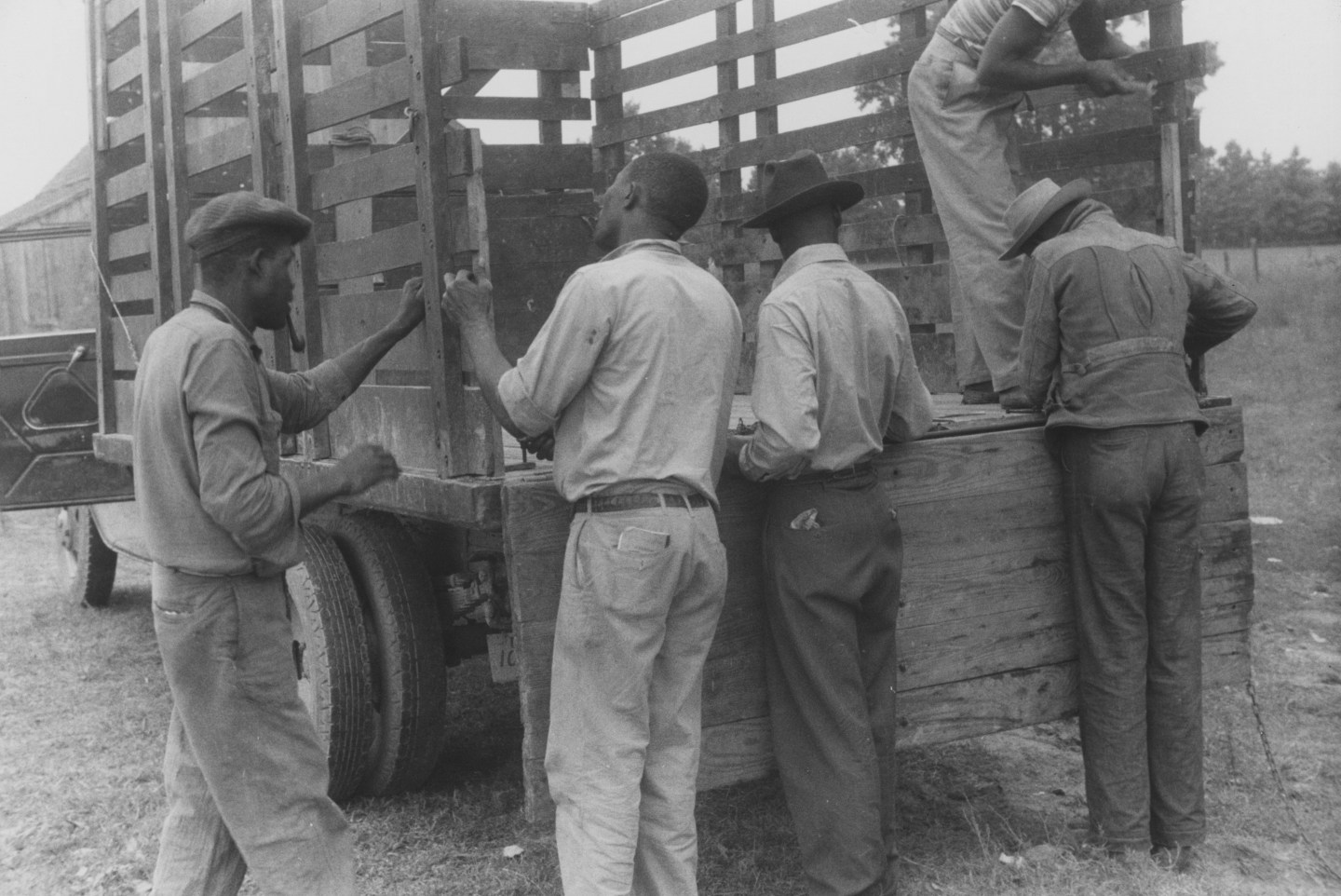
It took her 15 years and over 1,200 interviews to finish The Warmth of Other Suns, the massive and beautifully rendered account of the slow but steady migration of six million African Americans from the violent repression of the Jim Crow South, to the North and West in search of a better life. The Great Migration lasted between 1916 and 1970 and reshaped America in ways that we are just now starting to understand. (Don’t miss her extraordinary piece on the Great Migration published in the September special issue of the Smithsonian Magazine.)
It was a tough road. “The migrants were cast as poor illiterates, who imported out-of-wedlock births, joblessness and welfare dependency wherever they went,” Wilkerson writes.
Wilkerson’s extraordinary reporting, however, tells a different and more nuanced tale – one of risk, hard work, and achievement despite racial barriers that still exist in some forms. “It’s hard to imagine what it would be like if there was no Great Migration,” she says. “So many aspects of what we view as American culture were affected by this unleashing of pent up, unrecognized talent, creativity and ability, that had been withheld for centuries.”
An astonishing number of prominent African American executives, artists or athletes either are, or are direct descendants of, someone who took that perilous journey.
In a recent conversation, I asked Wilkerson to help explain what we get wrong about the Great Migration, and why it is imperative that business leaders closely study the difficult history that shapes our world in unseen ways. “If there are disparities in how African Americans are making their way in the business world, and they are encountering barriers and assumptions, it is a direct manifestation of the unaddressed history of the world in which we all live,” says Wilkerson. “History can be a tremendous guide, and more of a comfort than people can imagine.”
The interview has been lightly edited for clarity.
Fortune: You say that in order to understand how Great Migration affects us today, you have to understand the broader context. You call them the three great eras of American history.
Isabel Wilkerson: Yes. The first era, and where you have to start, is with the 246 years of enslavement in this country. That’s 12 generations. 12! We’ve grown almost inured to the magnitude of the effect of enslavement, and distant from the horror of it.
Then, following the Civil War and the Thirteenth Amendment, there was a re-shaping of enslavement in what we now call the Jim Crow era. It wasn’t just segregation, as it is often described when we compress history. It was actually a caste system in which everything that a person could and could not do was determined by what you looked like. And I mean everything. In the South you were either white or black – it was a binary world at that time – and that created an artificial hierarchy that extended many of the aspects of enslavement. And it was brutal and violent.
We’re not used to thinking about America as having a “caste system.”
And yet that’s exactly what anthropologists who were studying it at the time called it. It’s an objective descriptor of the time between the end of the 19th century to the early 20th century. At that time, 90% of African Americans were living in the South, and stuck in this brutal system. From the moment you woke up in the morning, until the moment you turned in at night, there could be no equal interaction between the two races, and there were extreme barriers at every turn. It’s almost inconceivable now.
So the violence to protect the hierarchy of white supremacy was a natural outcome.
Yes. The violence was tremendous, and it was used specifically to maintain the caste system. Now, there was also tremendous violence during enslavement, as we know so well– the whippings, dismemberments and the like. But after enslavement ended, and people were putatively free, there were new forms of violence that had not been the case before.
In the early 20th century, an African American was lynched every four days for some perceived breach of the caste system.
Which served as very public reminders of the world in which everybody lived. So, how did this set up the third era, the Great Migration?
As re-enslavement became the new normal in the Jim Crow South, what could they do? The only thing that they could do was to defect, was to seek political asylum within the borders of their own country. And six million people did just that.
Now that we can look at it with the benefit of time, we can now see this was a leaderless freedom movement, a declaration of independence, and a seeking of recognition of their citizenship within their own country. And they traveled in these beautifully predictable routes, three of them, that brought them to the East Coast, the Midwest and to California and Seattle.
When you describe it like that, they sound more like other immigrants who came to the U.S.
In many ways, they were. They lived in a part of the world where they had no citizenship recognition and couldn’t vote. And then they showed up wanting to work and vote and contribute to the culture in ways they couldn’t before.
But the migration also sets up the next era of racial tension – and barriers. And how threatening the new arrivals were to the people, many of them European immigrants, who were competing for the same jobs.
The North had not been – and has never been – forced to deal with the underlying biases and hierarchies that were as present in the South. The Civil Rights movement was fought on southern soil, and the laws that were enacted were directed primarily toward the South. When people arrived in these northern cities – looking for work, for better lives – they were met with great hostility and hyper-segregation in housing and education. And it’s dispiriting to see how that hostility still exists.
In what ways?
What we are currently seeing playing out in headlines are the effects of inaction and hostility to the arrival of these people.
Police overreach and brutality cases are a direct result of the unaddressed tensions and hostilities that are still with us. Think about it – Cleveland, Baltimore, Ferguson/St. Louis, Chicago, and Milwaukee – the most dramatic cases of police brutality are all happening in the places where people sought refuge.
Are you in favor of some form of reparations?
Well, I think that as a country we believe ourselves to be honorable and righteous and democratic. We have this ideal of who we are as a country. But…the history does not support that view. And sadly there are parts of our history that are very difficult. But we will not truly grow as a people and we will not truly grow as a country until we look at that history.
So, I believe that we should not shrink from the idea of, say, a “truth and reconciliation commission,” as others have done. There’s something liberating about “putting it all out there,” since we are living with it whether we acknowledge it or not, like a family secret no one can speak of.
Sign up for raceAhead, Fortune’s daily newsletter on race and culture here.
How might reconciliation manifest today?
Rather than looking at reparations for the period of enslavement, I would look start more recently.
One example – I would say that there are people alive today who were targeted by and suffered from the inequities of housing discrimination in our country. Millions of African Americans, who were by law or custom, prevented from getting FHA mortgages, while other white Americans were benefiting from a variety of government programs. There was redlining that prevented African Americans from getting financing, moving into certain neighborhoods and restrictive covenants that prevented white people from selling homes to black people even if they wanted to. This is not ancient history. So, just looking and examining how the disparities came to be –in all aspects of American life, could not just be enlightening, but healing for all of us.
Let’s talk about the frustration that black executives often feel – overlooked for promotions, not taken seriously as leaders, left out. What would reconciliation look like in the workplace?
There is a tremendous amount of good work that’s being done to identify what we now know is unconscious bias. And it affects all of us, anyone who has been exposed to the stereotypes that are inherent to this country’s history. It’s inescapable – passed down through generations and affirmed in popular culture.
So, if there are disparities in how African Americans are making their way in the business world, and they are encountering barriers and assumptions, it is a direct manifestation of the unaddressed history of the world in which we all live.
And that’s an opportunity for anyone who is doing this [diversity and inclusion] work – and it’s really important work and I admire it – to consider how history impacts the people they want to include. And themselves, as well. Without that – a deep understanding – they will look at a situation and not be able to understand what they’re seeing. Using an old rule book to solve our current problems will be of no use.
I just interviewed the new head of diversity for U.S. Bank. He said that some of best conversations he’d had about the bank’s plans for inclusion were occurring in areas where racial conflict had been happening, like Minneapolis and St. Louis.
That’s a perfect example. And really, those conversations should be happening everywhere. With employees and their experience of work and contribution and growth. But also the specific way that big corporations intersect with real communities – like banks. There is tremendous work that can be done there, in order to really understand where we are right now, and that we are all carrying down things that have been taught for generations without understanding them.
Follow Isabel Wilkinson on Facebook.
Ellen McGirt writes Fortune’s raceAhead, a daily newsletter about race and culture.