• Home
  • Latest
  • Fortune 500
  • Finance
  • Tech
  • Leadership
  • Lifestyle
  • Rankings
  • Multimedia
Techsolar power

Solar Power Is Finding Its Day in the Sun

By
Reuters
Reuters
Down Arrow Button Icon
By
Reuters
Reuters
Down Arrow Button Icon
July 5, 2016, 7:36 AM ET
SunEdison Installs Solar Panels On Kohl's Rooftops
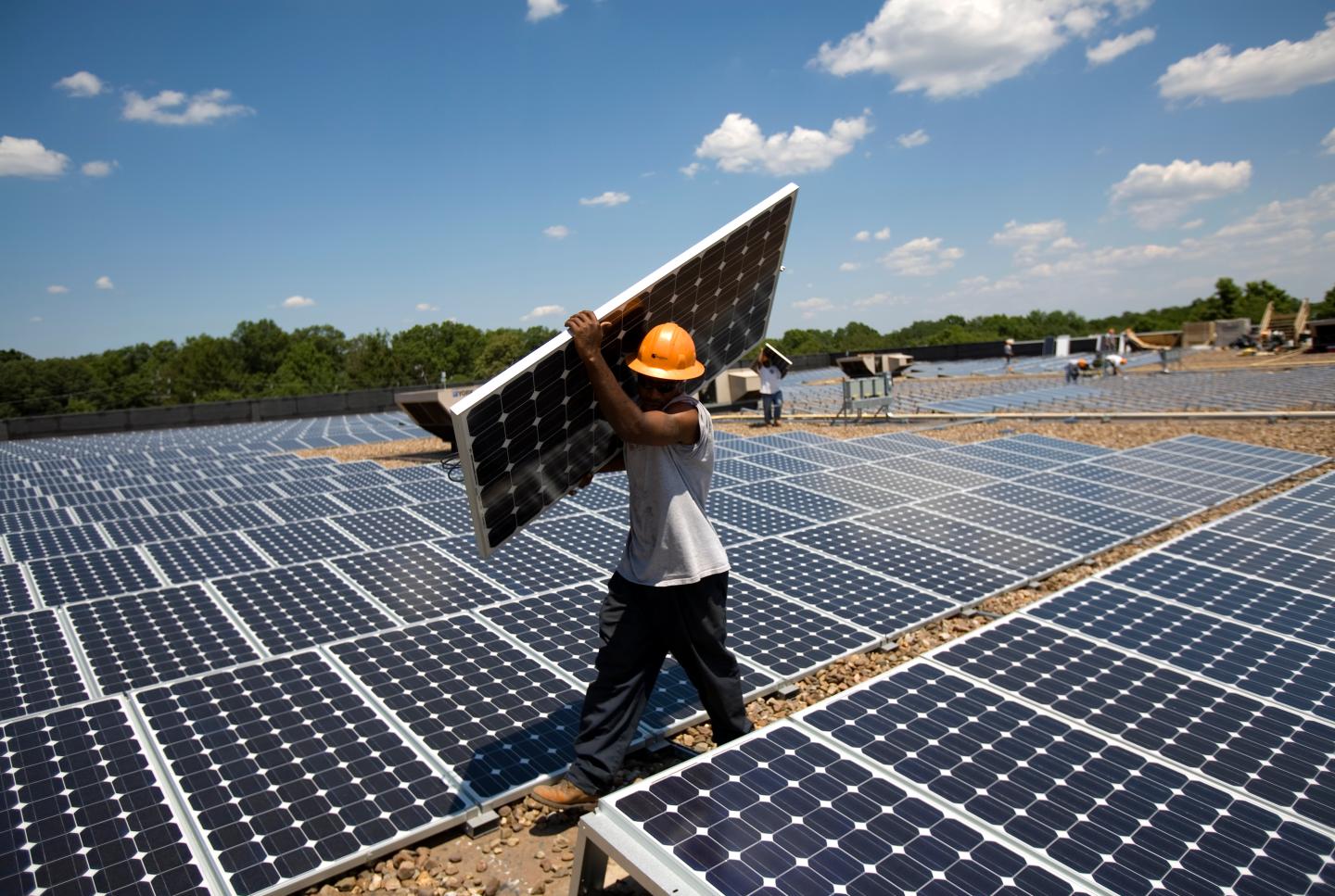
HILLSBOROUGH, NJ - JULY 15: Employees of SunEdison install photovoltaic solar panels on the roof of a Kohl's Department Store on July 15, 2008 in Hillsborough, New Jersey. Company engineers estimate Kohl's will be able to reduce their electricity usage on average by 25% once power begins flowing from the 1980 rooftop panels. Kohl's signed a contract with SunEdison, based in Beltsville, Maryland, to receive electricity for 20 years at a reduced price from public utility rates. New Jersey is the nation's second largest producer of solar energy behind California. State and federal tax incentives help individuals and commercial enterprises cover the costs of solar panel installations. SunEdison is North America's largest solar energy service provider. (Photo by Robert Nickelsberg/Getty Images)Photograph by Robert Nickelsberg/Getty Images

Solar power is on pace for the first time this year to contribute more new electricity to the grid than will any other form of energy—a feat driven more by economics than green mandates.

The cost of electricity from large-scale solar installations now is comparable to and sometimes cheaper than natural gas-fired power, even without incentives aimed at promoting environmentally friendly power, according to industry players and outside cost studies.

Buoyed by appeals to self-reliance and environmental stewardship, as well as government subsidies, the early solar industry was dominated by rooftop panels that powered individual homes and businesses. But such small-scale installations are expensive, requiring hefty incentives to make them attractive to homeowners.

Today, large systems that sell directly to utilities dominate. They are expected to account for more than 70% of new solar added to the grid this year, according to industry research firm GTM Research.

The success of large-scale solar has raised questions about the wisdom of continuing incentives for rooftop installations, which remain far more expensive than most other forms of electricity.

Unsubsidized utility-scale solar power costs $50 to $70 per megawatt-hour (or 5 to 7 cents a kilowatt hour), compared with $52 to $78 for the most efficient type of gas plant, according to a 2015 study by investment bank Lazard.

Get Data Sheet, Fortune’s technology newsletter.

Generating power from residential rooftop panels is far more expensive, ranging from $184 to $300 a MWh before subsidies, the report said.

“If you take a solar panel from someone’s rooftop and put it in a field, the amount you would pay for that power drops precipitously,” said Matt Freedman, an attorney with California ratepayer advocate The Utility Reform Network. “What’s the magic of having it on the rooftop? It’s not clear.”

Going Big

Many trace the tipping point for utility-scale solar to a 2014 announcement by Austin Energy that it would buy power from a new 150 megawatt solar plant—enough to light and cool 30,000 homes—for 5 cents a kilowatt hour. At the time, it was a record low price for solar power. Since then, projects have brought the price below 4 cents a kWh.

The Austin Energy contract opened a market for big solar in sunny Southeastern states, Jim Hughes, chief executive of utility-scale solar developer First Solar told investors in April.

“The response has been, quite honestly, astonishing,” Hughes told them. “The utility world suddenly sat up and took notice and said, I had no idea that’s where the cost of solar stood.”

Large-scale solar is taking off even in states without policies promoting green power.

Georgia, for example, was the sixth-largest U.S. solar market last year with very little rooftop solar.

“We don’t need mandates,” said Lauren “Bubba” McDonald, a member of the Georgia Public Service Commission, who is widely credited with helping jumpstart the state’s solar industry.

Utilities in states like North Carolina, Texas, and Alabama also are building large-scale solar facilities because it makes financial sense.

“We are seeing large swaths of centralized utility-scale solar be procured primarily because of how cost competitive it is,” said Cory Honeyman, who follows the U.S. solar industry for market research firm GTM Research. “That’s a different kind of narrative.”

Subsidy Scrutiny

Rooftop installers like SolarCity (SCTY) enjoyed rapid growth thanks in part to a marketing message that peddles the romance and freedom of generating emissions-free power at home. And, for homeowners in states with favorable policies, rooftop panels can be a good investment, ultimately offering savings.

But the math only works in places with so-called “net metering” laws, which require utilities to buy the electricity rooftop panels generate at prices far above what they pay for centralized power.

To what extent governments and ratepayers should support rooftop solar is a matter of debate in several state legislatures and utility commissions.

Opponents argue that as more homeowners go solar, other ratepayers are left to shoulder the cost of maintaining the electrical grid, which solar owners still use when the sun isn’t shining.

Advocates counter that the higher the concentration of rooftop solar systems in a neighborhood, the less a utility has to spend on distribution to shore up grid reliability.

Last year, at least 24 states reviewed or made decisions to study the value of rooftop solar, according to the North Carolina Clean Energy Technology Center, which compiles a database of state renewable energy incentives. The studies aim to determine what benefits, if any, on-site solar delivers above the simple cost of power.

But there is little consensus. In Louisiana and California, for instance, studies commissioned by state regulators found that net metering policies resulted in higher costs for all ratepayers. Studies in Mississippi and Minnesota, on the other hand, found the policy provided a net benefit.

A major difference among the studies is whether they consider as part of the equation the environmental benefits of solar, which can be difficult to quantify.

“I’d put the value of solar in the eye of the beholder,” said Brian Lips, who manages the incentives database for the North Carolina Clean Energy Technology Center.

Rooftop solar’s dependence on incentives is a key reason investors have punished solar stocks in the last year.

Tesla Motors (TSLA) is seeking to take advantage of that weakness by buying rooftop installer SolarCity.

Elon Musk, Tesla’s founder and chief executive, also is the chairman of and largest shareholder in SolarCity. Musk has touted the benefits of bundling rooftop solar with home battery storage and electric cars in promoting the takeover.

But many of the electric vehicle maker’s shareholders are wary of a deal they see as risky.

And last year hedge fund manager David Tepper sought to block SunEdison (SUNE) and TerraForm Power’s acquisition of installer Vivint Solar on his assessment that rooftop assets were inferior to solar power plants, which have long-term contracts with utilities.

In a bid to stay relevant, some rooftop solar companies are expanding their repertoire. In May, for instance, SolarCity introduced a set of services for utilities, including development of solar power plants, battery storage, and other grid planning resources.

SunPower said in June it would it would offer solar systems with battery storage to 300 New York homeowners in what would serve as a “virtual power plant” to utility Con Edison.

About the Author
By Reuters
See full bioRight Arrow Button Icon

Latest in Tech

Finance
Lorem ipsum dolor sit amet, consectetur adipiscing elit, sed do eiusmod tempor incididunt ut labore et dolore magna aliqua. Ut enim ad minim veniam
By Fortune Editors
October 20, 2025
Finance
Lorem ipsum dolor sit amet, consectetur adipiscing elit, sed do eiusmod tempor incididunt ut labore et dolore magna aliqua. Ut enim ad minim veniam
By Fortune Editors
October 20, 2025
Finance
Lorem ipsum dolor sit amet, consectetur adipiscing elit, sed do eiusmod tempor incididunt ut labore et dolore magna aliqua. Ut enim ad minim veniam
By Fortune Editors
October 20, 2025
Finance
Lorem ipsum dolor sit amet, consectetur adipiscing elit, sed do eiusmod tempor incididunt ut labore et dolore magna aliqua. Ut enim ad minim veniam
By Fortune Editors
October 20, 2025
Finance
Lorem ipsum dolor sit amet, consectetur adipiscing elit, sed do eiusmod tempor incididunt ut labore et dolore magna aliqua. Ut enim ad minim veniam
By Fortune Editors
October 20, 2025
Finance
Lorem ipsum dolor sit amet, consectetur adipiscing elit, sed do eiusmod tempor incididunt ut labore et dolore magna aliqua. Ut enim ad minim veniam
By Fortune Editors
October 20, 2025

Most Popular

Finance
Lorem ipsum dolor sit amet, consectetur adipiscing elit, sed do eiusmod tempor incididunt ut labore et dolore magna aliqua. Ut enim ad minim veniam
By Fortune Editors
October 20, 2025
Finance
Lorem ipsum dolor sit amet, consectetur adipiscing elit, sed do eiusmod tempor incididunt ut labore et dolore magna aliqua. Ut enim ad minim veniam
By Fortune Editors
October 20, 2025
Finance
Lorem ipsum dolor sit amet, consectetur adipiscing elit, sed do eiusmod tempor incididunt ut labore et dolore magna aliqua. Ut enim ad minim veniam
By Fortune Editors
October 20, 2025
Finance
Lorem ipsum dolor sit amet, consectetur adipiscing elit, sed do eiusmod tempor incididunt ut labore et dolore magna aliqua. Ut enim ad minim veniam
By Fortune Editors
October 20, 2025
Finance
Lorem ipsum dolor sit amet, consectetur adipiscing elit, sed do eiusmod tempor incididunt ut labore et dolore magna aliqua. Ut enim ad minim veniam
By Fortune Editors
October 20, 2025
Finance
Lorem ipsum dolor sit amet, consectetur adipiscing elit, sed do eiusmod tempor incididunt ut labore et dolore magna aliqua. Ut enim ad minim veniam
By Fortune Editors
October 20, 2025
Fortune Secondary Logo
Rankings
  • 100 Best Companies
  • Fortune 500
  • Global 500
  • Fortune 500 Europe
  • Most Powerful Women
  • Future 50
  • World’s Most Admired Companies
  • See All Rankings
Sections
  • Finance
  • Fortune Crypto
  • Features
  • Leadership
  • Health
  • Commentary
  • Success
  • Retail
  • Mpw
  • Tech
  • Lifestyle
  • CEO Initiative
  • Asia
  • Politics
  • Conferences
  • Europe
  • Newsletters
  • Personal Finance
  • Environment
  • Magazine
  • Education
Customer Support
  • Frequently Asked Questions
  • Customer Service Portal
  • Privacy Policy
  • Terms Of Use
  • Single Issues For Purchase
  • International Print
Commercial Services
  • Advertising
  • Fortune Brand Studio
  • Fortune Analytics
  • Fortune Conferences
  • Business Development
  • Group Subscriptions
About Us
  • About Us
  • Editorial Calendar
  • Press Center
  • Work At Fortune
  • Diversity And Inclusion
  • Terms And Conditions
  • Site Map
  • About Us
  • Editorial Calendar
  • Press Center
  • Work At Fortune
  • Diversity And Inclusion
  • Terms And Conditions
  • Site Map
  • Facebook icon
  • Twitter icon
  • LinkedIn icon
  • Instagram icon
  • Pinterest icon

Latest in Tech

Sal Khan
SuccessEducation
This CEO has teamed up with Google, Microsoft, and McKinsey to build an AI degree that could rival Harvard—and it will only cost $10,000 to attend
By Preston ForeApril 15, 2026
20 minutes ago
Why insurance giant Travelers’ CTO is placing fewer, bigger bets on AI
NewslettersCIO Intelligence
Why insurance giant Travelers’ CTO is placing fewer, bigger bets on AI
By John KellApril 15, 2026
40 minutes ago
horowitz
AIdisruption
a16z’s Ben Horowitz sees ‘AI anxiety’ consuming Silicon Valley founders. Workers’ fear of something else is killing adoption
By Nick LichtenbergApril 15, 2026
40 minutes ago
News outlets like NYT and USA Today are blocking the Internet Archive’s Wayback Machine to prevent AI training models from using their content
AIMedia
News outlets like NYT and USA Today are blocking the Internet Archive’s Wayback Machine to prevent AI training models from using their content
By Dave Lozo and Morning BrewApril 15, 2026
2 hours ago
raikes
CommentaryMicrosoft
Jeff Raikes: AI is capturing cognition — and most companies are building a talent debt they don’t see yet
By Jeff RaikesApril 15, 2026
2 hours ago
Current price of Ethereum for April 15, 2026
Personal FinanceEthereum
Current price of Ethereum for April 15, 2026
By Joseph HostetlerApril 15, 2026
2 hours ago

Most Popular

Billionaire philanthropist MacKenzie Scott has donated again—a week after gifting millions to a college, she's just given $70 million to Meals on Wheels America
Success
Billionaire philanthropist MacKenzie Scott has donated again—a week after gifting millions to a college, she's just given $70 million to Meals on Wheels America
By Fortune EditorsApril 13, 2026
2 days ago
Retirees are facing a $345,000 bill they never saw coming — and most aren't prepared
Commentary
Retirees are facing a $345,000 bill they never saw coming — and most aren't prepared
By Fortune EditorsApril 14, 2026
1 day ago
He was coding at 12 like Elon Musk and became one of Google’s youngest-ever CMOs—but now says Gen Z is better off ice skating than learning to code
Success
He was coding at 12 like Elon Musk and became one of Google’s youngest-ever CMOs—but now says Gen Z is better off ice skating than learning to code
By Fortune EditorsApril 14, 2026
1 day ago
Anthropic is facing a wave of user backlash over reports of performance issues with its Claude AI chatbot
AI
Anthropic is facing a wave of user backlash over reports of performance issues with its Claude AI chatbot
By Fortune EditorsApril 14, 2026
1 day ago
Palantir CEO says working at his $316 billion software company is better than a degree from Harvard or Yale: ‘No one cares about the other stuff’
Success
Palantir CEO says working at his $316 billion software company is better than a degree from Harvard or Yale: ‘No one cares about the other stuff’
By Fortune EditorsApril 14, 2026
1 day ago
Warren Buffett’s first tax return showed $7 owed to the IRS. The then paperboy and former Berkshire Hathaway CEO is now worth $143 billion
Success
Warren Buffett’s first tax return showed $7 owed to the IRS. The then paperboy and former Berkshire Hathaway CEO is now worth $143 billion
By Fortune EditorsApril 14, 2026
1 day ago

© 2026 Fortune Media IP Limited. All Rights Reserved. Use of this site constitutes acceptance of our Terms of Use and Privacy Policy | CA Notice at Collection and Privacy Notice | Do Not Sell/Share My Personal Information
FORTUNE is a trademark of Fortune Media IP Limited, registered in the U.S. and other countries. FORTUNE may receive compensation for some links to products and services on this website. Offers may be subject to change without notice.