• Home
  • Latest
  • Fortune 500
  • Finance
  • Tech
  • Leadership
  • Lifestyle
  • Rankings
  • Multimedia

Trendingnow

1

After forcing workers back to the office, Goldman Sachs and JPMorgan Chase are now letting their staff work remotely—but only for the World Cup

2

The Pentagon said Iran War costs $29 billion, but the real cost is closer to $200 billion—and counting

3

Current price of oil as of June 23, 2026

1

After forcing workers back to the office, Goldman Sachs and JPMorgan Chase are now letting their staff work remotely—but only for the World Cup

2

The Pentagon said Iran War costs $29 billion, but the real cost is closer to $200 billion—and counting

3

Current price of oil as of June 23, 2026
Commentarygig economy

Working in the Gig Economy Is Both Desirable and Detestable

By
Rick Wartzman
Rick Wartzman
Down Arrow Button Icon
By
Rick Wartzman
Rick Wartzman
Down Arrow Button Icon
April 27, 2016, 7:00 PM ET
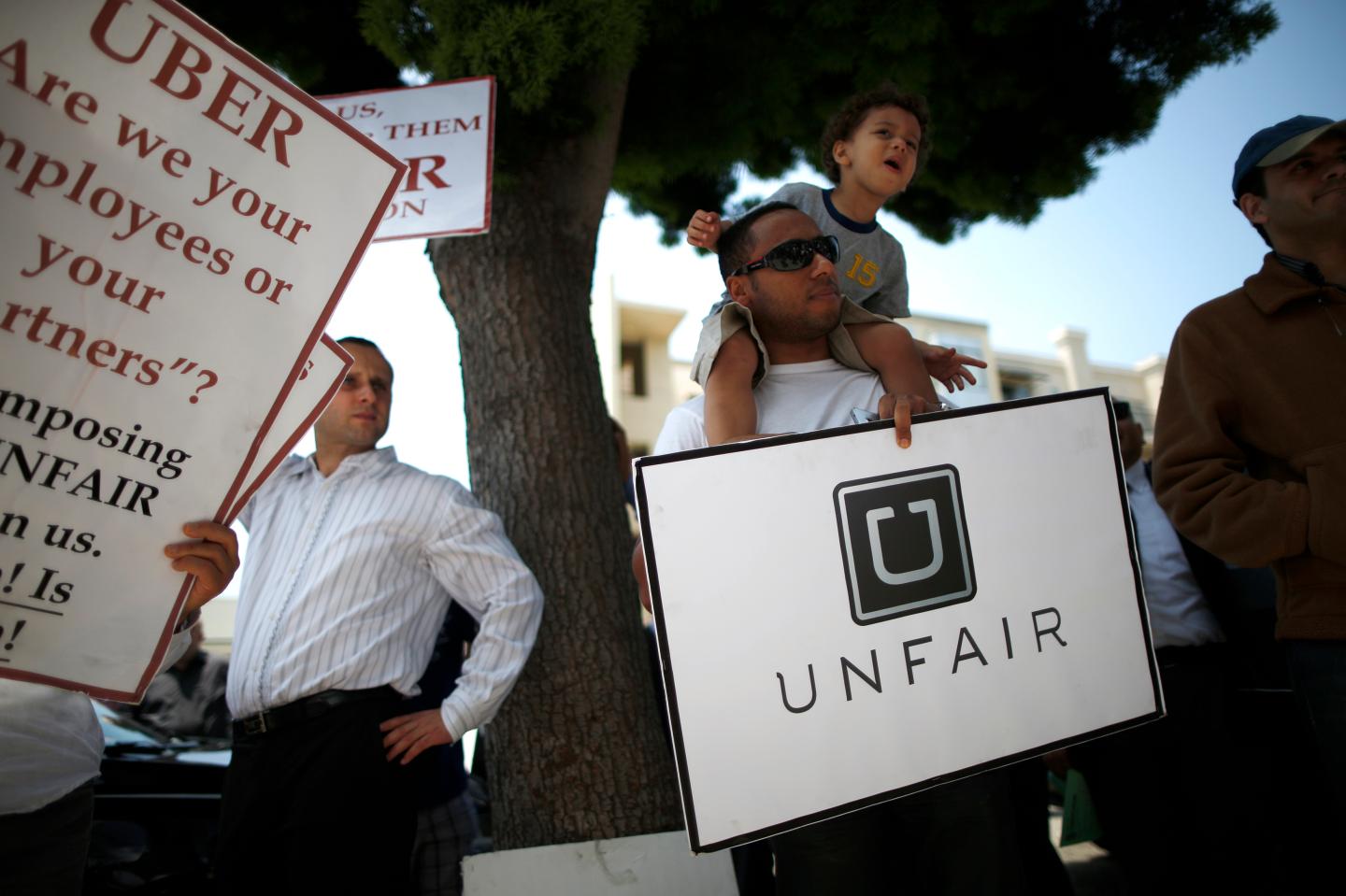
Uber driver Levin protests with other drivers against working conditions, in Santa Monica
Uber driver Aaron Levin, 31, (R) holds his two-year-old son William as he protests with other commercial drivers with the app-based, ride-sharing company Uber against working conditions outside the company's office in Santa Monica, California June 24, 2014. REUTERS/Lucy Nicholson (UNITED STATES - Tags: BUSINESS EMPLOYMENT TRANSPORT CIVIL UNREST) - RTR3VKIFPhotograph by Lucy Nicholson — Reuters
Add Fortune on Google for similar content.

As Uber reached a proposed settlement last week of up to $100 million in a pair of class-action cases, CEO Travis Kalanick highlighted the part of the deal that classified drivers of the app-enabled ride hailing service as independent contractors, not employees.

“Drivers value their independence—the freedom to push a button rather than punch a clock,” he asserted.

And then there’s David Weil, the head of the U.S. Labor Department’s Wage and Hour Division, who has warned of an increasingly “fissured workplace” in which many a business is likely to “completely wash its hands of labor standards and say, ‘Not my employees, not my problem.’”

So which is it? Do workers in these nonstandard settings relish their autonomy and flexibility? Or are they stuck in terrible jobs that they’re surely dying to get out of?

The answer isn’t straightforward. It all depends on which workers you ask.

Independent contractors do, in fact, overwhelmingly prefer the setup that they have, according to new research by Harvard’s Lawrence Katz and Princeton’s Alan Krueger. By contrast, the vast majority of people employed by temp agencies would rather have a different work situation.

Katz and Krueger have been studying temps, contract company employees, freelancers, and others in so-called alternative work arrangements. In late March, the two economists made a splash when they reported that those engaged in these forms of work now constitute about 16% of the American labor force, up from 10% a decade earlier and 9% 20 years ago. (Interestingly, given all the headlines they grab, online “gig economy” jobs at Uber, TaskRabbit, and the like register barely a blip — just 0.5% of the workforce.)

Katz and Krueger based their results on a 2015 survey of nearly 4,000 workers, administered for them by RAND, that mirrored earlier analyses conducted by the federal Bureau of Labor Statistics in 1995 and 2005.

Most remarkably, they discovered that all of the net employment growth in the United States between 2005 and the end of last year could be attributed to alternative work.

The latest iteration of their paper, which will be presented on Saturday at a meeting of labor experts, peeks into the mindset of those with nonstandard jobs. It shows that 84% of independent contractors prefer to work for themselves. That’s right in line with the 83% who indicated the same thing in 2005 and 1995.

But temp-agency workers express just the opposite: Seventy-seven percent would prefer a job that is permanent. That’s down slightly from 84% in 2005 and 83% in 1995.

The idea that alternative employment can be both desirable and detestable has been around since scholars first began to focus on what was then termed “peripheral work.” To the degree that this sort of job represents “enlargement of the area of choice of work experience, it is a positive,” labor economist Dean Morse wrote in 1969. “On the other hand, to the extent that the peripheral worker is treated as if he were a second-class worker,” it “cannot but lead to waste, frustration, and angry despair.”

Katz notes that, today, the more than eight out of 10 independent contractors who say they favor their status do so despite “anecdotal evidence” that many such workers “worry about the volatility of their incomes” and a lack of benefits. In the end, he says, the “flexibility of working for themselves” really does appear to trump other considerations.

Meanwhile, for the 16 million Americans who work at some point during the year as temps or contract employees, it’s not that they all have it bad. “There are staffing agencies that treat their employees wonderfully,” says David Dourgarian, the CEO of TempWorks, which provides software and services to the industry. For some people, a temp job is a great way to juggle school or parenting, or to suss out whether a particular career is right for them.

But it’s also without question that many temps encounter various kinds of exploitation. And “employment and labor law are way behind” in terms of affording them adequate protection, says Kathleen Christensen, a program director at the Alfred P. Sloan Foundation who has long studied changes in how people work.

Temps tend to make less per hour than do permanent employees for the same work. They typically collect no sick pay or vacation pay and have no insurance or retirement plan. And all too many fail to receive proper safety training before being told to take on hazardous tasks.

A big concern is that this ugly side of work is not limited to temps, but has quickly spread to those who are employed through all manner of intermediaries, many of whom fall outside the scope of Katz and Krueger’s survey: subcontractors, labor brokers, franchisees, and third-party managers. (Uber’s critics maintain that its drivers are also being taken advantage of.)

For a large portion of companies using these structures, workers are simply “seen as a drain on the bottom line,” says Erin Hatton, a sociologist at the State University of New York at Buffalo and the author of The Temp Economy. “This is a paradigm shift—a broader cultural shift.”

Indeed, Weil says that since arriving at the Labor Department two years ago from Boston University, he has been struck by “the pervasiveness” of jobs that don’t adhere to a straight-ahead employer-employee model. “They’re constantly cropping up in unexpected places,” he says, pointing to everything from shipbuilding and car dealers to law and medicine. “The workplace is so different now.”

For some, that is undoubtedly a blessing. But for many others, it is a travesty, leaving them wishing that the traditional world of work wasn’t fading so fast.

Rick Wartzman is senior advisor to the Drucker Institute at Claremont Graduate University. The author or editor of five books, he is currently writing a narrative history of how the social contract between employer and employee in America has changed since the end of World War II.

About the Author
By Rick Wartzman
See full bioRight Arrow Button Icon
Add Fortune on Google for similar content.

Latest in Commentary

Finance
Lorem ipsum dolor sit amet, consectetur adipiscing elit, sed do eiusmod tempor incididunt ut labore et dolore magna aliqua. Ut enim ad minim veniam
By Fortune Editors
October 20, 2025
Finance
Lorem ipsum dolor sit amet, consectetur adipiscing elit, sed do eiusmod tempor incididunt ut labore et dolore magna aliqua. Ut enim ad minim veniam
By Fortune Editors
October 20, 2025
Finance
Lorem ipsum dolor sit amet, consectetur adipiscing elit, sed do eiusmod tempor incididunt ut labore et dolore magna aliqua. Ut enim ad minim veniam
By Fortune Editors
October 20, 2025
Finance
Lorem ipsum dolor sit amet, consectetur adipiscing elit, sed do eiusmod tempor incididunt ut labore et dolore magna aliqua. Ut enim ad minim veniam
By Fortune Editors
October 20, 2025
Finance
Lorem ipsum dolor sit amet, consectetur adipiscing elit, sed do eiusmod tempor incididunt ut labore et dolore magna aliqua. Ut enim ad minim veniam
By Fortune Editors
October 20, 2025
Finance
Lorem ipsum dolor sit amet, consectetur adipiscing elit, sed do eiusmod tempor incididunt ut labore et dolore magna aliqua. Ut enim ad minim veniam
By Fortune Editors
October 20, 2025

Most Popular

Finance
Lorem ipsum dolor sit amet, consectetur adipiscing elit, sed do eiusmod tempor incididunt ut labore et dolore magna aliqua. Ut enim ad minim veniam
By Fortune Editors
October 20, 2025
Finance
Lorem ipsum dolor sit amet, consectetur adipiscing elit, sed do eiusmod tempor incididunt ut labore et dolore magna aliqua. Ut enim ad minim veniam
By Fortune Editors
October 20, 2025
Finance
Lorem ipsum dolor sit amet, consectetur adipiscing elit, sed do eiusmod tempor incididunt ut labore et dolore magna aliqua. Ut enim ad minim veniam
By Fortune Editors
October 20, 2025
Finance
Lorem ipsum dolor sit amet, consectetur adipiscing elit, sed do eiusmod tempor incididunt ut labore et dolore magna aliqua. Ut enim ad minim veniam
By Fortune Editors
October 20, 2025
Finance
Lorem ipsum dolor sit amet, consectetur adipiscing elit, sed do eiusmod tempor incididunt ut labore et dolore magna aliqua. Ut enim ad minim veniam
By Fortune Editors
October 20, 2025
Finance
Lorem ipsum dolor sit amet, consectetur adipiscing elit, sed do eiusmod tempor incididunt ut labore et dolore magna aliqua. Ut enim ad minim veniam
By Fortune Editors
October 20, 2025
Fortune Secondary Logo
Rankings
  • 100 Best Companies
  • Fortune 500
  • Global 500
  • Fortune 500 Europe
  • Most Powerful Women
  • World's Most Admired Companies
  • See All Rankings
  • Lists Calendar
Sections
  • Finance
  • Fortune Crypto
  • Features
  • Leadership
  • Health
  • Commentary
  • Success
  • Retail
  • Mpw
  • Tech
  • Lifestyle
  • CEO Initiative
  • Asia
  • Politics
  • Conferences
  • Europe
  • Newsletters
  • Personal Finance
  • Environment
  • Magazine
  • Education
Customer Support
  • Frequently Asked Questions
  • Customer Service Portal
  • Privacy Policy
  • Terms Of Use
  • Single Issues For Purchase
  • International Print
Commercial Services
  • Advertising
  • Fortune Brand Studio
  • Fortune Analytics
  • Fortune Conferences
  • Business Development
  • Group Subscriptions
About Us
  • About Us
  • Press Center
  • Work At Fortune
  • Terms And Conditions
  • Site Map
  • About Us
  • Press Center
  • Work At Fortune
  • Terms And Conditions
  • Site Map
  • Facebook icon
  • Twitter icon
  • LinkedIn icon
  • Instagram icon
  • Pinterest icon

Latest in Commentary

steve
Commentary250 Years of Innovation
Steve Case: America was built by entrepreneurs. Here’s how we keep that edge for the next 250 years
By Steve CaseJune 24, 2026
5 hours ago
t
CommentaryWhite House
Trump mistakes the bully pulpit for bullying leadership — history’s villains were never heroes
By Jeffrey Sonnenfeld and Steven TianJune 24, 2026
6 hours ago
mg
CommentaryHealth
The ‘tech neck’ time bomb: why 43 million young Americans could cripple U.S. health care within a generation
By Michael GerlingJune 24, 2026
6 hours ago
sb
Commentaryclimate change
The climate policy triangle: why leaders can no longer choose between growth, security and sustainability
By Sebastian BuckupJune 23, 2026
20 hours ago
brett
CommentaryManagement
Middle managers aren’t going extinct—they’re evolving into something more powerful
By Brett HurtJune 23, 2026
1 day ago
ravi
CommentaryAI agents
Yale School of Management: surveillance pricing is just the beginning. AI agents will be the real test of corporate trust
By Ravi Dhar and Jon IwataJune 23, 2026
1 day ago

Most Popular

After forcing workers back to the office, Goldman Sachs and JPMorgan Chase are now letting their staff work remotely—but only for the World Cup
Success
After forcing workers back to the office, Goldman Sachs and JPMorgan Chase are now letting their staff work remotely—but only for the World Cup
By Orianna Rosa RoyleJune 23, 2026
1 day ago
The Pentagon said Iran War costs $29 billion, but the real cost is closer to $200 billion—and counting
Economy
The Pentagon said Iran War costs $29 billion, but the real cost is closer to $200 billion—and counting
By Jacqueline MunisJune 24, 2026
11 hours ago
Current price of oil as of June 23, 2026
Personal Finance
Current price of oil as of June 23, 2026
By Joseph HostetlerJune 23, 2026
1 day ago
Markets tumble worldwide as Fed resets expectations: $400 billion wiped off SpaceX stock
Banking
Markets tumble worldwide as Fed resets expectations: $400 billion wiped off SpaceX stock
By Jim EdwardsJune 23, 2026
1 day ago
Current price of gold as of June 23, 2026
Personal Finance
Current price of gold as of June 23, 2026
By Danny BakstJune 23, 2026
1 day ago
Texas and Charlotte used to build huge McMansions—now they're copying the California design tricks they once mocked
Real Estate
Texas and Charlotte used to build huge McMansions—now they're copying the California design tricks they once mocked
By Sydney LakeJune 22, 2026
2 days ago

© 2026 Fortune Media IP Limited. All Rights Reserved. Use of this site constitutes acceptance of our Terms of Use and Privacy Policy | CA Notice at Collection and Privacy Notice | Do Not Sell/Share My Personal Information
FORTUNE is a trademark of Fortune Media IP Limited, registered in the U.S. and other countries. FORTUNE may receive compensation for some links to products and services on this website. Offers may be subject to change without notice.