• Home
  • Latest
  • Fortune 500
  • Finance
  • Tech
  • Leadership
  • Lifestyle
  • Rankings
  • Multimedia
FinanceEconomy

Here’s How Ben Bernanke’s “Helicopter Money” Plan Might Work

By
Chris Matthews
Chris Matthews
Down Arrow Button Icon
By
Chris Matthews
Chris Matthews
Down Arrow Button Icon
April 12, 2016, 10:56 AM ET
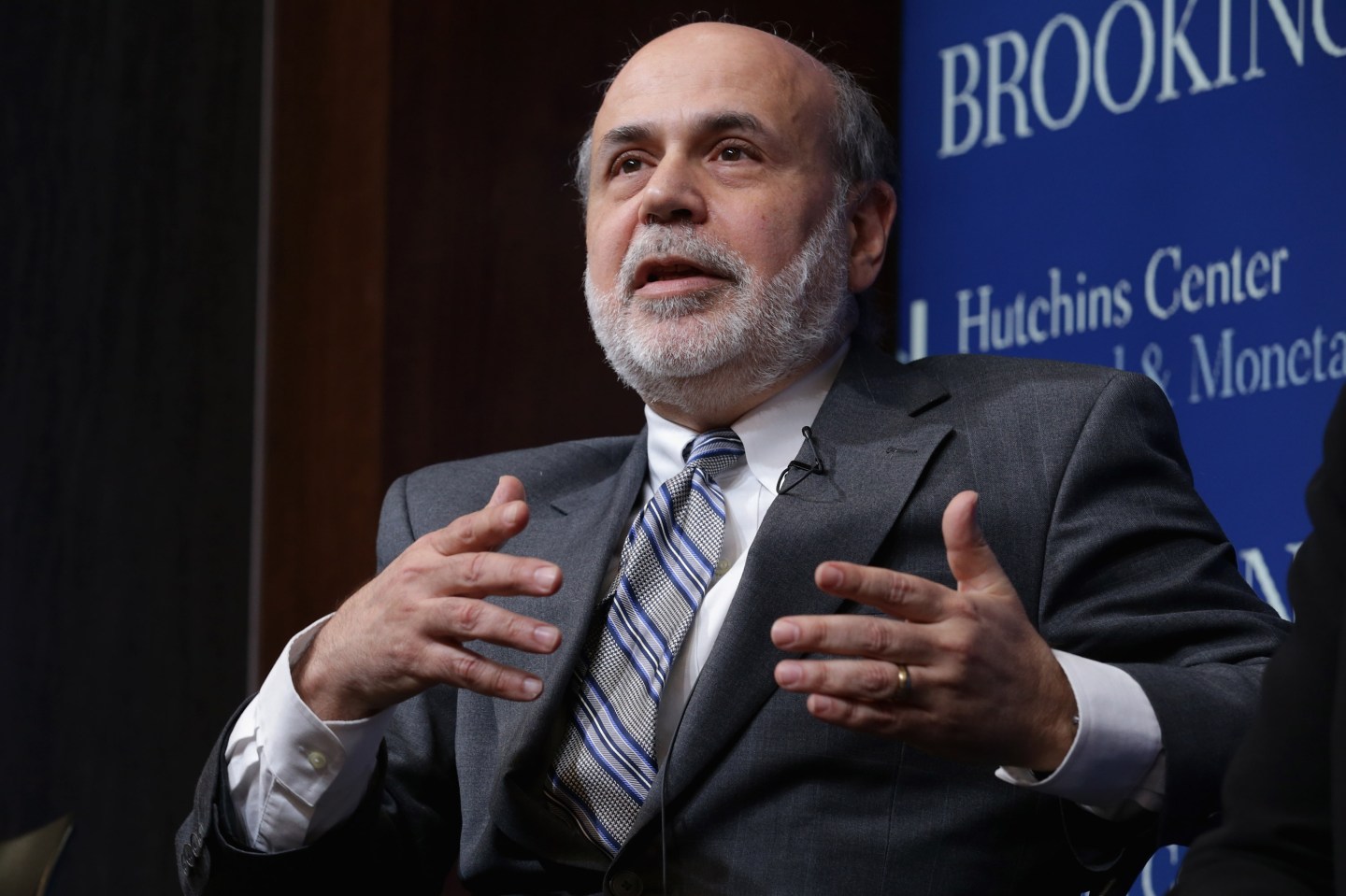
Bernanke, Former Fed Officials Discuss Role Of Federal Reserve In 21st Century
WASHINGTON, DC - MARCH 02: Former Fed Chairman Ben Bernanke participates in a panel discussion at the Brookings Institution March 2, 2015 in Washington, DC. The institution hosted a series of lectures and discussions as party of a program called "The Fed in the 21st century: Independence, governance, and accountability." (Photo by Chip Somodevilla/Getty Images)Photograph by Chip Somodevilla — Getty Images

You’d think it wouldn’t be so hard to spark a little inflation.

But in recent years, the Federal Reserve has consistently fallen short of its goal of a 2% annual inflation rate, despite the fact that it has kept interest rates at historically low levels, and has maintained trillions of dollars of government debt and mortgage-backed securities on its balance sheet.

This inability of the Fed to hit its inflation goal has caused many economic commentators to wonder what the central bank will do once the next recession hits. If the U.S. economy does suffer a recession in the near future, it’s unlikely that the federal funds rate will be high enough that the central bank will be able to stimulate the economy with interest rate cuts anywhere near the magnitude it did following recent downturns.

The situation has economists in general, and former Federal Reserve Chairman Ben Bernanke in particular, worried about what to do when the next recession hits. In a blog post Monday, Bernanke took a look at one of the more exciting (and controversial) ideas for future fed policy: helicopter money.

The term was invented by famed conservative economist Milton Friedman, who used the metaphor of dropping money down from a helicopter to illustrate the fact that a determined central bank could cause inflation if it really wanted to, if by no other means than simply handing out free money. “In theory at least, helicopter money could prove a valuable tool,” Bernanke writes. “In particular, it has the attractive feature that it should work even when more conventional monetary policies are ineffective and the initial level of government debt is high.”

Bernanke famously used the same “helicopter” analogy in a 2002 speech, which critics say gave then-Fed Chair Alan Greenspan the intellectual cover to pursue the loose monetary policies that led to the housing bubble and, ultimately, the 2008 financial crisis.

Fast forward to the present and many people are understandably concerned about giving the central bank the power to just print dollars and hand that money out, as opposed to conducting monetary policy through the banking system as it does now. Many accounts in the media wrongly equate the Fed’s program of quantitative easing (QE), with “printing money,” even though it is really creating bank reserves and using them to buy government debt and mortgage-backed securities from large banks; this stimulates the economy only if the resulting lowering of interest rates encourages banks to lend out more money. One reason the U.S. economy has remained sluggish despite the Fed’s extraordinary actions to address the financial crisis is that its QE program failed to spur a dramatic increase in bank lending.


Helicopter money, however, could finance government spending—or a tax cut—without relying on the banks increasing their lending, and without increasing government debt. But it is difficult to imagine a scenario in which the Federal Reserve could institute a “helicopter drop” of money without coordination with Congress. Sure, the Fed could credit the Treasury Department with extra dollars, but Congress would have to decide how to spend it. The first concern economists who study central banks have with such a program is that this sort of coordination with Congress could undermine the independence of the Federal Reserve, and turn the central bank into an institution that is run by elected officials.

Bernanke shares these concerns but the former Fed Chair does foresee a scenario in which the Fed finances tax cuts or government spending. He writes:

A possible arrangement, set up in advance, might work as follows: Ask Congress to create, by statute, a special Treasury account at the Fed, and to give the Fed . . . the sole authority to “fill” the account, perhaps up to some prespecified limit. At almost all times, the account would be empty; the Fed would use its authority to add funds to the account only when the [Fed] assessed that a [helicopter drop] of specified size was needed to achieve the Fed’s employment and inflation goals.
Should the Fed act, under this proposal, the next step would be for the Congress and the Administration—through the usual, but possibly expedited, legislative process—to determine how to spend the funds (for example, on a tax rebate or on public works). Importantly, the Congress and Administration would have the option to leave the funds unspent. If the funds were not used within a specified time, the Fed would be empowered to withdraw them.
Such an arrangement would enable the Fed to inject money into the system directly, without risking too much coordination between Congress and the central bank. But such an arrangement does raise the question that if Congress can summon the political will to fund a tax cut or stimulus by telling the Fed to print money, why doesn’t it just fund those projects with government debt? After all, there’s no evidence that current levels of federal government debt are high enough that they will slow economic growth or otherwise imperil the American economy—plus borrowing rates remain near historically low levels.
At the same time, one of the dynamics that made the Fed a relatively effective actor following the financial crisis is that it’s relatively shielded from the fallout of unpopular decisions. One could imagine a scenario where the Democratic Party—which is more amenable to using government action to stimulate the economy— gains control of Congress and passes a law giving the Fed the authority to credit Treasury with funds during a time of crisis. Such a scenario would mean that there would not need to be a public debate each time the authority is used, because Congress would have already voted on the issue. It’s difficult to imagine even a Republican administration resisting the ability to cut taxes without raising the deficit or causing inflation to rise beyond where the Fed wants it.
Granted, it’s unlikely that Washington will summon the political will to set up a system to implement a helicopter money drop anytime soon. But with a major figure like Ben Bernanke arguing that it would be wise to at least have such a system in the Fed’s toolkit, you can bet that policy makers will seriously consider it the next time a recession hits.
About the Author
By Chris Matthews
See full bioRight Arrow Button Icon

Latest in Finance

Finance
Lorem ipsum dolor sit amet, consectetur adipiscing elit, sed do eiusmod tempor incididunt ut labore et dolore magna aliqua. Ut enim ad minim veniam
By Fortune Editors
October 20, 2025
Finance
Lorem ipsum dolor sit amet, consectetur adipiscing elit, sed do eiusmod tempor incididunt ut labore et dolore magna aliqua. Ut enim ad minim veniam
By Fortune Editors
October 20, 2025
Finance
Lorem ipsum dolor sit amet, consectetur adipiscing elit, sed do eiusmod tempor incididunt ut labore et dolore magna aliqua. Ut enim ad minim veniam
By Fortune Editors
October 20, 2025
Finance
Lorem ipsum dolor sit amet, consectetur adipiscing elit, sed do eiusmod tempor incididunt ut labore et dolore magna aliqua. Ut enim ad minim veniam
By Fortune Editors
October 20, 2025
Finance
Lorem ipsum dolor sit amet, consectetur adipiscing elit, sed do eiusmod tempor incididunt ut labore et dolore magna aliqua. Ut enim ad minim veniam
By Fortune Editors
October 20, 2025
Finance
Lorem ipsum dolor sit amet, consectetur adipiscing elit, sed do eiusmod tempor incididunt ut labore et dolore magna aliqua. Ut enim ad minim veniam
By Fortune Editors
October 20, 2025

Most Popular

Finance
Lorem ipsum dolor sit amet, consectetur adipiscing elit, sed do eiusmod tempor incididunt ut labore et dolore magna aliqua. Ut enim ad minim veniam
By Fortune Editors
October 20, 2025
Finance
Lorem ipsum dolor sit amet, consectetur adipiscing elit, sed do eiusmod tempor incididunt ut labore et dolore magna aliqua. Ut enim ad minim veniam
By Fortune Editors
October 20, 2025
Finance
Lorem ipsum dolor sit amet, consectetur adipiscing elit, sed do eiusmod tempor incididunt ut labore et dolore magna aliqua. Ut enim ad minim veniam
By Fortune Editors
October 20, 2025
Finance
Lorem ipsum dolor sit amet, consectetur adipiscing elit, sed do eiusmod tempor incididunt ut labore et dolore magna aliqua. Ut enim ad minim veniam
By Fortune Editors
October 20, 2025
Finance
Lorem ipsum dolor sit amet, consectetur adipiscing elit, sed do eiusmod tempor incididunt ut labore et dolore magna aliqua. Ut enim ad minim veniam
By Fortune Editors
October 20, 2025
Finance
Lorem ipsum dolor sit amet, consectetur adipiscing elit, sed do eiusmod tempor incididunt ut labore et dolore magna aliqua. Ut enim ad minim veniam
By Fortune Editors
October 20, 2025
Fortune Secondary Logo
Rankings
  • 100 Best Companies
  • Fortune 500
  • Global 500
  • Fortune 500 Europe
  • Most Powerful Women
  • Future 50
  • World’s Most Admired Companies
  • See All Rankings
Sections
  • Finance
  • Fortune Crypto
  • Features
  • Leadership
  • Health
  • Commentary
  • Success
  • Retail
  • Mpw
  • Tech
  • Lifestyle
  • CEO Initiative
  • Asia
  • Politics
  • Conferences
  • Europe
  • Newsletters
  • Personal Finance
  • Environment
  • Magazine
  • Education
Customer Support
  • Frequently Asked Questions
  • Customer Service Portal
  • Privacy Policy
  • Terms Of Use
  • Single Issues For Purchase
  • International Print
Commercial Services
  • Advertising
  • Fortune Brand Studio
  • Fortune Analytics
  • Fortune Conferences
  • Business Development
  • Group Subscriptions
About Us
  • About Us
  • Editorial Calendar
  • Press Center
  • Work At Fortune
  • Diversity And Inclusion
  • Terms And Conditions
  • Site Map
  • About Us
  • Editorial Calendar
  • Press Center
  • Work At Fortune
  • Diversity And Inclusion
  • Terms And Conditions
  • Site Map
  • Facebook icon
  • Twitter icon
  • LinkedIn icon
  • Instagram icon
  • Pinterest icon

Latest in Finance

AIData centers
Southeast Asia could become a booming data center market if its data centers can beat the heat
By Angelica AngMarch 26, 2026
4 minutes ago
Jessica Thompson poses outside her home.
Future of Workgender issues
Today’s Equal Pay Day. Women and men still disagree about who has more economic opportunities
By Jacqueline MunisMarch 26, 2026
11 minutes ago
startup team smiles in front of camera
CryptoCryptocurrency
Exclusive: Megapot raises $5 million to create a crypto-powered global lottery
By Carlos GarciaMarch 26, 2026
4 hours ago
gas
Economyunemployment
Trump’s war in Iran is costing the U.S. economy 10,000 jobs a month, Goldman Sachs says
By Nick LichtenbergMarch 26, 2026
4 hours ago
Young woman looks at her computer looking stressed and holding a credit card
Economystudent loans and debt
Gen Z’s credit scores are cratering — and Trump’s student loan crackdown is the biggest reason why
By Tristan BoveMarch 26, 2026
4 hours ago
iran war
Real EstateIran
How a war in the Middle East is hiking your mortgage rate in America
By Jake AngeloMarch 26, 2026
5 hours ago

Most Popular

C-Suite
'I didn’t want anybody shooting me': Five Guys CEO gave away $1.5 million bonus to employees over botched BOGO burger birthday celebration
By Fortune EditorsMarch 25, 2026
1 day ago
Success
Palantir’s billionaire CEO says only two kinds of people will succeed in the AI era: trade workers — ‘or you’re neurodivergent’
By Fortune EditorsMarch 24, 2026
2 days ago
Environment
Vail Resorts CEO says it’s time to think beyond the $1,000 ski pass that helped build the empire
By Fortune EditorsMarch 26, 2026
14 hours ago
Success
JPMorgan’s Jamie Dimon says remote work breeds ‘rope-a-dope politics’ and stunts young workers’ growth
By Fortune EditorsMarch 25, 2026
1 day ago
Commentary
The Treasury just declared the U.S. insolvent. The media missed it
By Fortune EditorsMarch 23, 2026
3 days ago
Magazine
The youngest-ever female CEO of a Fortune 500 company is fighting Trump's cuts to keep Medicaid strong
By Fortune EditorsMarch 24, 2026
3 days ago

© 2026 Fortune Media IP Limited. All Rights Reserved. Use of this site constitutes acceptance of our Terms of Use and Privacy Policy | CA Notice at Collection and Privacy Notice | Do Not Sell/Share My Personal Information
FORTUNE is a trademark of Fortune Media IP Limited, registered in the U.S. and other countries. FORTUNE may receive compensation for some links to products and services on this website. Offers may be subject to change without notice.