• Home
  • Latest
  • Fortune 500
  • Finance
  • Tech
  • Leadership
  • Lifestyle
  • Rankings
  • Multimedia
TechMedia

Do the Guardian’s Losses Mean Its “Open Journalism” Has Failed?

By
Mathew Ingram
Mathew Ingram
Down Arrow Button Icon
By
Mathew Ingram
Mathew Ingram
Down Arrow Button Icon
February 3, 2016, 11:25 AM ET
BRITAIN-MEDIA-GUARDIAN-NEWSPAPER
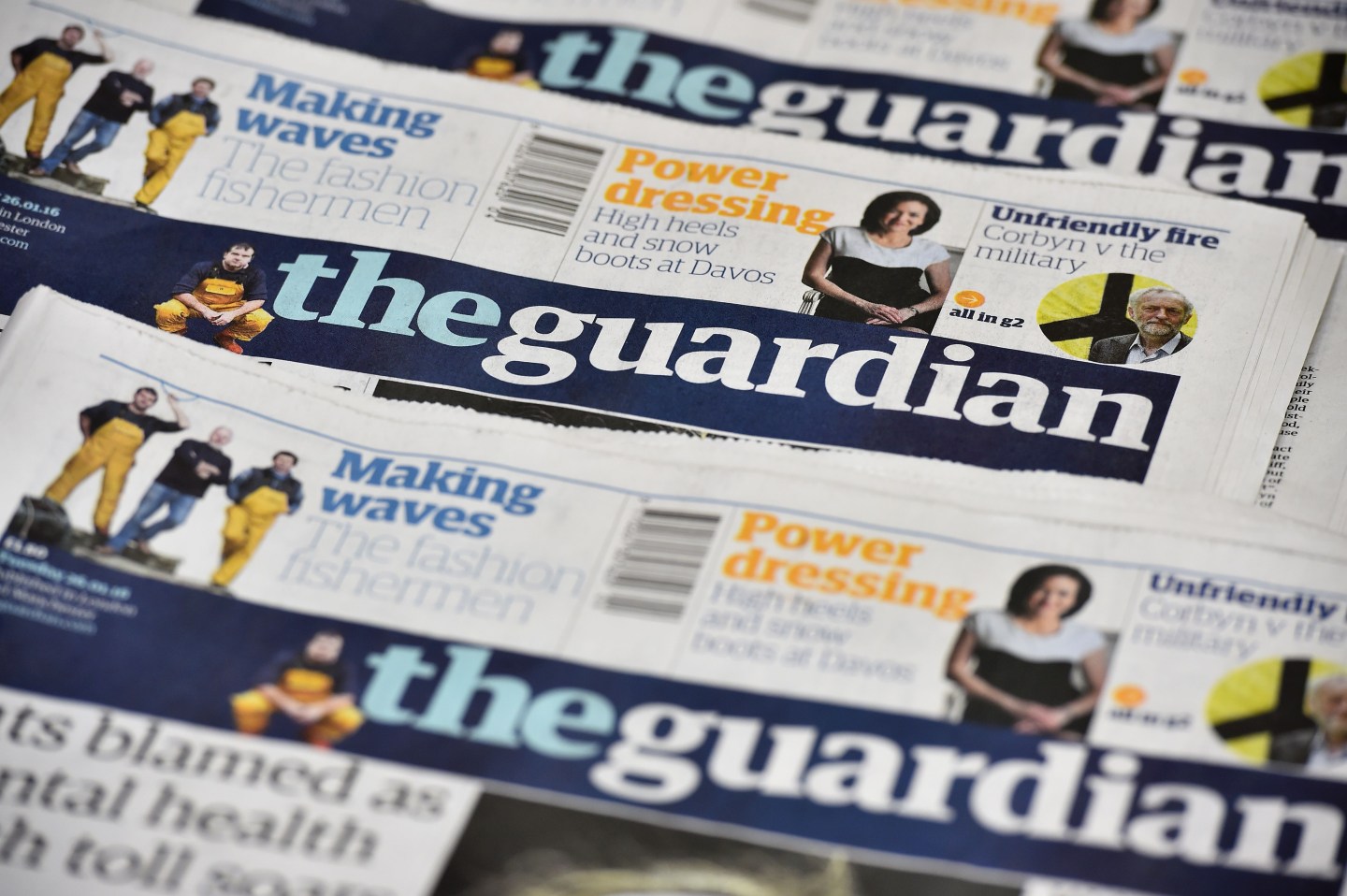
An arrangment of Guardian newspapers is photographed in an office in London on January 26, 2016. The Guardian newspaper is to cut running costs by 20 percent over three years and may begin charging for some online content following a 25-percent plunge in print advertising, British media reported Tuesday. / AFP / BEN STANSALL (Photo credit should read BEN STANSALL/AFP/Getty Images)BEN STANSALL AFP/Getty Images

After a series of reports about ballooning losses at the Guardian, the British newspaper’s parent company Guardian News & Media announced recently that the company is looking to cut more than $70 million in costs over the next three years, after losing more than that in 2015. The paper has spent the past several years focusing on a mission its former editor called “open journalism.” Is that to blame for its losses?

In a recent column, media critic Michael Wolff said the Guardian “has been something of an ultimate experiment in the migration from paper to digital publishing,” but argues its expansion and online experiments have resulted in nothing but financial ruin, a “quixotic test of digital faith.”

Instead of cutting its costs and implementing a paywall like other newspapers, Wolff says, the Guardian maintained its open approach to journalism in the face of overwhelming odds, and now it is doomed. Why? Because advertising revenue alone can’t support media organizations, he says—which he argues was the central digital conceit the Guardian bought into. The paper, according to Wolff, is to digital media “what Cuba is to socialism.”

While Wolff might like to use the Guardian‘s losses to paint its strategy as a failure, and paywalls as the only solution, what’s happening at the British newspaper isn’t quite that simple. Like everyone else, it is trying to figure out how to get from one place—namely, print—to a different place, namely the web.

For more on new media, read: Yahoo’s Worst Problem? It’s a Media Company

It’s true that the Guardian has been steadfastly opposed to erecting a paywall, primarily because doing so would interfere with the “open journalism” approach that former editor Alan Rusbridger argued was the paper’s core value. But it’s also true that many newspapers that have tried paywalls are still struggling financially. Even the New York Times‘ paywall is barely compensating for the decline in print advertising.

Rusbridger’s “open journalism” wasn’t just some digital fad or social-media driven frenzy, as Wolff and other critics like to imply, but rather a fundamental part of the Guardian‘s commitment to journalism as a public good. And that itself stems from the newspaper’s mandate, which is to spread a liberal political and social perspective as broadly as possible. That’s why it’s run by a trust.

Evan Williams says Twitter is primarily a news network:

So when the paper launches projects like the ground-breaking MP Expenses crowdsourcing project—in which tens of thousands of readers pored over expense reports filed by British politicians—or opens up its editorial process by allowing readers to contribute ideas, it isn’t because crowdsourcing is hip. It’s because the Guardian sees its readers as partners in creating journalism, not just content consumers.

That relationship with its readers is also critical to solving the problem that Wolff describes, namely diversifying away from advertising. It’s why the Guardian has spent so much time trying to develop a membership-based revenue model based around live events and special features. Wolff dismisses this as naive, but it’s arguably better than a one-size-fits-all paywall around everything.

Do the losses that Wolff is referring to—which amount to about $70 million once exceptional one-time costs are removed, or slightly larger than the loss from the previous year—mean that the Guardian‘s goals were misplaced, or that expanding online and into the U.S. and Australia was a mistake? In a word, no.

Get Data Sheet, Fortune‘s technology newsletter.

The reality is that almost every media company, traditional or not, is losing money, even some of the ones with paywalls. Yes, the Wall Street Journal and the Financial Times might be making a living, but they are members of a very small group. Even the Washington Post is in what its owner and Amazon (AMZN) founder Jeff Bezos describes euphemistically as “investment mode,” and likely will be for some time.

Should the Guardian have been cutting costs and laying hundreds of people off, as other newspapers have been? Probably. But that wouldn’t necessarily guarantee its losses would be dramatically smaller than they are now, and it might mean that it would have missed opportunities that will eventually pay off in other ways, such as the expansion into the U.S. (which won’t be affected by the upcoming cuts, the paper says).

Obviously, the Guardian needs to reduce its costs and move steadily away from print to digital, just as every other newspaper and magazine company needs to—that’s not an easy process, especially when the bulk of your revenue still comes from print. And the British newspaper has at least as good a chance of making that transition with an open, membership-based model as anyone else Wolff might care to look at.

About the Author
By Mathew Ingram
See full bioRight Arrow Button Icon

Latest in Tech

Finance
Lorem ipsum dolor sit amet, consectetur adipiscing elit, sed do eiusmod tempor incididunt ut labore et dolore magna aliqua. Ut enim ad minim veniam
By Fortune Editors
October 20, 2025
Finance
Lorem ipsum dolor sit amet, consectetur adipiscing elit, sed do eiusmod tempor incididunt ut labore et dolore magna aliqua. Ut enim ad minim veniam
By Fortune Editors
October 20, 2025
Finance
Lorem ipsum dolor sit amet, consectetur adipiscing elit, sed do eiusmod tempor incididunt ut labore et dolore magna aliqua. Ut enim ad minim veniam
By Fortune Editors
October 20, 2025
Finance
Lorem ipsum dolor sit amet, consectetur adipiscing elit, sed do eiusmod tempor incididunt ut labore et dolore magna aliqua. Ut enim ad minim veniam
By Fortune Editors
October 20, 2025
Finance
Lorem ipsum dolor sit amet, consectetur adipiscing elit, sed do eiusmod tempor incididunt ut labore et dolore magna aliqua. Ut enim ad minim veniam
By Fortune Editors
October 20, 2025
Finance
Lorem ipsum dolor sit amet, consectetur adipiscing elit, sed do eiusmod tempor incididunt ut labore et dolore magna aliqua. Ut enim ad minim veniam
By Fortune Editors
October 20, 2025

Most Popular

Finance
Lorem ipsum dolor sit amet, consectetur adipiscing elit, sed do eiusmod tempor incididunt ut labore et dolore magna aliqua. Ut enim ad minim veniam
By Fortune Editors
October 20, 2025
Finance
Lorem ipsum dolor sit amet, consectetur adipiscing elit, sed do eiusmod tempor incididunt ut labore et dolore magna aliqua. Ut enim ad minim veniam
By Fortune Editors
October 20, 2025
Finance
Lorem ipsum dolor sit amet, consectetur adipiscing elit, sed do eiusmod tempor incididunt ut labore et dolore magna aliqua. Ut enim ad minim veniam
By Fortune Editors
October 20, 2025
Finance
Lorem ipsum dolor sit amet, consectetur adipiscing elit, sed do eiusmod tempor incididunt ut labore et dolore magna aliqua. Ut enim ad minim veniam
By Fortune Editors
October 20, 2025
Finance
Lorem ipsum dolor sit amet, consectetur adipiscing elit, sed do eiusmod tempor incididunt ut labore et dolore magna aliqua. Ut enim ad minim veniam
By Fortune Editors
October 20, 2025
Finance
Lorem ipsum dolor sit amet, consectetur adipiscing elit, sed do eiusmod tempor incididunt ut labore et dolore magna aliqua. Ut enim ad minim veniam
By Fortune Editors
October 20, 2025
Fortune Secondary Logo
Rankings
  • 100 Best Companies
  • Fortune 500
  • Global 500
  • Fortune 500 Europe
  • Most Powerful Women
  • Future 50
  • World’s Most Admired Companies
  • See All Rankings
Sections
  • Finance
  • Fortune Crypto
  • Features
  • Leadership
  • Health
  • Commentary
  • Success
  • Retail
  • Mpw
  • Tech
  • Lifestyle
  • CEO Initiative
  • Asia
  • Politics
  • Conferences
  • Europe
  • Newsletters
  • Personal Finance
  • Environment
  • Magazine
  • Education
Customer Support
  • Frequently Asked Questions
  • Customer Service Portal
  • Privacy Policy
  • Terms Of Use
  • Single Issues For Purchase
  • International Print
Commercial Services
  • Advertising
  • Fortune Brand Studio
  • Fortune Analytics
  • Fortune Conferences
  • Business Development
  • Group Subscriptions
About Us
  • About Us
  • Editorial Calendar
  • Press Center
  • Work At Fortune
  • Diversity And Inclusion
  • Terms And Conditions
  • Site Map
  • About Us
  • Editorial Calendar
  • Press Center
  • Work At Fortune
  • Diversity And Inclusion
  • Terms And Conditions
  • Site Map
  • Facebook icon
  • Twitter icon
  • LinkedIn icon
  • Instagram icon
  • Pinterest icon

Latest in Tech

lancaster
AIschools
Two private school boys get probation for using AI to create 350 fake nudes of their classmates
By Mark Scolforo and The Associated PressMarch 25, 2026
15 minutes ago
melania
PoliticsWhite House
Enter Melania Trump, escorted by humanoid robot: ‘I’m Figure 03, a humanoid built for the United States of America’
By Darlene Superville and The Associated PressMarch 25, 2026
23 minutes ago
bernie
AICongress
Bernie Sanders and AOC launch bill to ban new data-center construction
By Matthew Daly and The Associated PressMarch 25, 2026
44 minutes ago
Big TechSocial Media
A court just ruled that tech addiction is real—and dangerous. It could be Meta and YouTube’s Big Tobacco moment
By Kristin StollerMarch 25, 2026
1 hour ago
Warner gestures
AIAmerican Politics
New college grad unemployment will spike to 35% in 2 years, senator warns, forcing ‘Dario, Sam’ to quit AI fear-mongering
By Jacqueline MunisMarch 25, 2026
3 hours ago
Big TechMeta
Meta and YouTube found liable in landmark child social media harm case, ordered to pay $3 million—with punitive damages still to come
By Kaitlyn Huamani, Barbara Ortutay and The Associated PressMarch 25, 2026
3 hours ago

Most Popular

Magazine
The youngest-ever female CEO of a Fortune 500 company is fighting Trump's cuts to keep Medicaid strong
By Fortune EditorsMarch 24, 2026
2 days ago
Commentary
The Treasury just declared the U.S. insolvent. The media missed it
By Fortune EditorsMarch 23, 2026
2 days ago
Success
Palantir’s billionaire CEO says only two kinds of people will succeed in the AI era: trade workers — ‘or you’re neurodivergent’
By Fortune EditorsMarch 24, 2026
1 day ago
Energy
Nobel laureate Paul Krugman calls it 'treason': $580 million in suspicious oil futures traded minutes before Trump's Iran reversal
By Fortune EditorsMarch 24, 2026
1 day ago
Success
The job market is so bad that ‘reverse recruiters’ are charging $1,500 a month just to help people look for jobs
By Fortune EditorsMarch 25, 2026
14 hours ago
Success
JPMorgan has started monitoring the keystrokes, video calls, and meetings of its junior investment bankers—and they say it's for employee well-being
By Fortune EditorsMarch 24, 2026
1 day ago

© 2026 Fortune Media IP Limited. All Rights Reserved. Use of this site constitutes acceptance of our Terms of Use and Privacy Policy | CA Notice at Collection and Privacy Notice | Do Not Sell/Share My Personal Information
FORTUNE is a trademark of Fortune Media IP Limited, registered in the U.S. and other countries. FORTUNE may receive compensation for some links to products and services on this website. Offers may be subject to change without notice.