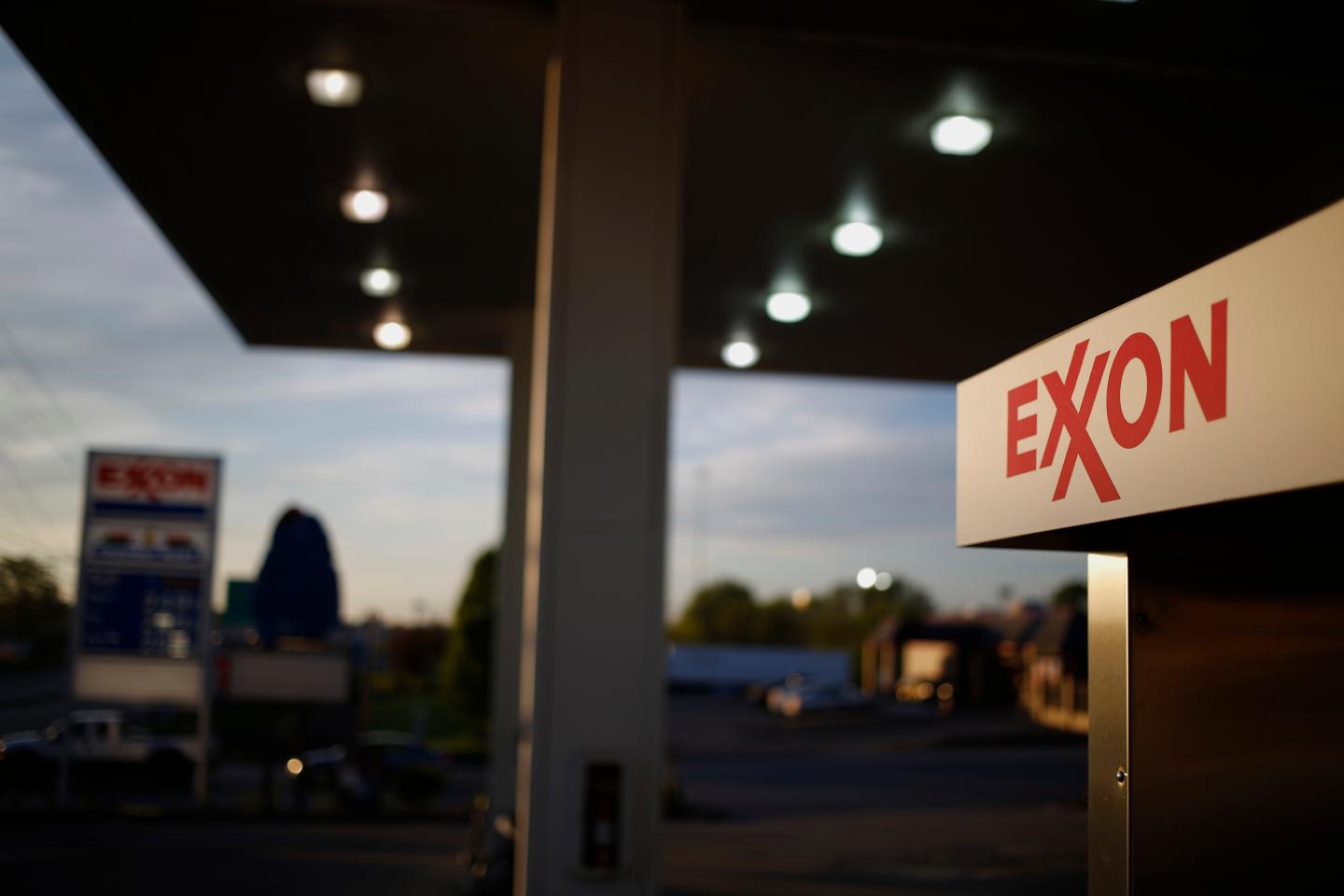
ExxonMobil is proving that being an integrated energy company might not be such a bad idea after all. The giant oil and gas company reported dismal earnings on Tuesday, down 53% from the same time last year. But it would have been far worse if it had follow the path of some of its rivals—such as BP, Marathon Petroleum, Murphy Petroleum, ConocoPhillips, or Hess—and sold off or massively scaled down its U.S. refining businesses to focus on exploration and production.
For ExxonMobil (XOM), refining truly saved the day, helping it post a positive quarter, while its less integrated and less efficient rivals suffered. So, while low oil prices will make this a trying quarter for the entire energy industry, companies with a more balanced portfolio of assets should fare better than the pure-plays.
It should come as no surprise that the large energy companies are reporting relatively chintzy earnings for the fourth quarter of 2015. After all, oil prices were down as much as 70% in the quarter from where they were trading in 2014. But while the price of crude is arguably the most important factor when assessing the value of an energy company, it isn’t the only thing investors should consider. You need to look beyond the recent oil shock if you want to truly assess how large energy companies are performing relative to their peers.
Major energy companies are called “Big Oil” for a reason, as the vast majority of their profits comes from the upstream divisions, which explore and produce oil. But while the upstream has traditionally been the most profitable business segment for the large energy companies, it isn’t the only part that generates cash. Large integrated oil companies are known as such because they not only produce oil, but they also refine it into finished products, such as jet fuel, gasoline, heating oil, and diesel, and sell it via a network of gasoline stations. This is known as the “downstream” part of the business.
While these two business verticals are linked, with the upstream providing the feedstock for the downstream, their respective markets aren’t perfectly correlated. For example, refining margins tend to expand when oil prices decline as the savings refiners reap from using cheaper crude to make gasoline and other products aren’t immediately passed on to consumers at the pump.
Now, in a perfect world, the price of oil and the price of gasoline would move in lock-step, but it rarely, if ever, happens that way. This is partly because there are many middle men involved, from the well head to the gas pump. From pipeline operators to jobbers to brokers, everyone wants their fee, which doesn’t automatically change with fluctuations in oil prices. This allows refiners to buy time and retain more profit when crude is cheap.
It’s the opposite case when crude is expensive. It takes time for refiners to jack up the price of gasoline to match higher oil prices. While gasoline is relatively inelastic, a sharp increase in prices can cause quite a stir on the home front. Political leaders will be pushed by the public to take action to hurt the industry, such as instituting some sort of “windfall” tax on “excess profits,” or worse, institute price caps. So, when oil prices are high, refiners tend to do worse.
Before the summer of last year, it has been years since crude was considered “cheap” for an extended period of time. This last happened in the 1990s. At the time, many investors forgot why the upstream and downstream segments of the industry were ever united, threatening the raison d’etre of Big Oil.
The price for this natural hedge was beginning to look very high, especially to activist shareholders, who saw the downstream business as nothing more than a drag on the upstream division. The thinking was that the upstream and downstream were completely different businesses that traded at totally different multiples. Based on a sum-of-the-parts analysis, integrated oil companies traded at a discount to their pure-play competitors, whether they were pure-play upstream, like an Anadarko or a Chesapeake, or downstream, like Valero or Tesoro.
In the first decade of the century, the large integrated oil companies traded at an average discount of between 11% and 12% compared to their pure-play competitors, according to a study conducted at the time by Citi Investment Research and Analysis.
This reached a fever pitch at the beginning of the decade when we saw many integrated oil companies get broken up in a bid to “unlock” hidden value. The consensus at the time was that this was a no-brainer, although there were some—ahem, Fortune—who questioned the logic. Those that made the split didn’t do so voluntarily—they were browbeaten into it by investors who claimed that the integrated model no longer made any sense, on the premise that oil would never be cheap again.
One of the first movers was Marathon. At the beginning of 2011, the small integrated energy company voluntarily split into a pure-play upstream company, called Marathon Oil, and a pure-play refiner, called Marathon Petroleum Corporation. The day before Marathon announced it was breaking up in January 2011, the combined company had a market value of around $28.9 billion, when oil was trading at around $90 to a $100 a barrel. A year later, at the end of February, with oil prices still around $90 to $100 a barrel, Marathon Oil Corporation was valued at $23.8 billion and Marathon Petroleum Corporation was valued at $14.5 billion. This alluded to a combined market value of $38.3 billion. Those who were pro-spinoff cheered, saying the split “unlocked” some $9.4 billion in “hidden” value.
But was it really the split that unlocked that $9.4 billion or was it hype around the split that caused such a surge? Let’s take a quick look at how the two companies are doing today. Marathon Petroleum Corp (MPC), the downstream part of the company, was trading on February 3 at around $36.02, giving it a market value of about $19.6 billion. That’s an increase of a little over 35% from where it was trading four years ago, when oil prices were three times higher. Not too shabby. Marathon Oil Corporation (MRO), the upstream division, traded on February 3 at $9.27, giving it a market value of around $6.3 billion. Oh how the mighty have fallen. That’s an almost 75% decrease from where it was trading four years ago, which is roughly equal to the drop in crude prices over that time.
[fortune-brightcove videoid=4692300647001]
If Marathon were still a combined company, the sum of its parts would be valued at a combined $27.4 billion, around 5% below where it was valued on the day before Marathon announced the breakup. That’s great news for Marathon Petroleum Corp but it is terrible for its former upstream cousin. As a standalone company, Marathon Oil Corp cannot count on its downstream division to keep it going; it is at the mercy of volatile oil prices. Now, there is concern over whether Marathon Oil Corp can even survive this downturn. If oil continues to trade below $50 a barrel, the company will be in serious trouble.
During the splitting mania of 2011 through 2013, all the integrated energy companies were under pressure to hive off their downstream units. Eventually, Hess, Murphy, and ConocoPhillips (COP) spun off their downstream divisions. The supermajors, including ExxonMobil resisted. But BP, struggling from the Deepwater Horizon disaster, was persuaded to sell off several of its big refineries, including its massive plant in Texas City, which had the ability to refine 451,000 barrels of oil per day. After a long time on the market, the refinery was purchased in 2013 by Marathon Petroleum Corp for a measly $2.4 billion. BP (BP) reported a dismal $6.6 billion loss this week, which would have been mitigated greatly if it held on to Texas City and the other refineries it sold off.
ExxonMobil resisted the siren calls to sell its massive downstream division. In 2012, at the company’s annual analyst meeting, CEO Rex Tillerson said, “there’s no doubt in my mind that the integrated model adds incremental value to just about everything we do.”
In Tuesday’s earnings, Exxon reported that its downstream division contributed around two-thirds of the company’s earnings in the fourth quarter, which were, overall, better than analysts had expected.
ExxonMobil is a conservative company—some say too conservative. But its decision to remain integrated was a sound one. While low oil prices aren’t fun for the company, it won’t lead to its immediate demise, either.