• Home
  • Latest
  • Fortune 500
  • Finance
  • Tech
  • Leadership
  • Lifestyle
  • Rankings
  • Multimedia
RetailSchool lunch

Look at what is being sold to kids in school

By
Faith Boninger
Faith Boninger
,
Alex Molnar
Alex Molnar
, and
The Conversation
The Conversation
Down Arrow Button Icon
By
Faith Boninger
Faith Boninger
,
Alex Molnar
Alex Molnar
, and
The Conversation
The Conversation
Down Arrow Button Icon
November 3, 2015, 9:00 AM ET
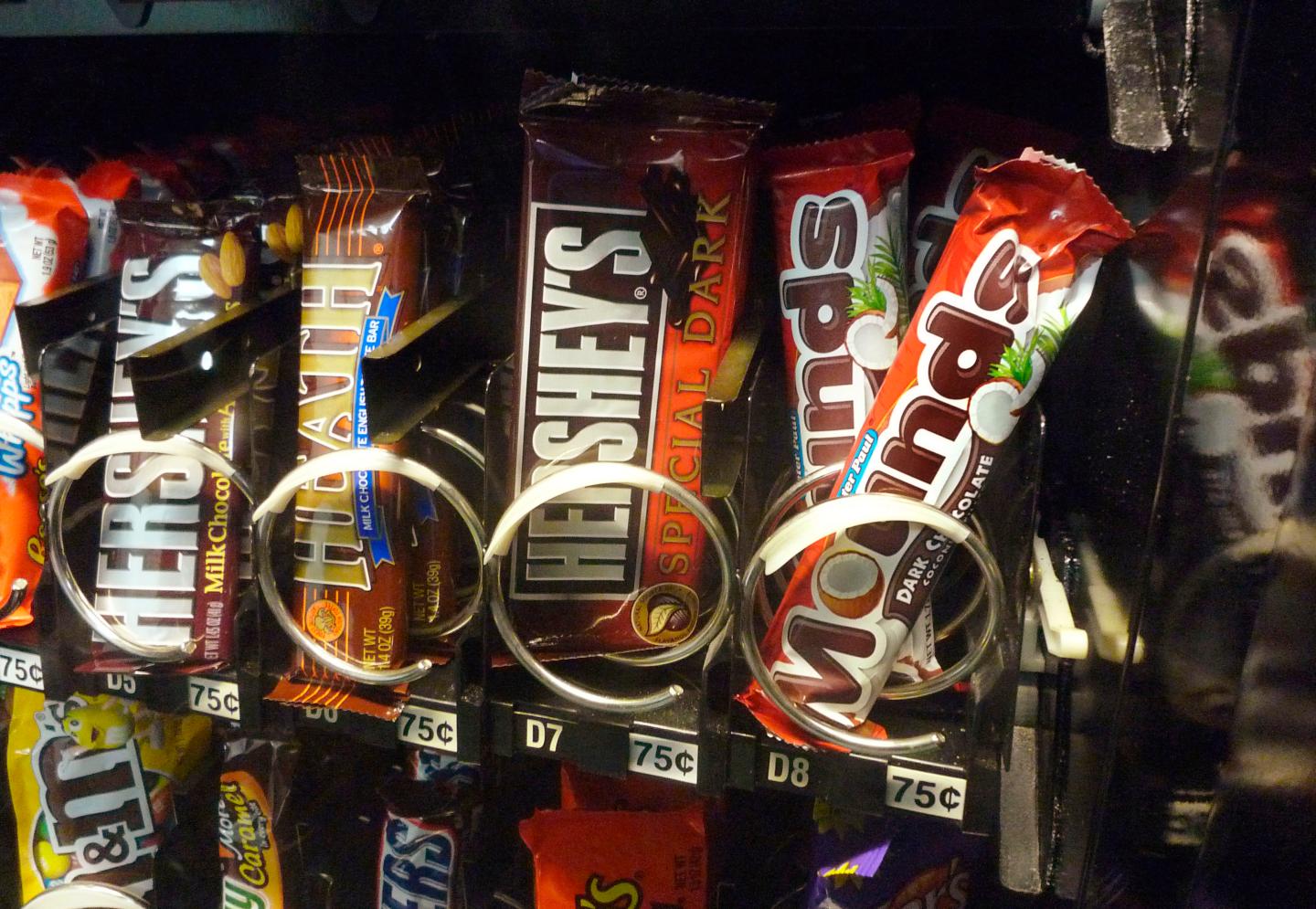
A row of candy bars manufactured by Hershey is seen in a vending machine in Washington
A row of candy bars manufactured by Hershey is seen in a vending machine in Washington June 17, 2008. Hershey cut its long-term earnings growth target on Tuesday and laid out a strategic plan to boost its biggest brands in the United States with more advertising and tighten development of new products. In unveiling the plan to analysts the largest U.S. chocolate company acknowledged that attempts to move into areas like cookies and snack bars hurt its mainstay products like Hershey bars and Reese's peanut butter cups. REUTERS/Jim Bourg (UNITED STATES) - RTX71KWJim Bourg / Reuters

Students are greeted these days with a barrage of marketing and advertising as they enter the school year. And there is no let-up. The ads are all over.

The US Government Accountability Office (GAO) found ads in corridors, on scoreboards and vending machines, and inserted in the curricula through supplementary educational materials. They were on school equipment (eg, uniforms, cups, water coolers, beverage cases, food display racks) and on school buses. Ads were also put out through school newspapers, yearbooks and the school radio stations.

What is the impact of such marketing on children?

Our book, Sold Out, details the results of our study of marketing and advertising to children in schools over the past 25 years.

We found that while schools often welcome them, marketing and advertising activities in schools threaten children’s psychological and physical well-being, as well as the integrity of their education.

What is sold the most to children?

Unhealthy food products are the most heavily marketed products in school.

In 2012, the Federal Trade Commission reported that 48 major food and beverage companies marketing to children in the US spent US$149 million on marketing to children in schools alone.

Soft-drink bottling companies, in particular, often enter into multi-year exclusive contractsthat bring product and branded vending machines, scoreboards, coolers and other paraphernalia into the schools.

A 2008 study found that the average high school in Montgomery County, Maryland, had 21 vending machines – each one both selling the product and functioning as a lit-up billboard.

Another 2012 study found advertising for soft drinks and other “foods of minimal nutritional value” in 85% of the high schools in Maine.
Younger students, in schools without vending machines, routinely receive free couponspromoting food products.

Numerous studies demonstrate that food marketing influences children’s food preferences, what young children ask their parents to buy for them and what older children buy for themselves.

Although no study ties any specific marketing campaign to poor health, it stands to reason that the more children are encouraged to eat foods that are unhealthy when consumed to excess, the more likely they are to suffer from metabolic syndrome, obesity and the host of illnesses associated with them.

Impact of marketing

In one way or another, all marketing promotes the idea that identity, fulfillment, self-expression and confidence are achieved through consumption.

When children are occupied with consumer-oriented activity (shopping, for example, or thinking about products or fantasizing about purchases), they simply have less time and brain-space for other pursuits, such as creative thinking and play, family and friends, artistic endeavors, or spiritual practices.

Materialistic values have been linked to higher rates of such psychological problems as anxiety, depression, psychological distress, chronic physical symptoms and lower self-esteem.

Marketing in schools can have other consequences as well. It can take up class time, contradict what children learn in their classes (particularly about proper nutrition) and create an environment that encourages them to uncritically accept sponsors’ points of view.

When children, for example, learn about “energy balance” from curricular materialsprovided by a food-industry-funded nonprofit organization, they are encouraged to accept the industry’s point of view that individuals are responsible for balancing their “calories in” and “calories out.”

Assumed in this point of view is that all food products are healthy in moderation; excluded is industry’s role in encouraging children to consume food products that are unhealthy when consumed to excess.

Why do schools allow marketing?

Given the threats posed by advertising and marketing in school, how is it possible that so many well-intentioned principals, district administrators and parent groups are eager to embrace it?

It is possible that these stakeholders are unaware of the threats posed through marketing. People tend to underestimate the extent to which they are influenced by marketing messages. Many reason that children are so exposed to marketing in other settings that adding it in a school setting won’t matter in any appreciable way.

Even if stakeholders are aware of the potential harm marketing can do to children, the immediate need for school funding often overwhelms their concerns.

States have been cutting funding to schools for quite some time now, and school districts across the nation are so fiscally stressed that they are ever more open to the enticements of corporate marketing campaigns, often soothingly billed as “school-business partnerships,” that promise to yield extra cash.

Parent groups, eager to provide needed resources for their children, also seek out corporate fundraising “partnerships.”

Who gains?

Studies examining financial benefit to schools find, however, that marketing actually brings schools negligible financial returns.

In a 2006 nationally representative study, we found that 67% of US schools engaged in marketing activities did not make any money at all from them. Another 19% of US schools made less than $5,000 over the course of the entire school year.

The self-interested commercial goals of corporations and the public interest goals of schools are in fundamental conflict.

Since corporations are legally mandated to prioritize profit to their shareholders over any other goal, by definition, their activities in schools must also serve that purpose.

Cash-strapped schools are a perfect resource for companies that recognize that students are a captive market of great value, a source of immediate business and/or a lifelong customer base.

If we’re honest about the real value and costs of marketing and advertising to children in school, we will find that corporations are the ones emerging as the big winners. Schools make little money even as the well-being of their students is threatened.

It is past time to declare schools ad-free zones.

This piece was originally published on The Conversation.The Conversation

About the Authors
By Faith Boninger
See full bioRight Arrow Button Icon
By Alex Molnar
See full bioRight Arrow Button Icon
By The Conversation
See full bioRight Arrow Button Icon

Latest in Retail

Finance
Lorem ipsum dolor sit amet, consectetur adipiscing elit, sed do eiusmod tempor incididunt ut labore et dolore magna aliqua. Ut enim ad minim veniam
By Fortune Editors
October 20, 2025
Finance
Lorem ipsum dolor sit amet, consectetur adipiscing elit, sed do eiusmod tempor incididunt ut labore et dolore magna aliqua. Ut enim ad minim veniam
By Fortune Editors
October 20, 2025
Finance
Lorem ipsum dolor sit amet, consectetur adipiscing elit, sed do eiusmod tempor incididunt ut labore et dolore magna aliqua. Ut enim ad minim veniam
By Fortune Editors
October 20, 2025
Finance
Lorem ipsum dolor sit amet, consectetur adipiscing elit, sed do eiusmod tempor incididunt ut labore et dolore magna aliqua. Ut enim ad minim veniam
By Fortune Editors
October 20, 2025
Finance
Lorem ipsum dolor sit amet, consectetur adipiscing elit, sed do eiusmod tempor incididunt ut labore et dolore magna aliqua. Ut enim ad minim veniam
By Fortune Editors
October 20, 2025
Finance
Lorem ipsum dolor sit amet, consectetur adipiscing elit, sed do eiusmod tempor incididunt ut labore et dolore magna aliqua. Ut enim ad minim veniam
By Fortune Editors
October 20, 2025

Most Popular

Finance
Lorem ipsum dolor sit amet, consectetur adipiscing elit, sed do eiusmod tempor incididunt ut labore et dolore magna aliqua. Ut enim ad minim veniam
By Fortune Editors
October 20, 2025
Finance
Lorem ipsum dolor sit amet, consectetur adipiscing elit, sed do eiusmod tempor incididunt ut labore et dolore magna aliqua. Ut enim ad minim veniam
By Fortune Editors
October 20, 2025
Finance
Lorem ipsum dolor sit amet, consectetur adipiscing elit, sed do eiusmod tempor incididunt ut labore et dolore magna aliqua. Ut enim ad minim veniam
By Fortune Editors
October 20, 2025
Finance
Lorem ipsum dolor sit amet, consectetur adipiscing elit, sed do eiusmod tempor incididunt ut labore et dolore magna aliqua. Ut enim ad minim veniam
By Fortune Editors
October 20, 2025
Finance
Lorem ipsum dolor sit amet, consectetur adipiscing elit, sed do eiusmod tempor incididunt ut labore et dolore magna aliqua. Ut enim ad minim veniam
By Fortune Editors
October 20, 2025
Finance
Lorem ipsum dolor sit amet, consectetur adipiscing elit, sed do eiusmod tempor incididunt ut labore et dolore magna aliqua. Ut enim ad minim veniam
By Fortune Editors
October 20, 2025
Fortune Secondary Logo
Rankings
  • 100 Best Companies
  • Fortune 500
  • Global 500
  • Fortune 500 Europe
  • Most Powerful Women
  • World's Most Admired Companies
  • See All Rankings
  • Lists Calendar
Sections
  • Finance
  • Fortune Crypto
  • Features
  • Leadership
  • Health
  • Commentary
  • Success
  • Retail
  • Mpw
  • Tech
  • Lifestyle
  • CEO Initiative
  • Asia
  • Politics
  • Conferences
  • Europe
  • Newsletters
  • Personal Finance
  • Environment
  • Magazine
  • Education
Customer Support
  • Frequently Asked Questions
  • Customer Service Portal
  • Privacy Policy
  • Terms Of Use
  • Single Issues For Purchase
  • International Print
Commercial Services
  • Advertising
  • Fortune Brand Studio
  • Fortune Analytics
  • Fortune Conferences
  • Business Development
  • Group Subscriptions
About Us
  • About Us
  • Press Center
  • Work At Fortune
  • Terms And Conditions
  • Site Map
  • About Us
  • Press Center
  • Work At Fortune
  • Terms And Conditions
  • Site Map
  • Facebook icon
  • Twitter icon
  • LinkedIn icon
  • Instagram icon
  • Pinterest icon

Latest in Retail

Tapestry thinks it’s cracked the code of ‘expressive luxury’ for Gen Z: a ‘Goldilocks’ combo of aspirational and approachable
Investingearnings
Tapestry thinks it’s cracked the code of ‘expressive luxury’ for Gen Z: a ‘Goldilocks’ combo of aspirational and approachable
By Nick LichtenbergMay 7, 2026
14 hours ago
eBay bans GameStop CEO’s account after he started listing store signs and old carpets to fund his $56 billion offer to buy the marketplace
C-SuiteGameStop
eBay bans GameStop CEO’s account after he started listing store signs and old carpets to fund his $56 billion offer to buy the marketplace
By Marco Quiroz-GutierrezMay 7, 2026
16 hours ago
‘Blue dot fever’ plagues musicians like Post Malone, Meghan Trainor, and Zayn as a growing list of artists cancel tours due to lagging ticket sales
Arts & EntertainmentMusic
‘Blue dot fever’ plagues musicians like Post Malone, Meghan Trainor, and Zayn as a growing list of artists cancel tours due to lagging ticket sales
By Dave Lozo and Morning BrewMay 7, 2026
16 hours ago
Two Americas, one drive-thru: Welcome to fast food’s contradictory, split-screen economy
EconomyMcDonald's
Two Americas, one drive-thru: Welcome to fast food’s contradictory, split-screen economy
By Nick LichtenbergMay 7, 2026
18 hours ago
people watching tv
Arts & EntertainmentGen Z
Gen Z just broke the streaming model: A majority subscribe, binge, and cancel over and over, study finds
By Jake AngeloMay 7, 2026
18 hours ago
mcdonald's logo
RetailMcDonald's
McDonald’s posts better-than-expected first quarter sales. But higher gas prices threaten demand
By The Associated Press and Dee-Ann DurbinMay 7, 2026
19 hours ago

Most Popular

U.S. Treasury will have to borrow $2 trillion this year just to continue functioning—more than $166 billion every month
Economy
U.S. Treasury will have to borrow $2 trillion this year just to continue functioning—more than $166 billion every month
By Eleanor PringleMay 7, 2026
1 day ago
California farmers must destroy 420,000 peach trees after Del Monte closes its canneries and cancels more than $550 million in long-term contracts
North America
California farmers must destroy 420,000 peach trees after Del Monte closes its canneries and cancels more than $550 million in long-term contracts
By Sasha RogelbergMay 7, 2026
15 hours ago
Tokyo is throwing out its strict office dress code and asking workers to wear shorts amid the war in Iran energy crisis
Success
Tokyo is throwing out its strict office dress code and asking workers to wear shorts amid the war in Iran energy crisis
By Emma BurleighMay 5, 2026
3 days ago
A Michigan farm town voted down plans for a giant OpenAI-Oracle data center. Weeks later, construction began
Magazine
A Michigan farm town voted down plans for a giant OpenAI-Oracle data center. Weeks later, construction began
By Sharon GoldmanMay 6, 2026
2 days ago
Current price of oil as of May 7, 2026
Personal Finance
Current price of oil as of May 7, 2026
By Joseph HostetlerMay 7, 2026
22 hours ago
The IRS may owe COVID-era refunds to tens of millions of taxpayers. Here’s who could qualify
Personal Finance
The IRS may owe COVID-era refunds to tens of millions of taxpayers. Here’s who could qualify
By Sydney LakeMay 6, 2026
2 days ago

© 2026 Fortune Media IP Limited. All Rights Reserved. Use of this site constitutes acceptance of our Terms of Use and Privacy Policy | CA Notice at Collection and Privacy Notice | Do Not Sell/Share My Personal Information
FORTUNE is a trademark of Fortune Media IP Limited, registered in the U.S. and other countries. FORTUNE may receive compensation for some links to products and services on this website. Offers may be subject to change without notice.