• Home
  • Latest
  • Fortune 500
  • Finance
  • Tech
  • Leadership
  • Lifestyle
  • Rankings
  • Multimedia
Finance

American companies are in a profits recession: You can blame King Dollar

By
Chris Matthews
Chris Matthews
Down Arrow Button Icon
By
Chris Matthews
Chris Matthews
Down Arrow Button Icon
October 26, 2015, 3:11 PM ET
Risk Illustrations
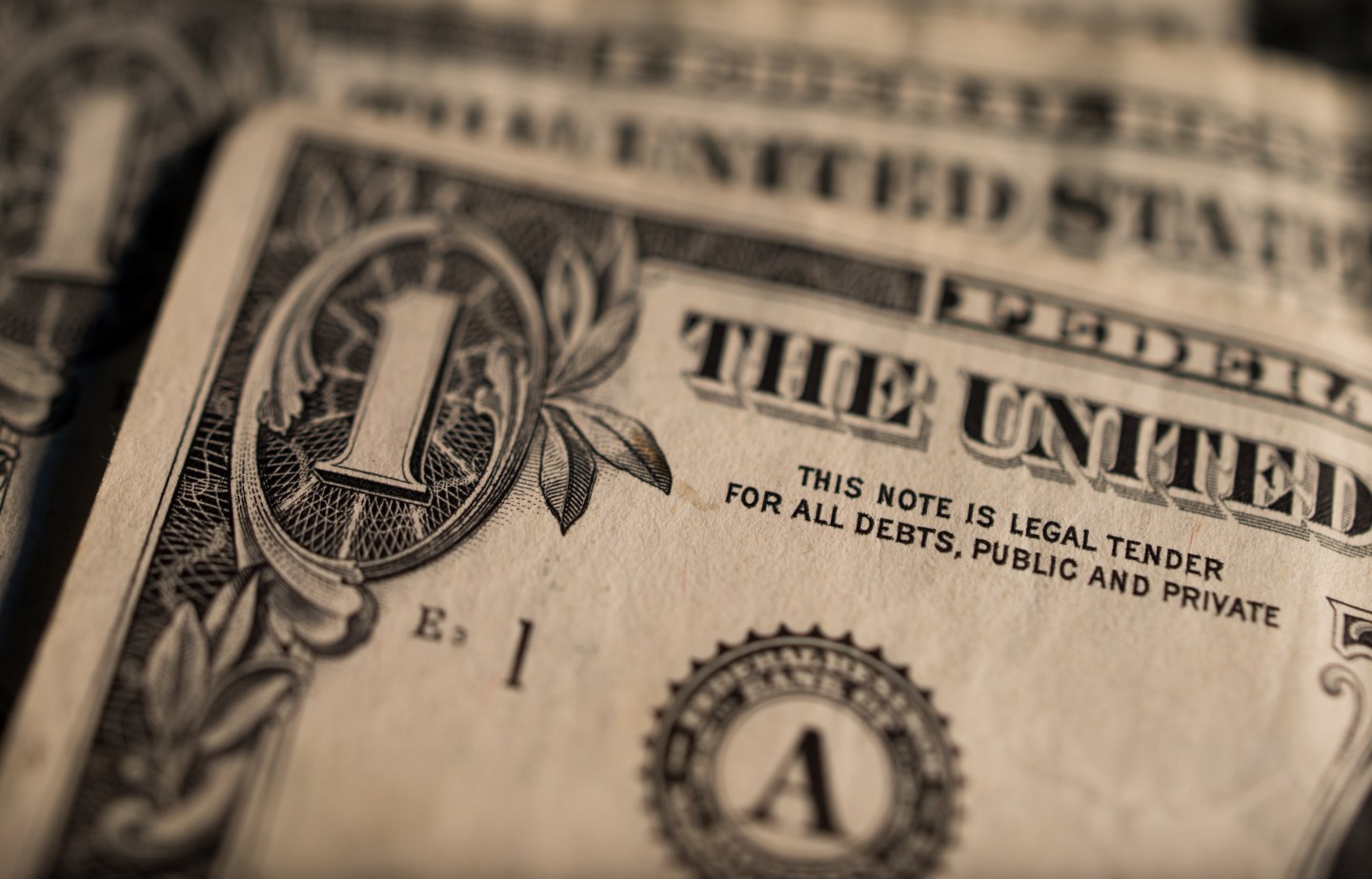
U.S. one dollar bills are arranged for a photograph to illustrate the theme of risk in Oradell, New Jersey, U.S., on Thursday, June 18, 2015. Photographer: Ron Antonelli/Bloomberg via Getty ImagesPhotograph by Ron Antonelli — Bloomberg via Getty Images

The U.S. economy is in the midst of a recession. Well, a profits recession, at least.

The consensus for Q3 earnings per share is down 2.8% from the third quarter of last year, and that’s following a 10.9% year-over-year decline in aggregate S&P 500 earnings in the second quarter. That’s the first earnings recession we’ve had since 2009, when the economy was just recovering from the worst of the financial crisis.

Some of America’s biggest industrial powerhouses are feeling the pain. On Monday, the Wall Street Journal pointed out that firms like Caterpillar (CAT), Kimberly Clark (KMB), and Johnson & Johnson (JNJ) are contributing to the current earnings contraction. “The industrial environment’s in a recession. I don’t care what anybody says,” Daniel Florness, chief financial officer of Fastenal Co., (FAST) said in an earnings call earlier this month.

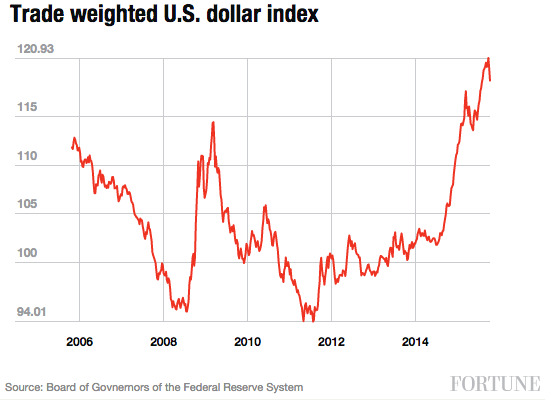
These companies are suffering from the recent, sharp run-up in the dollar, which shrinks dollar-denominated earnings from sales abroad. S&P 500 companies are also struggling with the collapse in oil prices. Because a large chunk of S&P 500 companies are linked to the energy sector, this trend hits big business harder than it does the broader economy.
trade-weighted-dollar


On a positive note, earnings recessions brought on by a weak dollar and slumping oil prices haven’t generally triggered recessions in the broader economy. Jim O’Sullivan of High Frequency Economics argues that a good point of comparison is the 1998 profits recession:

Back then global growth and and exports weakened significantly, oil and other commodity prices prices fell sharply and the dollar surged, yet overall growth remained solid.

As the effects of a stronger dollar and weak oil dissipate, so should sluggish profits growth. But what if the strong dollar and cheap oil are here to stay?

There is a growing consensus among economists that a global financial system based on the dollar is not an “exorbitant privilege” for the U.S. as was once thought, but a burden on an economy that has bled jobs in labor intensive industries for more than a generation. These economists argue that the massive demand for dollar-denominated assets from foreign multinationals and central banks has created an artificially strong dollar and has hamstrung American exporters.

Sure, the dollar’s rise has pulled back a bit lately, as markets question whether the Federal Reserve really will raise interest rates this year. But with the U.S. economy the only bright spot in a world of slowing growth, and central banks in Europe, Japan, and China loosening their monetary policy, there’s plenty of reason to believe that the dollar will remain pricey for years to come, even if the Fed refrains from hiking rates.

This overvaluing of the the U.S. dollar relative to the Euro, yen, and Chinese yuan has led to a huge trade deficit and was one of the drivers of the global financial crisis, as foreign savers piled into overvalued, “safe” dollar-denominated assets, like U.S. mortgage debt. Though global regulators have made strides in making the international banking system safer, the fundamental drivers of global trade imbalances have been largely ignored.

This fact has led some economists to question whether we need another Plaza Accord to bring stability to global trade. The Plaza Accord is shorthand for a series of agreements signed between 1985 and 1986 by the five major economies at the time: the United States, West Germany, France, Japan, and the United Kingdom. It committed these five powers to work to bring down the value of the U.S. dollar and reduce the American trade deficit.

As economist C. Fred Bergsten of the Rice Institute points out, the trade deficit today is as large as it was back in 1985 in terms of GDP, and the Plaza Accord helped the United States eliminate its trade deficit within the decade, before it began to rise again. This suggests to Bergsten that another Plaza Accord would be wise 30 years later.

Of course, the global economy is in a much different place than it was in the mid-1980s. Political support for implementing protectionist policies was much greater in the U.S. at that time, with a labor-backed Democratic Congress demanding relief from American deindustrialization. This motivated exporters like West Germany and Japan to come to the negotiating table lest the U.S. take unilateral action to get its trade deficit under control.

At the same time, global trade imbalance led by an over-reliance on the the U.S. dollar was a primary cause of the financial crisis, and now we can see such imbalances hurting U.S. companies during this recovery. Whether it’s another Plaza Accord, the creation of a new international reserve currency, or the beefing up of international organizations like the IMF to relieve the need for emerging markets to hoard dollar assets, something must be done to ease pressure on the U.S. dollar as the sole lubricant for global commerce.

About the Author
By Chris Matthews
See full bioRight Arrow Button Icon

Latest in Finance

Finance
Lorem ipsum dolor sit amet, consectetur adipiscing elit, sed do eiusmod tempor incididunt ut labore et dolore magna aliqua. Ut enim ad minim veniam
By Fortune Editors
October 20, 2025
Finance
Lorem ipsum dolor sit amet, consectetur adipiscing elit, sed do eiusmod tempor incididunt ut labore et dolore magna aliqua. Ut enim ad minim veniam
By Fortune Editors
October 20, 2025
Finance
Lorem ipsum dolor sit amet, consectetur adipiscing elit, sed do eiusmod tempor incididunt ut labore et dolore magna aliqua. Ut enim ad minim veniam
By Fortune Editors
October 20, 2025
Finance
Lorem ipsum dolor sit amet, consectetur adipiscing elit, sed do eiusmod tempor incididunt ut labore et dolore magna aliqua. Ut enim ad minim veniam
By Fortune Editors
October 20, 2025
Finance
Lorem ipsum dolor sit amet, consectetur adipiscing elit, sed do eiusmod tempor incididunt ut labore et dolore magna aliqua. Ut enim ad minim veniam
By Fortune Editors
October 20, 2025
Finance
Lorem ipsum dolor sit amet, consectetur adipiscing elit, sed do eiusmod tempor incididunt ut labore et dolore magna aliqua. Ut enim ad minim veniam
By Fortune Editors
October 20, 2025

Most Popular

Finance
Lorem ipsum dolor sit amet, consectetur adipiscing elit, sed do eiusmod tempor incididunt ut labore et dolore magna aliqua. Ut enim ad minim veniam
By Fortune Editors
October 20, 2025
Finance
Lorem ipsum dolor sit amet, consectetur adipiscing elit, sed do eiusmod tempor incididunt ut labore et dolore magna aliqua. Ut enim ad minim veniam
By Fortune Editors
October 20, 2025
Finance
Lorem ipsum dolor sit amet, consectetur adipiscing elit, sed do eiusmod tempor incididunt ut labore et dolore magna aliqua. Ut enim ad minim veniam
By Fortune Editors
October 20, 2025
Finance
Lorem ipsum dolor sit amet, consectetur adipiscing elit, sed do eiusmod tempor incididunt ut labore et dolore magna aliqua. Ut enim ad minim veniam
By Fortune Editors
October 20, 2025
Finance
Lorem ipsum dolor sit amet, consectetur adipiscing elit, sed do eiusmod tempor incididunt ut labore et dolore magna aliqua. Ut enim ad minim veniam
By Fortune Editors
October 20, 2025
Finance
Lorem ipsum dolor sit amet, consectetur adipiscing elit, sed do eiusmod tempor incididunt ut labore et dolore magna aliqua. Ut enim ad minim veniam
By Fortune Editors
October 20, 2025
Fortune Secondary Logo
Rankings
  • 100 Best Companies
  • Fortune 500
  • Global 500
  • Fortune 500 Europe
  • Most Powerful Women
  • Future 50
  • World’s Most Admired Companies
  • See All Rankings
Sections
  • Finance
  • Fortune Crypto
  • Features
  • Leadership
  • Health
  • Commentary
  • Success
  • Retail
  • Mpw
  • Tech
  • Lifestyle
  • CEO Initiative
  • Asia
  • Politics
  • Conferences
  • Europe
  • Newsletters
  • Personal Finance
  • Environment
  • Magazine
  • Education
Customer Support
  • Frequently Asked Questions
  • Customer Service Portal
  • Privacy Policy
  • Terms Of Use
  • Single Issues For Purchase
  • International Print
Commercial Services
  • Advertising
  • Fortune Brand Studio
  • Fortune Analytics
  • Fortune Conferences
  • Business Development
  • Group Subscriptions
About Us
  • About Us
  • Editorial Calendar
  • Press Center
  • Work At Fortune
  • Diversity And Inclusion
  • Terms And Conditions
  • Site Map
  • About Us
  • Editorial Calendar
  • Press Center
  • Work At Fortune
  • Diversity And Inclusion
  • Terms And Conditions
  • Site Map
  • Facebook icon
  • Twitter icon
  • LinkedIn icon
  • Instagram icon
  • Pinterest icon

Latest in Finance

hormuz
EnergyMiddle East
Trump’s big accomplishment in Iran is ‘de facto ‘toll booth’ regime’ in the Strait of Hormuz, shipping analyst says
By David McHugh, Jon Gambrell and The Associated PressMarch 27, 2026
1 hour ago
trump
PoliticsWhite House
Trump breaks with tradition, removing Treasury Secretary’s name with his own on the dollar
By Fatima Hussein and The Associated PressMarch 27, 2026
1 hour ago
Maya MacGuineas, center, Committee for Responsible Federal Budget.
Economydebt crisis
‘There is no silver lining in this trajectory’: Budget watchdog warns of financial, inflation, or currency crisis due to $39 trillion U.S. debt
By Eleanor PringleMarch 27, 2026
2 hours ago
NewslettersTerm Sheet
VC firms rarely reinvent themselves. Kleiner Perkins did—and has a new $3.5 billion to show for it
By Allie GarfinkleMarch 27, 2026
2 hours ago
Abstract business graph of AI growth. market growth, analysis, and future projections.
NewslettersCFO Daily
Why CFOs—not chief AI officers—are the secret to getting real value from AI
By Sheryl EstradaMarch 27, 2026
2 hours ago
Big TechMarkets
Anthropic accidentally leaked details of a new AI model that poses unprecedented cybersecurity risks
By Jim EdwardsMarch 27, 2026
2 hours ago

Most Popular

C-Suite
'I didn’t want anybody shooting me': Five Guys CEO gave away $1.5 million bonus to employees over botched BOGO burger birthday celebration
By Fortune EditorsMarch 25, 2026
2 days ago
Environment
Vail Resorts CEO says it’s time to think beyond the $1,000 ski pass that helped build the empire
By Fortune EditorsMarch 26, 2026
1 day ago
Success
Palantir’s billionaire CEO says only two kinds of people will succeed in the AI era: trade workers — ‘or you’re neurodivergent’
By Fortune EditorsMarch 24, 2026
3 days ago
Commentary
The Treasury just declared the U.S. insolvent. The media missed it
By Fortune EditorsMarch 23, 2026
4 days ago
Economy
Social Security insolvency: How a six-figure cap to flatten benefits for the ultrawealthy could buy the program 7 critical years
By Fortune EditorsMarch 26, 2026
1 day ago
Personal Finance
Current price of gold as of March 25, 2026
By Fortune EditorsMarch 25, 2026
2 days ago

© 2026 Fortune Media IP Limited. All Rights Reserved. Use of this site constitutes acceptance of our Terms of Use and Privacy Policy | CA Notice at Collection and Privacy Notice | Do Not Sell/Share My Personal Information
FORTUNE is a trademark of Fortune Media IP Limited, registered in the U.S. and other countries. FORTUNE may receive compensation for some links to products and services on this website. Offers may be subject to change without notice.