• Home
  • Latest
  • Fortune 500
  • Finance
  • Tech
  • Leadership
  • Lifestyle
  • Rankings
  • Multimedia
FinanceFederal Reserve

Ben Bernanke sees the upside of negative rates

By
Chris Matthews
Chris Matthews
Down Arrow Button Icon
By
Chris Matthews
Chris Matthews
Down Arrow Button Icon
October 21, 2015, 2:48 PM ET
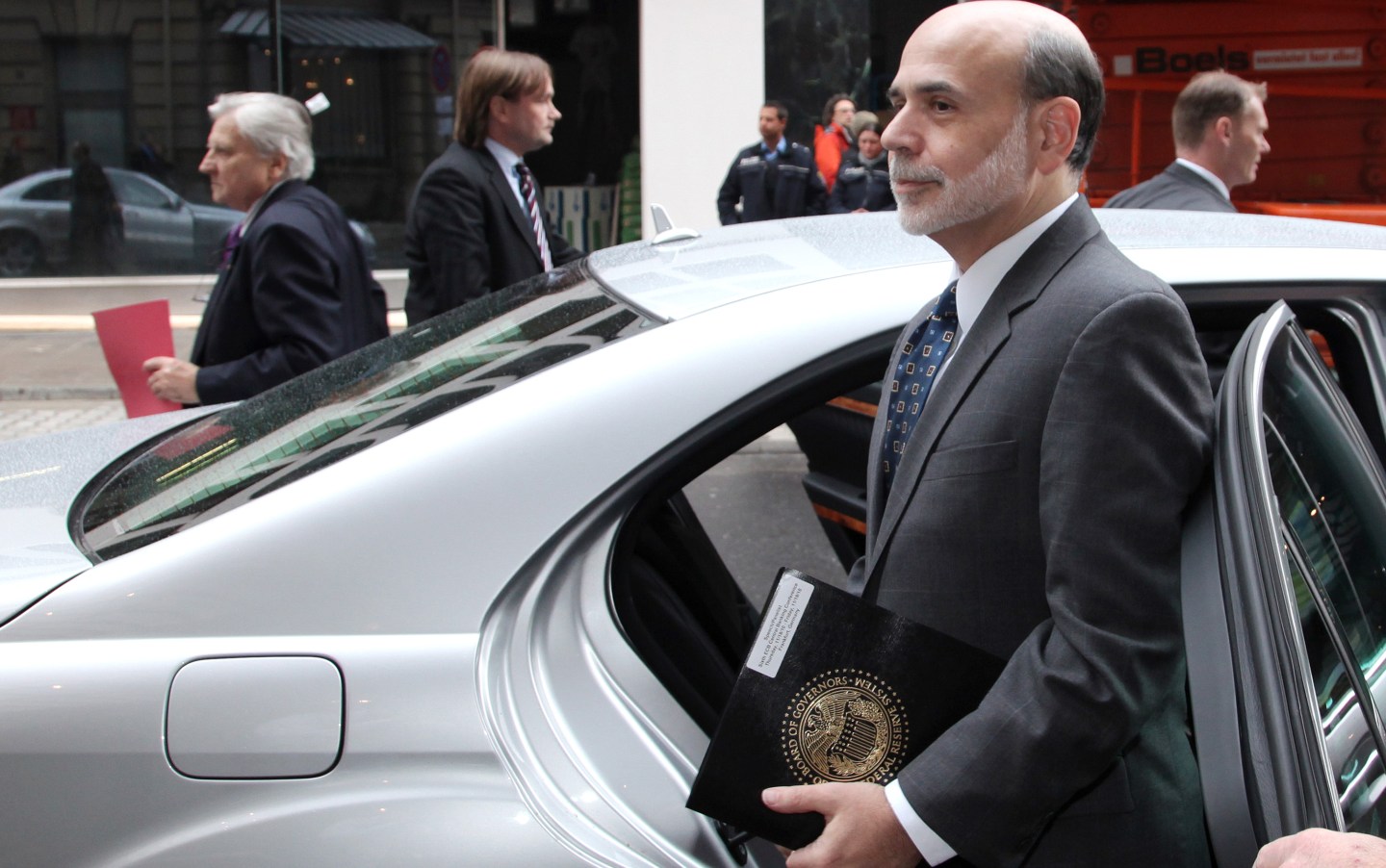
Former Federal Reserve Chairman Ben Bernanke
Former Federal Reserve Chairman Ben BernankePhotograph by Hannelore Foerster — Bloomberg via Getty Images

While the financial world awaits the Federal Reserve’s decision on whether or not to raise interest rates before year’s end, another, perhaps more serious question central bankers are focused on is, What should the Fed do when the next recession comes?

Don’t worry—economists don’t expect another major downturn anytime soon. But even if we don’t see a contraction until 2018, the central bank expects the federal funds rate to only reach 2.6% at the beginning of that year. (It’s been hovering around near-zero since 2008.) And given the fact that the Fed has consistently overestimated economic growth, inflation, and its own ability to raise rates, one could be forgiven for being skeptical that interest rates will even get that high.

And this is what has many economists worried, because historically following recessions, the Fed has had to cut rates much more than just 2.6% to get the economy going again, leaving many worried that the central bank will be out of ammunition to fight the next downturn.

Former Fed Chair Ben Bernanke might have a solution: negative interest rates. In a discussion with Politico’s Ben White at Nasdaq MarketSite on Wednesday morning, Bernanke floated the possibility that the central bank could resort to dropping rates below zero for the first time in history. While the second line of attack against a recession—after reducing interest rates to zero—should be fiscal stimulus, he argued, stimulus is a policy that would not likely receive support from Congress. “If you don’t get that and you get a significant slowdown that requires response, there are things the Fed can do, but none of them are incredibly attractive,” he said.


One of those things is setting interest rates below zero. Economists once believed that a main flaw of using monetary policy to stimulate the economy out of a recession is that rates can’t go below zero, even if the theoretical “market-clearing rate” that gets economy growing again is a negative number. After all, if you start charging people to save money, the thinking goes, people will just start storing cash under their mattresses. But as Bernanke said this morning, “Europe has demonstrated that negative rates are possible.”

Bernanke was referring to recent trials by central banks in Europe, including the European Central Bank, the Bank of Switzerland, and the Danish National Bank, which have all experimented with setting interest rates below what was once thought to be the zero “lower bound.” The Danes have held their overnight rates at negative 0.75% since around 2012, but the effects on the economy have been mixed. According to a recent report in Bloomberg:

Danes have actually been squirreling [money] away. According to central bank data, Danish households’ have added 28 billion kroner ($4.3 billion) to bank deposits since rates shrank to their record low on Feb. 5.

Danish businesses, meanwhile, have barely increased their investments, adding less than 6 percent in the 12 quarters since Denmark’s policy rate turned negative for the first time. At a growth rate of 5 percent over the period, private consumption has been similarly muted.

In other words, negative rates haven’t been the cure-all that some economists had hoped. Then again, 75 basis points below zero isn’t exactly a huge move below where U.S. policy is right now. And banks have been reluctant to pass on the penalties they’ve been paying for keeping their cash parked at the central bank on to consumers and business, although this might be slowly changing.

To engineer interest rates significantly below the rates we’re now seeing, we’d have to change our relationship to paper money. As it stands now, the government guarantees that the nominal return on paper money is at least zero. But if the laws were changed so that paper money was not required to be accepted for “all debts public and private,” and the central bank was allowed to dictate new values of paper money, the Fed could engineer significantly negative interest rates. For instance, if the central bank were able to declare that a person depositing $100 in cash could only be credited $98 when he deposited that money, that would in effect be the same as setting short-term interest rates at negative 2%.

University of Michigan economist Miles Kimball thinks that if governments had the ability to engineer significantly negative interest rates following the recovery, say around negative 4% or more, it would “would have brought robust recovery by the end of 2009.”

These however, are changes that would have to be initiated by Congress and not just the Federal Reserve. But with such figures as Ben Bernanke arguing that the Fed could set rates at least somewhat below zero, it’s not out of the realm of possibility that American consumers and businesses could be charged to save money in the near future.

About the Author
By Chris Matthews
See full bioRight Arrow Button Icon

Latest in Finance

Finance
Lorem ipsum dolor sit amet, consectetur adipiscing elit, sed do eiusmod tempor incididunt ut labore et dolore magna aliqua. Ut enim ad minim veniam
By Fortune Editors
October 20, 2025
Finance
Lorem ipsum dolor sit amet, consectetur adipiscing elit, sed do eiusmod tempor incididunt ut labore et dolore magna aliqua. Ut enim ad minim veniam
By Fortune Editors
October 20, 2025
Finance
Lorem ipsum dolor sit amet, consectetur adipiscing elit, sed do eiusmod tempor incididunt ut labore et dolore magna aliqua. Ut enim ad minim veniam
By Fortune Editors
October 20, 2025
Finance
Lorem ipsum dolor sit amet, consectetur adipiscing elit, sed do eiusmod tempor incididunt ut labore et dolore magna aliqua. Ut enim ad minim veniam
By Fortune Editors
October 20, 2025
Finance
Lorem ipsum dolor sit amet, consectetur adipiscing elit, sed do eiusmod tempor incididunt ut labore et dolore magna aliqua. Ut enim ad minim veniam
By Fortune Editors
October 20, 2025
Finance
Lorem ipsum dolor sit amet, consectetur adipiscing elit, sed do eiusmod tempor incididunt ut labore et dolore magna aliqua. Ut enim ad minim veniam
By Fortune Editors
October 20, 2025

Most Popular

Finance
Lorem ipsum dolor sit amet, consectetur adipiscing elit, sed do eiusmod tempor incididunt ut labore et dolore magna aliqua. Ut enim ad minim veniam
By Fortune Editors
October 20, 2025
Finance
Lorem ipsum dolor sit amet, consectetur adipiscing elit, sed do eiusmod tempor incididunt ut labore et dolore magna aliqua. Ut enim ad minim veniam
By Fortune Editors
October 20, 2025
Finance
Lorem ipsum dolor sit amet, consectetur adipiscing elit, sed do eiusmod tempor incididunt ut labore et dolore magna aliqua. Ut enim ad minim veniam
By Fortune Editors
October 20, 2025
Finance
Lorem ipsum dolor sit amet, consectetur adipiscing elit, sed do eiusmod tempor incididunt ut labore et dolore magna aliqua. Ut enim ad minim veniam
By Fortune Editors
October 20, 2025
Finance
Lorem ipsum dolor sit amet, consectetur adipiscing elit, sed do eiusmod tempor incididunt ut labore et dolore magna aliqua. Ut enim ad minim veniam
By Fortune Editors
October 20, 2025
Finance
Lorem ipsum dolor sit amet, consectetur adipiscing elit, sed do eiusmod tempor incididunt ut labore et dolore magna aliqua. Ut enim ad minim veniam
By Fortune Editors
October 20, 2025
Fortune Secondary Logo
Rankings
  • 100 Best Companies
  • Fortune 500
  • Global 500
  • Fortune 500 Europe
  • Most Powerful Women
  • Future 50
  • World’s Most Admired Companies
  • See All Rankings
Sections
  • Finance
  • Fortune Crypto
  • Features
  • Leadership
  • Health
  • Commentary
  • Success
  • Retail
  • Mpw
  • Tech
  • Lifestyle
  • CEO Initiative
  • Asia
  • Politics
  • Conferences
  • Europe
  • Newsletters
  • Personal Finance
  • Environment
  • Magazine
  • Education
Customer Support
  • Frequently Asked Questions
  • Customer Service Portal
  • Privacy Policy
  • Terms Of Use
  • Single Issues For Purchase
  • International Print
Commercial Services
  • Advertising
  • Fortune Brand Studio
  • Fortune Analytics
  • Fortune Conferences
  • Business Development
  • Group Subscriptions
About Us
  • About Us
  • Editorial Calendar
  • Press Center
  • Work At Fortune
  • Diversity And Inclusion
  • Terms And Conditions
  • Site Map
  • About Us
  • Editorial Calendar
  • Press Center
  • Work At Fortune
  • Diversity And Inclusion
  • Terms And Conditions
  • Site Map
  • Facebook icon
  • Twitter icon
  • LinkedIn icon
  • Instagram icon
  • Pinterest icon

Latest in Finance

Personal FinanceGold
How to sell gold and silver: Tax implications and what you should know
By Joseph HostetlerMarch 25, 2026
5 hours ago
iran
Middle EastMiddle East
‘We do not plan on any negotiations’: Iran laughs at White House’s claims of cease-fire talks
By Jon Gambrell, Mike Corder, Munir Ahmed, Aamer Madhani and The Associated PressMarch 25, 2026
5 hours ago
bernie
AICongress
Bernie Sanders and AOC launch bill to ban new data-center construction
By Matthew Daly and The Associated PressMarch 25, 2026
6 hours ago
EconomyHiring
‘Don’t leave’: the remote work guru who nailed the labor market during the Great Resignation offers job advice for 2026
By Marco Quiroz-GutierrezMarch 25, 2026
7 hours ago
Jack Fusco, chief executive officer of Cheniere Energy, at the CERAWeek by S&P Global conference in Houston.
Energyliquified natural gas
U.S. natural gas exporters literally answer Asia’s calls for ‘help’ from the Iran war, but aid can’t come overnight
By Jordan BlumMarch 25, 2026
7 hours ago
BankingSoFi
A notorious short-seller unloaded on SoFi. The stock shrugged it off
By Jeff John RobertsMarch 25, 2026
7 hours ago

Most Popular

Magazine
The youngest-ever female CEO of a Fortune 500 company is fighting Trump's cuts to keep Medicaid strong
By Fortune EditorsMarch 24, 2026
2 days ago
Commentary
The Treasury just declared the U.S. insolvent. The media missed it
By Fortune EditorsMarch 23, 2026
2 days ago
Success
Palantir’s billionaire CEO says only two kinds of people will succeed in the AI era: trade workers — ‘or you’re neurodivergent’
By Fortune EditorsMarch 24, 2026
1 day ago
Success
The job market is so bad that ‘reverse recruiters’ are charging $1,500 a month just to help people look for jobs
By Fortune EditorsMarch 25, 2026
18 hours ago
Energy
Nobel laureate Paul Krugman calls it 'treason': $580 million in suspicious oil futures traded minutes before Trump's Iran reversal
By Fortune EditorsMarch 24, 2026
1 day ago
Success
JPMorgan has started monitoring the keystrokes, video calls, and meetings of its junior investment bankers—and they say it's for employee well-being
By Fortune EditorsMarch 24, 2026
1 day ago

© 2026 Fortune Media IP Limited. All Rights Reserved. Use of this site constitutes acceptance of our Terms of Use and Privacy Policy | CA Notice at Collection and Privacy Notice | Do Not Sell/Share My Personal Information
FORTUNE is a trademark of Fortune Media IP Limited, registered in the U.S. and other countries. FORTUNE may receive compensation for some links to products and services on this website. Offers may be subject to change without notice.