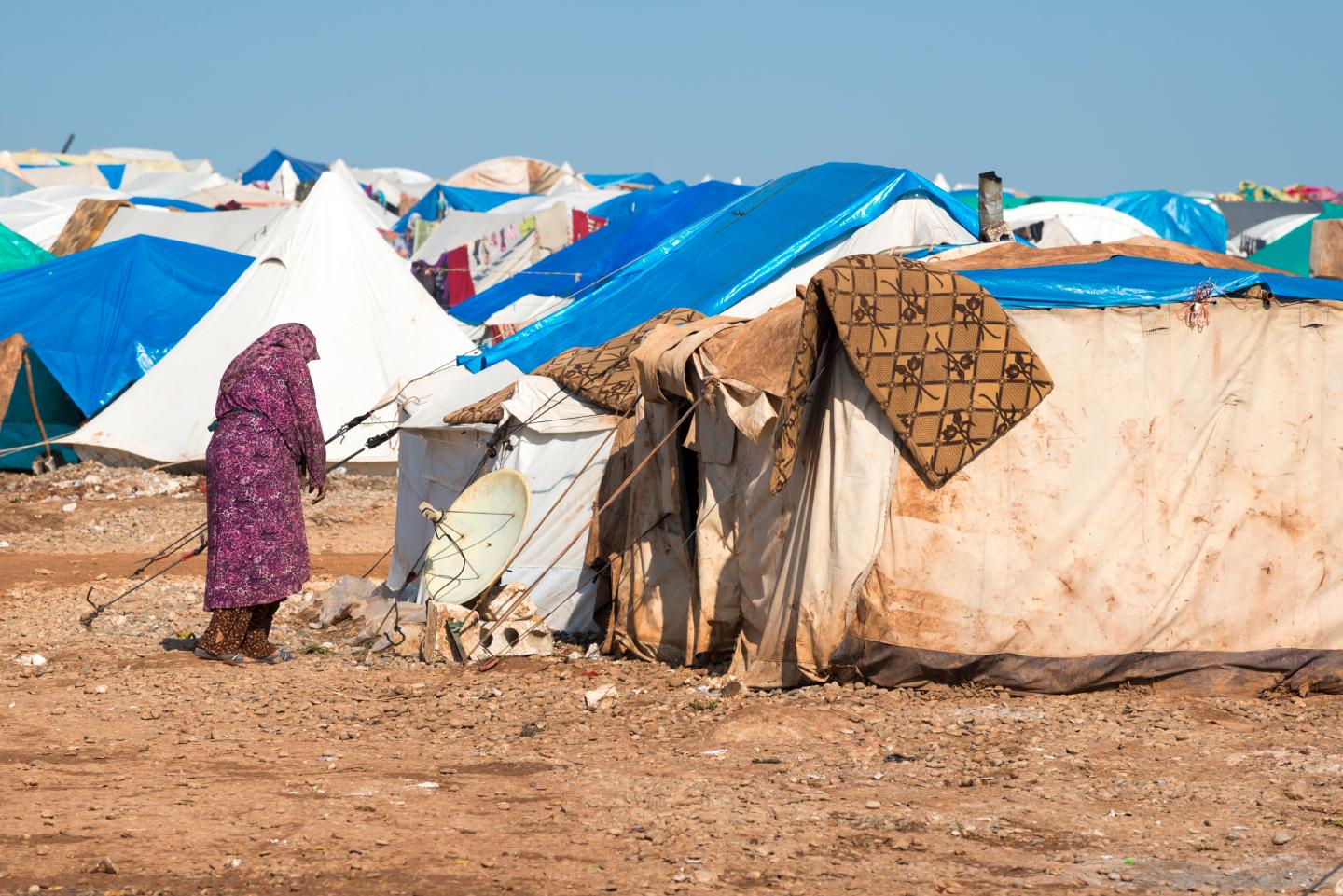
Afghan, Syrian and Eritrean refugees keep arriving on Europe’s shores, reputedly at an increasing rate. They attempt to traverse the Mediterranean by land and sea, presumably hastened by Putin’s bombing campaign. Now some even arrive by traveling across the Arctic.
So how does the proposed American response to this crisis compare to that of European countries? And how surprised should we be by the U.S.’ relatively paltry effort?
Two remarkable responses
Sweden’s response has been remarkable.
The Swedes’ longstanding “open door” policy means that they have now accepted the largest number of refugees per capita of any European country. One hundred and fifty thousand asylum seekers are expected to arrive there this year. Not surprisingly, it has been the preferred destination of many seeking asylum for quite some time.
Germany, of course, has accepted the largest total number of refugees. The estimated numbers could reach 2 million over the next two years at a cost of 25 billion Euros.
Yet Angela Merkel, Germany’s chancellor, has remained resolute. She has ruled out imposing a freeze on the numbers, even as the refugees keep arriving every day by the thousands. And despite growing right-wing domestic criticism, “We will manage,” declared Merkel. “I am quite strongly convinced of that.”
Members of other European countries, of course, like the Hungarians and Czechs, remain stubbornly opposed.
Even those generally in favor of accepting refugees, like the French, have become noticeably nervous as the estimated numbers grow, seeking “European-wide” solutions instead of just taking unilateral action. The UK’s nominal acceptance of 20,000 refugees over five years has drawn derision from 300 of its own former judges and lawyers.
How’s America doing?
By comparison, however, the American response can generously be described as anemic.
The U.S. has taken in about 1,600 Syrians since 2011. Last month, John Kerry announced that the U.S. would raise its annual ceiling of refugees and asylum seekers to include 10,000 more Syrians next year.
Kerry claimed the move would be “in keeping with America’s best tradition as a land of second chances and a beacon of hope.” But nowadays 10,000 refugees is just a busy day in Bavaria. If it took in the same proportion as the Germans or Swedes over the next two years, America would now be accepting nearer 10 million refugees, not 10,000.
It is important to put Kerry’s proposed paltry figure in some perspective.
Since the early days of the Cold War, the United States characteristically has had one of the more generous asylum policies in the world. It routinely accepts approximately 70,000 refugees a year from around the world – until very recently far more than any other country. And Kerry did note that the total figure would be increased to 85,000 in 2016 and 100,000 in 2017. But even this plan obscures a series of issues.
First of all, the total numbers of refugees the U.S. intends to accept — assuming that the next president even abides by this plan — obviously makes no serious contribution to the overall problem at all.
Second, as columnist Josh Rogin wrote in a recent piece in Bloomberg:
“The problem with the plan, no matter how quickly adopted, is how long it will take to have any effect. Migrants applying for refugee asylum in the United States now will not have their applications considered until at least 2017 because of a long backlog. And once an application begins to be considered, the asylum seekers can face a further 18 to 24 months before they are granted or denied asylum.”
So next year’s proposed 10,000-person increase would come almost exclusively from the backlog of Syrians who have already applied. It would not help the people who are fleeing now. Arguably, exceptional times call for exceptional measures.
Americans like to pride themselves on their humanity and generosity. And there are groups in the U.S. calling for a more generous response. Notably HIAS — the prominent American Jewish organization focused on Jewish refugee resettlement since 1881 — has been outspoken in supporting the mass resettlement of Syrians in the U.S. in far greater numbers.
Furthermore, there is the issue of responsibility: After all, a good argument can be made that America’s two wars in Iraq over the last decade have significantly contributed to the regional instability that bought about this crisis. The U.S. owes the Syrian refugees far more than the Germans or Swedes.
So why, faced with such a humanitarian crisis, the refusal to drastically increase these numbers and act more quickly to process applications?
It’s national security, stupid
The answer, of course, is political — and tied to perennial American concerns about national security.
Republicans have been particularly vocal in arguing that accepting refugees poses a potentially serious security threat, as Jihadists could embed themselves in the refugee population arriving in the U.S. Both America’s right-wing press and the conservative blogosphere have exploded with anger at the prospect of what they regard as President Obama’s disregard for the counterterrorism legislation.
It’s easy to conclude that these are exceptional times and they require exceptional diligence. But this national security syndrome when it comes to refugees and migrants is nothing new.
America has an unenviable historical record when it comes to barring immigrants or refugees from entry to the U.S., or denying them of their rights once they have settled, in the name of national security.
The list of nationalities, ethnic groups and religions that have been barred or denied their constitutional rights is long and shameful. Some advocates of exclusion are also quite surprising.
The historical record
National security and nationality? Benjamin Franklin once suggested that German immigrants were unable to subscribe to American values and republican political principles. Franklin worried that German immigrants would overwhelm America and change its most basic virtues, possibly bringing an end to the fledgling republic. “Not being used to Liberty,” Franklin wrote, “they know not how to make a modest use of it.”
National security and religion? Many thought that Republican candidate Ben Carson’s comments about a Muslim being unsuitable for the position of president because they might follow Sharia law was novel. But the Alien and Sedition Act signed by John Adams in 1798 authorized the president to imprison or deport aliens considered “dangerous to the peace and safety of the United States.” The legislation did not specifically single out any group. But it did in fact, herald a nativist crusade that focused on Irish immigrants and Catholics more generally.
That crusade was epitomized by Samuel FB Morse, more famous for inventing Morse Code and developing the telegraph. He once wrote, “It is a fact that popery is opposed in its very nature to democratic republicanism; and it is, therefore, as a political system, as well as religious, opposed to civil and religious liberty, and consequently to our form of government.”
National security and ethnicity? Under the terms of the Naturalization Act of 1870 and the Chinese Exclusion Act of 1882, restrictive measures were introduced that limited naturalization to “white persons and persons of African descent.”
But Solicitor General Holmes Conrad caught the tenor of the times in his plea before the Supreme Court, when he insisted that the U.S.-born Chinese “are just as obnoxious as their forebears.” When asked about the idea of a Chinese eligible for the presidency, he responded:
“If so, then verily there has been a most degenerate departure from the patriotic ideas of our forefathers, and surely in that case America citizenship is not worth saving.”
Remarkably, people of Chinese descent were not eligible for naturalization until 1943.
An endless cycle
The list of refugees or landed foreigners supposedly threatening American national security is endless — even in the 20th century.
Franklin D. Roosevelt is hailed as a great American president. But by the 1930s he purposely limited the entry of Jewish refugees fleeing Nazi-occupied Europe. Many of those arrived in the UK instead, and were then interned in camps in Australia and Canada on the grounds that they might be spies.
It is commonly known that Americans of Japanese descent were interned in World War II. What is less commonly known is that any foreign-born Japanese remained ineligible for naturalization until the McCarran-Walter Act of 1952.
I could go on at length. But the point is clear: When faced with conflict, America has a history of denial of entry and incarceration — on the grounds someone might remotely be a threat.
The Syrians are no different on that score. Their need is just particularly urgent.
Breaking the cycle
I accept that there may be a Jihadist, a criminal, or a terrorist in the bunch if America does show the moral courage to assume responsibility for a greater proportion of Syrian refugees. Every time I travel through Manhattan, I acutely aware of such risks. But one could argue that it is a remote risk. It is one we have to accept when we live in an open society.
Sadly, you can’t live in Arizona, Oregon or Texas and teach on a college campus without accepting a risk, because America’s gun laws protect the rights of many despite the evil few.
Likewise, America, we are told, was founded on a legal system that is designed to let guilty people go free for fear that one innocent person might be falsely imprisoned — implying a profound sense of risk in protecting the innocent despite the fact that guilty might go unpunished.
It is a shame that we don’t apply the same principle when it comes to accepting refugees.
Simon Reich is a professor in the division of global affairs at Rutgers University Newark. This article originally appeared on The Conversation.

Subscribe to Fortune Daily to get essential business stories straight to your inbox each morning.