Magicians and scientists have long appreciated the blurring of illusions with realities. The classic observer effect in physics reminds us that we often confuse our measurement tools in studying some phenomena with the underlying phenomena itself. We are reminded of such confusion between reality and image just this month.
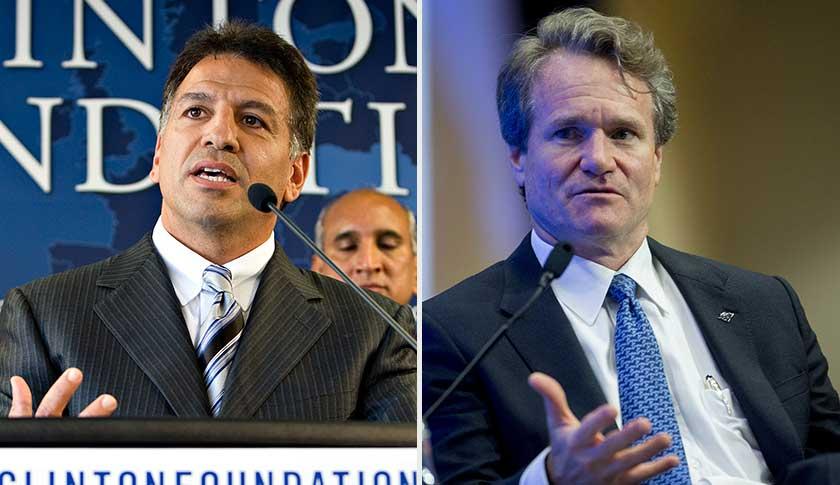
This September, investors get a powerful contrast of good governance language vs. good governance practice, in particular the superstitious worship of independent board chairmen as precursors of good governance, while combined chairman/CEO roles are summarily condemned. In reality there’s a lack of any research justifying that link and ample evidence debunking it—just look at the contrasting governance examples at Bank of America, which is led by a high-performing CEO/chairman, vs. Mylan, led by an entrenched chairman with a subordinate CEO who functions in his shadow.
The Bank of America backstory
The current Bank of America (BAC) was built by a visionary, uncommonly entrepreneurial banker—Hugh McColl—who leveraged his dual titles to great effect, leading takeovers of weakened pillars of finance including First Republic Bank, Boatmen’s Bancshares, Barnett Bank, C&S Sovereign Bank, FleetBoston, and BankAmerica. As chairman and CEO, McColl built the first ocean-to-ocean bank in U.S. history in what is widely considered the most significant banking story of the 20th century.
In 2001, McColl passed the ball to his loyal lieutenant, Ken Lewis, who who had been thought to be skilled at ensuring operational efficiency in streamlining the integration of McColl’s acquisitions. Instead, Lewis launched a serious of disastrous acquisitions including the botched purchases of Countrywide Financial and Merrill Lynch, which resulted in a $20 billion cash bailout from the federal government. While Bank of America had been healthy on the eve of 2008’s global financial crisis, Lewis’s ill-timed and overly generous acquisitions put it on life-support.
The shareholder revolt which followed in April 2009 led to a vote separating the positions of chairman and CEO with fully a third demanding Lewis’s complete removal. Five months later, Lewis “retired” at age 62. In 2010, Brian Moynihan was made CEO, and Bank of America’s board began its own extensive overhaul with 11 of 13 members independent.
Warren Buffett stated on CNBC recently that Moynihan “was handed one of the toughest jobs in the history of American banking,” but in just five years, he’s returned BofA to good health, cutting fat and reorganizing around eight client-focused business areas. Shuttering many troubled acquired units, he got out of $73 billion of non-core lines of business, and he restored sound banking with record levels of capital and liquidity, as well as strong earnings, despite challenges for the sector given the Fed’s low interest rate environment. While 2015 has been a tough year for banking, his cleanup paid off handsomely in shareholder gains after two years with BofA stock up 109%, 34%, and 15% in 2012, 2013, and 2014 respectively.
In recognition of such progress, last October, Bank of America’s board amended its bylaws and restored a combined chairman/CEO position for Moynihan and created a strong lead director position. But shareholders, including profit-seeking proxy advisory services along with a more innocent chorus of ideologically driven advocates, believe better decision-making at the top will come with separating BofA’s chairman and CEO roles. They have demanded a vote on this change, and a special meeting is scheduled for next week.
Mylan’s mysterious fortress governance
By contrast at Mylan (MYL), we see that separate chairman and CEO titles hardly ensure a distinction in roles. In the latest issue of Fortune, Jen Wieczner writes about the role of Robert Coury as Mylan’s “non-CEO” chairman in relation to CEO Heather Bresch:
“As executive chairman, he says, he retains four responsibilities: talent management, major M&A, dealing with “all the issues” (read: any controversies), and the not-so-minor task of “leading the strategic direction of the company.” He insists that Bresch “is the one that runs this company every day—period, said, done, dry!” But even his compliments have a way of minimizing her role. “You know what a woman can do for a home?” says Coury. “That’s what she’s done for this corporation.”
I was one of the sources for Wieczner’s piece, and from my own observations I have to point out that Mylan’s perfunctory separation of roles allows Coury to remain emperor for life. The Pennsylvania-based enterprise was newly registered as a Dutch company to insulate the chairman who can now restack his board virtually at will.
This arrangement, chosen by Mylan and legal under Dutch law, together with a poison-pill like device called a stichting were not apparent to Mylan shareholders when they ratified the change of incorporation. Fortune’s Wieczner reports that the poison-pill maneuver came as quite a surprise: “Of the more than a dozen analysts, investors, and governance experts polled by Fortune, only one remembered even reading about” the stichting. In fact, some investors have filed lawsuits against Mylan alleging misleading or vague disclosure on these points. These defensive governance tactics helped Mylan resists overtures from rival Teva, which had made a 48% premium bid.
[fortune-brightcove videoid=4342201416001]
A foul-mouthed, former benefits consultant, Coury has helped transform a regional drugmaker into a global generics force and experiences little board resistance to his imperial aura. The massive signage of the company’s 280,000-square-foot headquarters identifies itself as The Robert J. Coury Global Center more prominently than identifying the enterprise residing there. The contracts of chairman Coury and CEO Bresch permit them to use the company’s two jets for personal travel. In just three years, according to the Wall Street Journal, Coury charged up to $2 million in aviation expenses, including flights to support the electro-pop music career of his son, Tino.
Now shareholders are bullied further through Mylan’s hostile $27 billion takeover bid for Irish over-the-counter pharmaceutical Perrigo. Mylan launched its tender offer Monday, and if it does not achieve its required 80% control to meld the two businesses, it’s threatening to delist and weaken Perrigo, punishing prospective minority shareholders. What is not clear is how Mylan could achieve such a result, given Irish law protections and the need for a future board to deliberate with Perrigo’s interests in mind.
What is clear is the coercive intent of making such a threat now. Such hardball tactics may well make Perrigo’s coveted retail sales force a flight risk under Mylan control. While Mylan has done a notable job of enterprise building over the past decade with 300% shareholder return, Perrigo has towered over it, soaring more than tenfold. Every second, 1,600 people consume a Perrigo product. Industry analysts project Perrigo’s store brand offerings to grow far faster than Mylan’s generic prescription drugs. In fact, 20% of Mylan’s operating earnings come from one product, the EpiPen, an endangered monopoly with Teva and other rivals soon to introduce lower-cost competitive self-injecting allergy treatments.
Foreign governance imports often fail in U.S. firms
Board governance titles are largely cosmetic and not predictive of financial success; nor are they preventive of governance misconduct. Perhaps, on occasion, the model is helpful given family ownership, leadership transitions, or crises—such as at United Airlines last week or Bank of America five years ago.
However, there’s no empirical justification for this role split arrangement to be the norm. Eighteen of Fortune’s top 25 World’s Most Admired Companies have combined chairman/CEO leadership roles. Furthermore, many companies frequently cited by shareholder activists as poster children for the effectiveness of the separation of roles tried it—and dropped it. They include IBM, Procter & Gamble. Boeing, Dell, General Motors, and The Walt Disney Co. In fact, only 23% of U.S. firms actually have independent board chairs.
A systematic examination by large-scale studies over the past 15 years reveals that the separation of CEO and chairman roles is not a panacea—or even always a relevant factor in increased shareholder returns nor greater integrity in leadership actions. In fact, it can even hurt. Research on 309 firms between 2002 and 2006 by Mathew Samadeni and Ryan Krause of the University of Indiana found that the financial performance of once-high-performing firms was actually diminished through the introduction of separate roles. They concluded, that if it ain’t broke, don’t fix it.
[fortune-brightcove videoid=4473641546001]
Similarly, voluminous research over the past 15 years from scholars such as Yale Law School’s Roberto Romano, Sanjai Bhagat of the University of Colorado, and Bernard Black of Northwestern University demonstrate that simplistic, box-checking corporate governance metrics do not lead to superior financial returns.
Moreover, such cosmetic changes do not prevent executive misconduct. In fact, many of our biggest corporate scandals in U.S. corporate history, ranging from Enron to WorldCom and Computer Associates to Global Crossing, already had such separate roles in place and were showcased for their heavily promoted “good governance” models before they collapsed in criminal fraud.
Often European Governance Model Fail Back Home
Shareholder activists in the U.S. love to point to the separation of chairman and CEO as the prevailing model in Europe. But Mylan reminds us that European models are not necessarily superior pillars of good governance, and at every major European firm that has suffered from some kind of scandal over the past decade, this separation of roles already existed.
Just look at Siemens, BP, Royal Dutch Shell, Barclays, GlaxoSmithKline, and HSBC, among many others. The panic crisis response at many of these firms was only escalated as employees, regulators, employees, and media did not know who was calling the shots and who was accountable, and which of the inconsistent voices was the one with real authority.
Respected UK financial journalist Ian Fraser has written: “The shameful and scandalous behaviour of many FTSE-100 firms in recent years … proves that Britain’s elaborate attempts to codify corporate governance have failed. This is largely because the Codes have given rise to a shallow “box ticking” culture, in which directors are able to tick the relevant boxes but avoid their true responsibilities.”
The “Cadbury Commission” is the oft-cited but little-read bible prescribing the separation of roles in corporate governance in the UK. It was established by British regulators to enhance British corporate governance in the interest of restoring investor confidence. The most debated topic was supposedly the “requirement” for the separation of the chairmanship from the CEO role. In actuality, the separation was “recommended, not compulsory,” and “where there is a combined office of the chairman and CEO … board members might look to a senior non-executive director who might be deputy chairman as the person to whom they should address any concerns.”
But just this past week at United Airlines in the U.S., an alert nimble board with a strong lead director was able to swiftly remove its troubled CEO/chairman and install a well-qualified permanent successor—with no process barriers to good governance. There is no evidence that because the British now separate the board roles, others should follow—any more than we should require our business leaders to wear bowler hats and our lawyers to wear wigs and gowns to court.
Jeffrey Sonnenfeld is Senior Associate Dean for Executive Programs and Professor in the Practice of Management, Yale School of Management and past chairman of Blue Ribbon Commission on CEO Succession of the National Association of Corporate Directors.