• Home
  • Latest
  • Fortune 500
  • Finance
  • Tech
  • Leadership
  • Lifestyle
  • Rankings
  • Multimedia

Trendingnow

1

After forcing workers back to the office, Goldman Sachs and JPMorgan Chase are now letting their staff work remotely—but only for the World Cup

2

The Pentagon said Iran War costs $29 billion,but the real cost is closer to $200 billion—and counting

3

Markets tumble worldwide as Fed resets expectations: $400 billion wiped off SpaceX stock

1

After forcing workers back to the office, Goldman Sachs and JPMorgan Chase are now letting their staff work remotely—but only for the World Cup

2

The Pentagon said Iran War costs $29 billion,but the real cost is closer to $200 billion—and counting

3

Markets tumble worldwide as Fed resets expectations: $400 billion wiped off SpaceX stock
CommentaryGreece

Blame Europe’s slack politicians for paving the path of a Grexit

By
Barry Eichengreen
Barry Eichengreen
Down Arrow Button Icon
By
Barry Eichengreen
Barry Eichengreen
Down Arrow Button Icon
June 29, 2015, 11:08 AM ET
GREECE-POLITICS-ECONOMY-EU
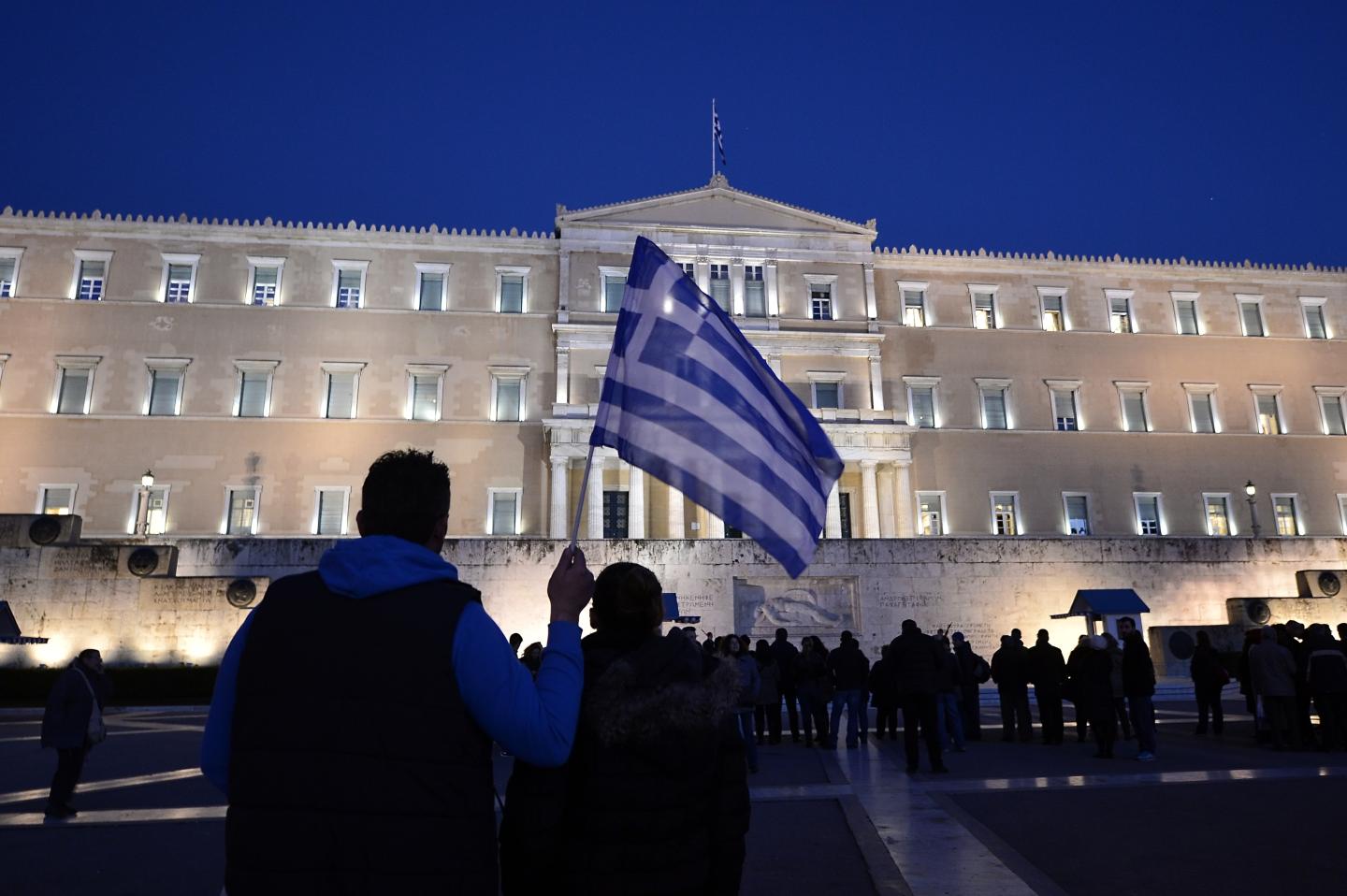
A man holds a Greek flag in front of the Greek parliament in Athens as people gather in support to their government on February 20, 2015. Greece and its sceptical European partners were near a much-needed compromise to agree a request by Athens to extend an EU loan programme that expires this month, sources close to the matter said. AFP PHOTO/ LOUISA GOULIAMAKI (Photo credit should read LOUISA GOULIAMAKI/AFP/Getty Images)Photograph by Louisa Gouliamaki — AFP/Getty Images
Add Fortune on Google for similar content.
Since our last episode, the crisis in Greece has escalated further. Negotiations between the government and its creditors collapsed over the weekend, and restrictions on bank withdrawals will now follow.

The next step is for the government to issue the equivalent of IOUs to pay salaries and pensions. The country is seemingly on the slippery slope to exiting the euro.

Many of us doubted that it would come to this. In particular, I doubted that it would come to this.

Nearly a decade ago, I analyzed scenarios for a country leaving the eurozone. I concluded that this was exceedingly unlikely to happen. The probability of a Grexit, or any Otherexit, I confidently asserted, was vanishingly small.

My friend and UC Berkeley colleague Brad DeLong regularly reminds us of the need to “mark our views to market.” So where did this prediction go wrong?

Why a euro exit didn’t make sense

My analysis was based on a comparison of economic costs and benefits of a country exiting the euro. The costs, I concluded, would be severe and heavily front-loaded.

Raising the possibility, however remote, of exit from the euro would ignite a bank run in said country. The authorities would be forced to shutter the financial system. Economic activity would grind to a halt. Losing access to not just their savings but also imported petrol, medicines and foodstuffs, angry citizens would take to the streets.

Not only would any subsequent benefits, by comparison, be delayed, but they would be disappointingly small.

With the government printing money to finance its spending, inflation would accelerate, and any improvement in export competitiveness due to depreciation of the newly reintroduced national currency would prove ephemeral.

In Greece’s case, moreover, there is the problem that the country’s leading export, refined petroleum, is priced in dollars and relies on imported oil, which is also priced in dollars. So much for the advantages of a depreciated currency.

Agricultural exports for their part will take several harvests to ramp up. And attracting more tourists won’t be easy against a drumbeat of political unrest.

What went wrong?

How did Greece end up in this pickle? Some say that the specter of a bank run was no longer a deterrent to exit once that bank run started anyway due to the deep depression into which the Greek economy had sunk.

But what is remarkable is how the so-called bank run remained a jog – it was still perfectly manageable until the Greek government called its referendum on the terms of the bail out deal offered by international creditors, negotiations broke down and exit became a real possibility.

Nonperforming loans — ones that are in default or close to it — were already rising, to be sure, but the banks still had all the liquidity they needed. The European Central Bank supported the Greek banking system with emergency liquidity assistance (ELA) right up to the very end of June. Only when Greece stopped negotiating did the Central Bank stop increasing ELA. And only then did a full-fledged bank run break out.

So I stand by the economic argument. Where I need to mark my views to market, however, is for underestimating the role of politics. In particular, I underestimated the extent of political incompetence – not just of the Greek government but even more so of its creditors.

In January Syriza had run on a platform of no more spending cuts or tax increases but also of keeping the euro. It should have anticipated that some compromise would be needed to square this circle. In the event, that realization was strangely late in coming.

And Prime Minister Alexis Tsipras and his government should have had the courage of its convictions. If it was unwilling to accept the creditors’ final offer, then it should have stated its refusal, pure and simple. If it preferred to continue negotiating, then it should have continued negotiating. The decision to call a referendum in midstream only heightened uncertainty. It was a transparent effort to evade responsibility. It was the action of leaders more interested in retaining office than in minimizing the cost to the country of the crisis.

A hard lesson learned

Still, this incompetence pales in comparison with that of the European Commission, the ECB and the IMF.

The three institutions opposed debt restructuring in 2010 when the crisis still could have been resolved at low cost. They continued to resist it in 2015, when a debt write-down was the obvious concession to Mr Tsipras & Company. The cost would have been small. Pretending instead that Greece’s debts could be repaid hardly enhanced their credibility.

Instead, the creditors first calculated the size of the primary budget surpluses that Greece would have to run in order to hypothetically repay its debt. They then required the government to raise taxes and cut spending sufficiently to produce those surpluses.

They ignored the fact that, in so doing, they consigned the country to an even deeper depression. By privileging their own balance sheets, they got the Greek government and the outcome they deserved.

The implication is clear. Never underestimate the ability of politicians to do the wrong thing. I will try to remember next time.

Barry Eichengreen is professor of economics and political science at University of California, Berkeley. This article was originally published on The Conversation. Read the original article here.

About the Author
By Barry Eichengreen
See full bioRight Arrow Button Icon
Add Fortune on Google for similar content.

Latest in Commentary

Finance
Lorem ipsum dolor sit amet, consectetur adipiscing elit, sed do eiusmod tempor incididunt ut labore et dolore magna aliqua. Ut enim ad minim veniam
By Fortune Editors
October 20, 2025
Finance
Lorem ipsum dolor sit amet, consectetur adipiscing elit, sed do eiusmod tempor incididunt ut labore et dolore magna aliqua. Ut enim ad minim veniam
By Fortune Editors
October 20, 2025
Finance
Lorem ipsum dolor sit amet, consectetur adipiscing elit, sed do eiusmod tempor incididunt ut labore et dolore magna aliqua. Ut enim ad minim veniam
By Fortune Editors
October 20, 2025
Finance
Lorem ipsum dolor sit amet, consectetur adipiscing elit, sed do eiusmod tempor incididunt ut labore et dolore magna aliqua. Ut enim ad minim veniam
By Fortune Editors
October 20, 2025
Finance
Lorem ipsum dolor sit amet, consectetur adipiscing elit, sed do eiusmod tempor incididunt ut labore et dolore magna aliqua. Ut enim ad minim veniam
By Fortune Editors
October 20, 2025
Finance
Lorem ipsum dolor sit amet, consectetur adipiscing elit, sed do eiusmod tempor incididunt ut labore et dolore magna aliqua. Ut enim ad minim veniam
By Fortune Editors
October 20, 2025

Most Popular

Finance
Lorem ipsum dolor sit amet, consectetur adipiscing elit, sed do eiusmod tempor incididunt ut labore et dolore magna aliqua. Ut enim ad minim veniam
By Fortune Editors
October 20, 2025
Finance
Lorem ipsum dolor sit amet, consectetur adipiscing elit, sed do eiusmod tempor incididunt ut labore et dolore magna aliqua. Ut enim ad minim veniam
By Fortune Editors
October 20, 2025
Finance
Lorem ipsum dolor sit amet, consectetur adipiscing elit, sed do eiusmod tempor incididunt ut labore et dolore magna aliqua. Ut enim ad minim veniam
By Fortune Editors
October 20, 2025
Finance
Lorem ipsum dolor sit amet, consectetur adipiscing elit, sed do eiusmod tempor incididunt ut labore et dolore magna aliqua. Ut enim ad minim veniam
By Fortune Editors
October 20, 2025
Finance
Lorem ipsum dolor sit amet, consectetur adipiscing elit, sed do eiusmod tempor incididunt ut labore et dolore magna aliqua. Ut enim ad minim veniam
By Fortune Editors
October 20, 2025
Finance
Lorem ipsum dolor sit amet, consectetur adipiscing elit, sed do eiusmod tempor incididunt ut labore et dolore magna aliqua. Ut enim ad minim veniam
By Fortune Editors
October 20, 2025
Fortune Secondary Logo
Rankings
  • 100 Best Companies
  • Fortune 500
  • Global 500
  • Fortune 500 Europe
  • Most Powerful Women
  • World's Most Admired Companies
  • See All Rankings
  • Lists Calendar
Sections
  • Finance
  • Fortune Crypto
  • Features
  • Leadership
  • Health
  • Commentary
  • Success
  • Retail
  • Mpw
  • Tech
  • Lifestyle
  • CEO Initiative
  • Asia
  • Politics
  • Conferences
  • Europe
  • Newsletters
  • Personal Finance
  • Environment
  • Magazine
  • Education
Customer Support
  • Frequently Asked Questions
  • Customer Service Portal
  • Privacy Policy
  • Terms Of Use
  • Single Issues For Purchase
  • International Print
Commercial Services
  • Advertising
  • Fortune Brand Studio
  • Fortune Analytics
  • Fortune Conferences
  • Business Development
  • Group Subscriptions
About Us
  • About Us
  • Press Center
  • Work At Fortune
  • Terms And Conditions
  • Site Map
  • About Us
  • Press Center
  • Work At Fortune
  • Terms And Conditions
  • Site Map
  • Facebook icon
  • Twitter icon
  • LinkedIn icon
  • Instagram icon
  • Pinterest icon

Latest in Commentary

steve
Commentary250 Years of Innovation
Steve Case: America was built by entrepreneurs. Here’s how we keep that edge for the next 250 years
By Steve CaseJune 24, 2026
2 hours ago
t
CommentaryWhite House
Trump mistakes the bully pulpit for bullying leadership — history’s villains were never heroes
By Jeffrey Sonnenfeld and Steven TianJune 24, 2026
2 hours ago
mg
CommentaryHealth
The ‘tech neck’ time bomb: why 43 million young Americans could cripple U.S. health care within a generation
By Michael GerlingJune 24, 2026
3 hours ago
sb
Commentaryclimate change
The climate policy triangle: why leaders can no longer choose between growth, security and sustainability
By Sebastian BuckupJune 23, 2026
17 hours ago
brett
CommentaryManagement
Middle managers aren’t going extinct—they’re evolving into something more powerful
By Brett HurtJune 23, 2026
1 day ago
ravi
CommentaryAI agents
Yale School of Management: surveillance pricing is just the beginning. AI agents will be the real test of corporate trust
By Ravi Dhar and Jon IwataJune 23, 2026
1 day ago

Most Popular

After forcing workers back to the office, Goldman Sachs and JPMorgan Chase are now letting their staff work remotely—but only for the World Cup
Success
After forcing workers back to the office, Goldman Sachs and JPMorgan Chase are now letting their staff work remotely—but only for the World Cup
By Orianna Rosa RoyleJune 23, 2026
1 day ago
The Pentagon said Iran War costs $29 billion,but the real cost is closer to $200 billion—and counting
Economy
The Pentagon said Iran War costs $29 billion,but the real cost is closer to $200 billion—and counting
By Jacqueline MunisJune 24, 2026
7 hours ago
Markets tumble worldwide as Fed resets expectations: $400 billion wiped off SpaceX stock
Banking
Markets tumble worldwide as Fed resets expectations: $400 billion wiped off SpaceX stock
By Jim EdwardsJune 23, 2026
1 day ago
Current price of oil as of June 23, 2026
Personal Finance
Current price of oil as of June 23, 2026
By Joseph HostetlerJune 23, 2026
1 day ago
Texas and Charlotte used to build huge McMansions—now they're copying the California design tricks they once mocked
Real Estate
Texas and Charlotte used to build huge McMansions—now they're copying the California design tricks they once mocked
By Sydney LakeJune 22, 2026
2 days ago
Current price of gold as of June 23, 2026
Personal Finance
Current price of gold as of June 23, 2026
By Danny BakstJune 23, 2026
1 day ago

© 2026 Fortune Media IP Limited. All Rights Reserved. Use of this site constitutes acceptance of our Terms of Use and Privacy Policy | CA Notice at Collection and Privacy Notice | Do Not Sell/Share My Personal Information
FORTUNE is a trademark of Fortune Media IP Limited, registered in the U.S. and other countries. FORTUNE may receive compensation for some links to products and services on this website. Offers may be subject to change without notice.