• Home
  • Latest
  • Fortune 500
  • Finance
  • Tech
  • Leadership
  • Lifestyle
  • Rankings
  • Multimedia

Trendingnow

1

After forcing workers back to the office, Goldman Sachs and JPMorgan Chase are now letting their staff work remotely—but only for the World Cup

2

Markets tumble worldwide as Fed resets expectations: $400 billion wiped off SpaceX stock

3

Current price of oil as of June 23, 2026

1

After forcing workers back to the office, Goldman Sachs and JPMorgan Chase are now letting their staff work remotely—but only for the World Cup

2

Markets tumble worldwide as Fed resets expectations: $400 billion wiped off SpaceX stock

3

Current price of oil as of June 23, 2026
CommentaryUber Technologies

What your FedEx and Uber drivers have in common

By
Alan Hyde
Alan Hyde
Down Arrow Button Icon
By
Alan Hyde
Alan Hyde
Down Arrow Button Icon
June 22, 2015, 2:04 PM ET
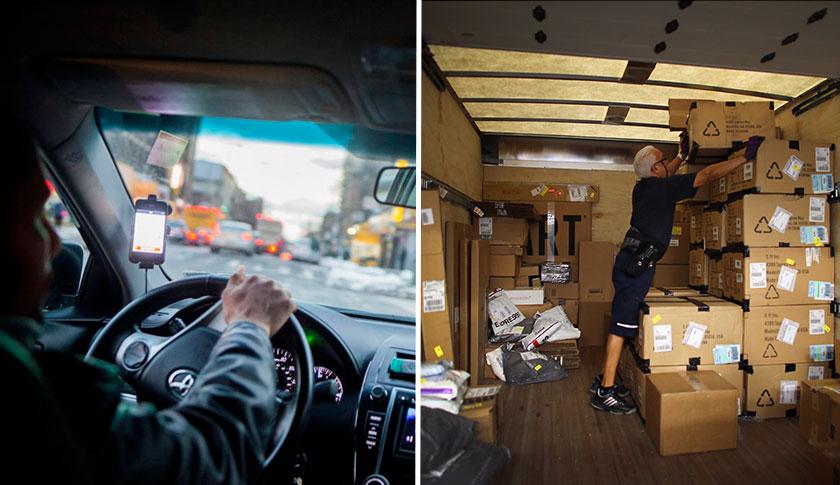
Photograph by Sam Hodgson — The New York Times/Redux; Getty Images
Add Fortune on Google for similar content.

Uber’s arm’s-length relationship with its drivers just got a bit closer after the California Labor Commission ruled that one of the ride-hailing company’s motorists in San Francisco is an employee, not a contractor, as it contends.

This is a big deal because the rights of Uber drivers depend sharply on whether they are deemed employees or self-employed independent contractors hired for particular jobs. By extension, the success of Uber’s business model may hinge on the question as well, but that’s for another article.

If they are employees, a litany of rights and requirements go along with it. They have a right to form a union, they must be paid minimum wage, they must be paid extra for overtime hours, their federal taxes must be withheld, Uber is liable if they hit anyone or anything, and Uber may not discriminate among drivers on the basis of race, color, religion, sex, national origin, age or disability.

But if they are self-employed, Uber may owe them nothing, except what it explicitly promises in the contracts it drafts.

Courts have given mixed rulings on the issue as more workers have been labeled “self-employed contractors” by companies eager to cut costs, a trend accelerated by the rise of the on-demand economy of companies that quickly provide goods and services. Part of the problem is that independent contractors fall into a hole in labor laws, one that could be filled by taking a page from our northern neighbors and creating a new class of worker: dependent contractors.

Merely a facilitator

Uber maintains that it is merely a software company that facilitates deals between customers and drivers. While the courts have generally been skeptical on this point, if Uber manages to win this argument, it would not be an employer at all – at least as far as the drivers are concerned.

Uber would not have to recognize a drivers’ union. So-called unions in which independent contractors fix their compensation normally fall outside of current labor laws and violate antitrust laws. Nor, if drivers are self-employed, would Uber be liable for their accidents, or owe them any particular level of compensation.

Employers naturally like to claim that the individuals who perform services for them are self-employed. But courts have been pushing back against these claims.

Let a jury decide

In May, a judge refused to dismiss a class action by Uber and Lyft drivers in San Francisco complaining of Uber’s treatment of their tips, saying it should be up to a jury to determine whether the drivers were employees or self-employed.

A few weeks ago, a federal appeals court similarly argued the determination should be left to a jury when it reversed a lower court’s ruling that FedEx (FDX) drivers are employees. The judges said it was unclear whether they were. Last year, a different federal appeals court found instead that FedEx drivers are its employees.

Other courts have been more forceful in favor of certain classes of workers that have slipped between the cracks. A federal judge in New York found that production interns on the set of the movie Black Swan were actually employees of both the production company and of Fox Searchlight Pictures.

And most recently, the California Labor Commission ruled last week that an Uber driver was an employee, not a contractor. Uber, while insisting the ruling applied to only that individual driver, is appealing.

The commission found that Uber is “involved in every aspect of the operation,” a sharp turnaround from the same agency’s ruling in 2012 that deemed an Uber driver an independent contractor.

Who’s in control

Such rulings are normally highly fact-specific. The basic legal approach to the question of employee status looks to who controls the means and manner of work. There are some interesting variations among the states, but they all – including federal statutes – look mainly to this question of control.

This is not a very clear test, and it would be impossible to find any labor relations expert who would defend it as a general approach. The Supreme Court has noted that the line between employee and independent contractor “can be manipulated largely at the will of” the employer, and is often a “very poor proxy for the interests at stake.”

The two decisions that found that Uber is, or might be, its drivers’ employer, rested on the tech company’s control of hiring, rules of driver conduct, restrictions on drivers’ ability to solicit other work and ability to terminate drivers at will. In some other ways, however, Uber drivers do control their work; they own their own cars and pick their own hours, for example.

More legal wrangling ahead

The latest decisions are invitations for future litigation. They do not settle the legal question permanently.

If you were Uber, you would not immediately begin treating drivers as employees, withholding taxes, paying back taxes, purchasing employment practices liability insurance and filing W-2 forms. You would be more likely to relax your control of drivers in minor ways, and then invite them to litigate again.

Uber might, for example, drop its rules over which radio stations drivers can play in their cars, permit drivers to hand out business cards, and then insist that now the drivers were actually self-employed.

The labor laws of Canada, Sweden and some other countries recognize a category called “dependent contractors.” Such workers are self-employed for some purposes, say tax administration. But if their livelihood depends on the richer entity that hires them, then that entity is bound by labor laws when it administers tips, or compensation.

Creation of such a category by US state legislators, or by some future Congress capable of legislation, would be highly desirable. It has been reported that tech companies are enthusiastic about the idea of creating such a category, though there is much hard work ahead in working out the details.

It would recognize that Americans are committed both to the creation of new ways of working and, at the same time, to the proposition that the powerful must not be permitted to exploit people whose services are integral to their businesses.

Alan Hyde is a professor of law and Sidney Reitman Scholar at Rutgers University in Newark. This article was originally published on The Conversation. Read the original article here.

About the Author
By Alan Hyde
See full bioRight Arrow Button Icon
Add Fortune on Google for similar content.

Latest in Commentary

Finance
Lorem ipsum dolor sit amet, consectetur adipiscing elit, sed do eiusmod tempor incididunt ut labore et dolore magna aliqua. Ut enim ad minim veniam
By Fortune Editors
October 20, 2025
Finance
Lorem ipsum dolor sit amet, consectetur adipiscing elit, sed do eiusmod tempor incididunt ut labore et dolore magna aliqua. Ut enim ad minim veniam
By Fortune Editors
October 20, 2025
Finance
Lorem ipsum dolor sit amet, consectetur adipiscing elit, sed do eiusmod tempor incididunt ut labore et dolore magna aliqua. Ut enim ad minim veniam
By Fortune Editors
October 20, 2025
Finance
Lorem ipsum dolor sit amet, consectetur adipiscing elit, sed do eiusmod tempor incididunt ut labore et dolore magna aliqua. Ut enim ad minim veniam
By Fortune Editors
October 20, 2025
Finance
Lorem ipsum dolor sit amet, consectetur adipiscing elit, sed do eiusmod tempor incididunt ut labore et dolore magna aliqua. Ut enim ad minim veniam
By Fortune Editors
October 20, 2025
Finance
Lorem ipsum dolor sit amet, consectetur adipiscing elit, sed do eiusmod tempor incididunt ut labore et dolore magna aliqua. Ut enim ad minim veniam
By Fortune Editors
October 20, 2025

Most Popular

Finance
Lorem ipsum dolor sit amet, consectetur adipiscing elit, sed do eiusmod tempor incididunt ut labore et dolore magna aliqua. Ut enim ad minim veniam
By Fortune Editors
October 20, 2025
Finance
Lorem ipsum dolor sit amet, consectetur adipiscing elit, sed do eiusmod tempor incididunt ut labore et dolore magna aliqua. Ut enim ad minim veniam
By Fortune Editors
October 20, 2025
Finance
Lorem ipsum dolor sit amet, consectetur adipiscing elit, sed do eiusmod tempor incididunt ut labore et dolore magna aliqua. Ut enim ad minim veniam
By Fortune Editors
October 20, 2025
Finance
Lorem ipsum dolor sit amet, consectetur adipiscing elit, sed do eiusmod tempor incididunt ut labore et dolore magna aliqua. Ut enim ad minim veniam
By Fortune Editors
October 20, 2025
Finance
Lorem ipsum dolor sit amet, consectetur adipiscing elit, sed do eiusmod tempor incididunt ut labore et dolore magna aliqua. Ut enim ad minim veniam
By Fortune Editors
October 20, 2025
Finance
Lorem ipsum dolor sit amet, consectetur adipiscing elit, sed do eiusmod tempor incididunt ut labore et dolore magna aliqua. Ut enim ad minim veniam
By Fortune Editors
October 20, 2025
Fortune Secondary Logo
Rankings
  • 100 Best Companies
  • Fortune 500
  • Global 500
  • Fortune 500 Europe
  • Most Powerful Women
  • World's Most Admired Companies
  • See All Rankings
  • Lists Calendar
Sections
  • Finance
  • Fortune Crypto
  • Features
  • Leadership
  • Health
  • Commentary
  • Success
  • Retail
  • Mpw
  • Tech
  • Lifestyle
  • CEO Initiative
  • Asia
  • Politics
  • Conferences
  • Europe
  • Newsletters
  • Personal Finance
  • Environment
  • Magazine
  • Education
Customer Support
  • Frequently Asked Questions
  • Customer Service Portal
  • Privacy Policy
  • Terms Of Use
  • Single Issues For Purchase
  • International Print
Commercial Services
  • Advertising
  • Fortune Brand Studio
  • Fortune Analytics
  • Fortune Conferences
  • Business Development
  • Group Subscriptions
About Us
  • About Us
  • Press Center
  • Work At Fortune
  • Terms And Conditions
  • Site Map
  • About Us
  • Press Center
  • Work At Fortune
  • Terms And Conditions
  • Site Map
  • Facebook icon
  • Twitter icon
  • LinkedIn icon
  • Instagram icon
  • Pinterest icon

Latest in Commentary

sb
Commentaryclimate change
The climate policy triangle: why leaders can no longer choose between growth, security and sustainability
By Sebastian BuckupJune 23, 2026
12 hours ago
brett
CommentaryManagement
Middle managers aren’t going extinct—they’re evolving into something more powerful
By Brett HurtJune 23, 2026
21 hours ago
ravi
CommentaryAI agents
Yale School of Management: surveillance pricing is just the beginning. AI agents will be the real test of corporate trust
By Ravi Dhar and Jon IwataJune 23, 2026
22 hours ago
elon
CommentaryElon Musk
Elon Musk’s trillion dollars aren’t real — and that’s the point
By Douglas P. McCormickJune 23, 2026
22 hours ago
gen z
CommentaryCareers
Gen Z: if you want to succeed at work, you need to start friction-maxxing
By Michelle SobelJune 23, 2026
23 hours ago
rp
CommentaryLaw
Cooley CEO: Big Law won’t survive if it treats AI as just an efficiency tool
By Rachel ProffittJune 23, 2026
23 hours ago

Most Popular

After forcing workers back to the office, Goldman Sachs and JPMorgan Chase are now letting their staff work remotely—but only for the World Cup
Success
After forcing workers back to the office, Goldman Sachs and JPMorgan Chase are now letting their staff work remotely—but only for the World Cup
By Orianna Rosa RoyleJune 23, 2026
22 hours ago
Markets tumble worldwide as Fed resets expectations: $400 billion wiped off SpaceX stock
Banking
Markets tumble worldwide as Fed resets expectations: $400 billion wiped off SpaceX stock
By Jim EdwardsJune 23, 2026
24 hours ago
Current price of oil as of June 23, 2026
Personal Finance
Current price of oil as of June 23, 2026
By Joseph HostetlerJune 23, 2026
21 hours ago
Meet the 2 men putting New York's $300 billion pension fund in play for the first time in 20 years
Investing
Meet the 2 men putting New York's $300 billion pension fund in play for the first time in 20 years
By Nick LichtenbergJune 22, 2026
2 days ago
Former U.S. Secret Service agent says bringing your authentic self to work stifles teamwork: 'You don’t get high performers, you get sloppiness'
Success
Former U.S. Secret Service agent says bringing your authentic self to work stifles teamwork: 'You don’t get high performers, you get sloppiness'
By Sydney LakeJune 21, 2026
3 days ago
Texas and Charlotte used to build huge McMansions—now they're copying the California design tricks they once mocked
Real Estate
Texas and Charlotte used to build huge McMansions—now they're copying the California design tricks they once mocked
By Sydney LakeJune 22, 2026
2 days ago

© 2026 Fortune Media IP Limited. All Rights Reserved. Use of this site constitutes acceptance of our Terms of Use and Privacy Policy | CA Notice at Collection and Privacy Notice | Do Not Sell/Share My Personal Information
FORTUNE is a trademark of Fortune Media IP Limited, registered in the U.S. and other countries. FORTUNE may receive compensation for some links to products and services on this website. Offers may be subject to change without notice.