
• Home
  • Latest
  • Fortune 500
  • Finance
  • Tech
  • Leadership
  • Lifestyle
  • Rankings
  • Multimedia

Trendingnow

1

MacKenzie Scott alone accounted for one-third of America's $19.2 billion in megagifts last year

2

Now worth $200 million, Sarah Jessica Parker credits being ‘one of eight kids that struggled financially’ for her hunger, ambition, and work ethic

3

Ikea’s billionaire founder was so frugal that he bought clothes from flea markets and took free salt and pepper from restaurants

1

MacKenzie Scott alone accounted for one-third of America's $19.2 billion in megagifts last year

2

Now worth $200 million, Sarah Jessica Parker credits being ‘one of eight kids that struggled financially’ for her hunger, ambition, and work ethic

3

Ikea’s billionaire founder was so frugal that he bought clothes from flea markets and took free salt and pepper from restaurants
Financeinvestment banking

How Deutsche Bank lost its way

Shawn Tully
By
Shawn Tully
Shawn Tully
Senior Editor-at-Large
Down Arrow Button Icon
Shawn Tully
By
Shawn Tully
Shawn Tully
Senior Editor-at-Large
Down Arrow Button Icon
June 10, 2015, 9:25 AM ET
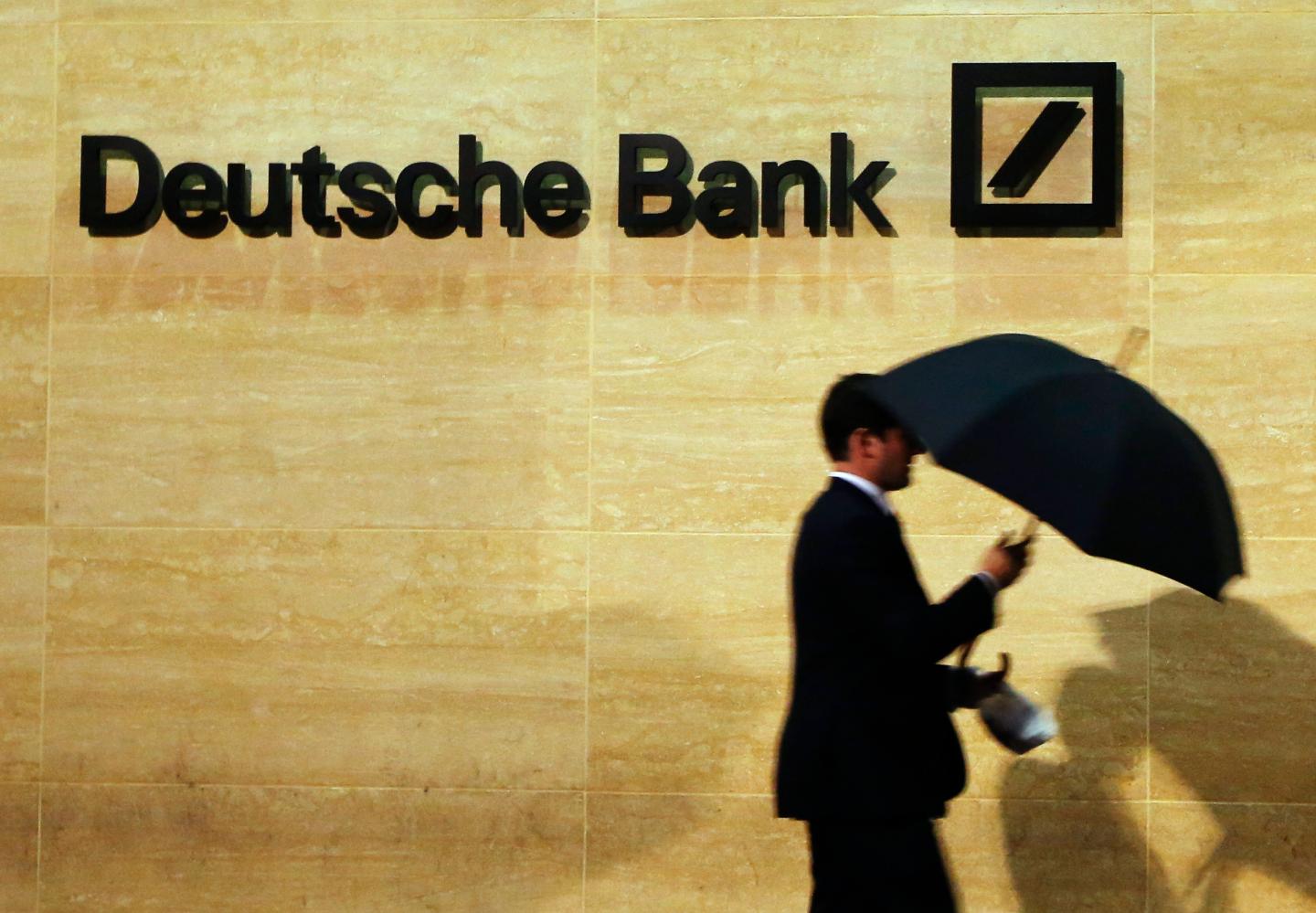
A man walks past Deutsche Bank offices in London
A man walks past Deutsche Bank offices in London.Photogrpah by Luke MacGregor — Reuters
Add Fortune on Google for similar content.

If any doubt lingers that traditional securities trading has faded from a fabulously profitable, glamorous enterprise to a shadow of its former self, the latest news from Deutsche Bank makes this new reality all too clear.

On June 7, Germany’s largest lender announced that its co-CEOs, Anshu Jain and Jurgen Fitschen, would resign from their posts. The new CEO (who technically will share the job with Fitschen until he departs next May) will be John Cryan, a member of the Deutsche Bank (DB) supervisory board and former CFO of rival UBS.

What’s remarkable about the shift is that while Deutsche Bank’s leadership will change, the board intends to follow the same basic strategy that failed under the previous regime: bolstering, one might even say doubling down, on investment banking, its primary pillar and Cryan’s area of expertise. Within investment banking, deutsche is wagering heavily on an antiquated area where modernization isn’t its friend: fixed income trading.

Appointed in 2012 to succeed the legendary Josef Ackermann, co-CEOs Jain and Fitschen set ambitious financial goals, and missed all of the big ones by a spectacular margin. In April, the duo unveiled a strategic overhaul with significantly reduced goals. At Deutsche Bank’s annual meeting in May, investors expressed deep disappointment with the plan; only 61% of shareholders endorsed it in a non-binding vote, which clearly shocked the board into action.

Two main factors account for Deutsche Bank’s chronically poor results. First, since the end of the financial crisis, a series of fines, settlements, and restructurings have inflicted billions upon billions of euros in charges on the bank. Those charges were far bigger than the bank’s leaders, analysts, or almost anyone else expected. In the past three years, the bank has paid a total of around $9 billion to settle a Libor-rigging action and lawsuits over its underwriting of mortgage-backed securities, as well as its role in the collapse of the Kirch media empire in 2002. It also dumped troubled portfolios of commercial real estate loans inherited in the acquisition of government-owned lender Postbank in 2008.

The new Basel III capital rules triggered additional losses. Once profitable swaps and assorted derivatives contracts sprung losses when new rules mandated that banks back those volatile contracts with heavy reserves. The tighter regulations forced Deutsche Bank to sell derivatives portfolios at heavy losses.

Similar travails afflicted most big banks in the post-2008 financial order. But Jain and Fitschen wouldn’t have whiffed so badly if Deutsche Bank’s basic operating businesses had posted strong results. Instead, they performed poorly, exploding the forecasts. In 2012, the co-CEOs announced three goals for 2015. First, they promised to achieve a 12% return on “book equity,” as stated on the balance sheet. Second, Jain and Fitschen pledged to reach an impressive ratio of operating costs to revenues of 65%. The third target: Hiking its regulatory capital level to 10% by the end of the three-year window, without raising any new capital.

As for return on equity, Deutsche Bank was faring so poorly in April that the co-CEOs lowered the goal in a big way. The new target is 10% on tangible equity, a lower number since it excludes goodwill. It’s the equivalent of 8% on book equity, four points below the previous bogey. Further infuriating shareholders, they pushed back the deadline to achieve this easier target by five years, to 2020. So far, progress is nowhere in sight. In 2014, Deutsche Bank posted a return on equity of 2.3%. “It will probably be in the low-single digits for 2015 as well,” says Dirk Becker, an analyst with Kepler Cheuvreux in Frankfurt. On the second objective, the expense ratio is now running not in the 60% range as planned, but in the 80s.

The duo did achieve a capital ratio of 10%. But they flopped again, since getting there required raising around $13 billion in new equity capital, diluting shareholders, who’ve fled the stock. Since 2007, Deutsche Bank’s share price has dropped from $150 to $33, erasing $100 billion in market value.

The poor performance of investment banking, and growing doubts that this will change any time soon, most seriously calls the bank’s current strategy into question.

Deutsche Bank relies far more heavily on investment banking than most of its peers. In recent years, it has placed even greater weight on that franchise. Deutsche Bank’s remarkable rise to the summit in investment banking began in 1990, when it purchased Britain’s Morgan Grenfell, followed by the acquisition of Bankers Trust eight years later. Thereafter, the investment bank thrived––Ackerman, followed by Jain, were principal architects of its success––rising to the top echelon alongside Goldman Sachs and Morgan Stanley.

Deutsche Bank’s greatest strength is its fixed income arm, especially, trading. In its best years, the bank was generating fantastic 40% ROEs in its bond business. Even in 2009, in the wake of the financial crisis, it enjoyed great success in trading. Investors were desperate to exit securities at any price, providing huge “spreads,” or margins, for the bank. At the same time, many of Deutsche Bank’s biggest competitors were reducing their bond trading or closing their fixed income desks altogether. So in 2009, Deutsche Bank profited handsomely by bucking the trend, and it maintained its signature franchise.

Jain-Fitschen decided to rely on their bastion of profitability, bond trading. Their plan was twofold. First, they believed that the retrenchment of many big players, including UBS and Credit Suisse, would put their bank in a far more powerful position. The idea was that the reduced competition would both raise both their market share and trading margins. They also figured that the ultra-tight capital restrictions would gradually loosen, so that banks could once again expand their trading books without huge increases in reserves.

Neither of those predictions worked out as planned.

To make matters worse, the flush, pre-financial crisis time, reprised in 2009, didn’t return. For the past half-decade, fixed income markets have been relatively placid. New regulations have forced the banks to substantially shrink the size of their inventories of bonds for sale. Most customers are in no hurry to sell their bonds and buy new ones at today’s rates, so turnover is low. “They keep waiting for the trends they predicted to happen, and they haven’t happened,” says Becker.

In announcing the changes at the top, the Deutsche Bank board stressed that it’s adhering to the investment banking-first strategy. The bank does have a substantial retail business, boasting around $220 billion in deposits at its branches. But it pledges to shrink that franchise by selling Postbank, which offers banking services in post offices throughout Germany and accounts for half of Deutsche Bank’s deposits.

If it’s well run, retail banking has a strong future because deposits provide big pools of money that’s pretty much interest-free. As rates on loans and securities inevitably rise, those cheap deposits become highly profitable.

The future isn’t nearly as predictable for bond trading. Electronic platforms are now matching big owners, the Fidelities and Vanguards, directly with one another, bypassing the banks and lowering costs in the process. We may be on the brink of a sister revolution to the one that modernized the equity markets and ominously squeezed most of the profit out of stock trading.

It’s usually safe to bet that, after a crisis, businesses can return to a state of normalcy. But it’s not always so, especially not in the outdated, bank-dominated bond business. The world has changed. The question is whether it will change back. For Deutsche Bank, planning on a reprise of the good old days may be a losing wager.

About the Author
Shawn Tully
By Shawn TullySenior Editor-at-Large

Shawn Tully is a senior editor-at-large at Fortune, covering the biggest trends in business, aviation, politics, and leadership.

See full bioRight Arrow Button Icon
Add Fortune on Google for similar content.

Latest in Finance

Finance
Lorem ipsum dolor sit amet, consectetur adipiscing elit, sed do eiusmod tempor incididunt ut labore et dolore magna aliqua. Ut enim ad minim veniam
By Fortune Editors
October 20, 2025
Finance
Lorem ipsum dolor sit amet, consectetur adipiscing elit, sed do eiusmod tempor incididunt ut labore et dolore magna aliqua. Ut enim ad minim veniam
By Fortune Editors
October 20, 2025
Finance
Lorem ipsum dolor sit amet, consectetur adipiscing elit, sed do eiusmod tempor incididunt ut labore et dolore magna aliqua. Ut enim ad minim veniam
By Fortune Editors
October 20, 2025
Finance
Lorem ipsum dolor sit amet, consectetur adipiscing elit, sed do eiusmod tempor incididunt ut labore et dolore magna aliqua. Ut enim ad minim veniam
By Fortune Editors
October 20, 2025
Finance
Lorem ipsum dolor sit amet, consectetur adipiscing elit, sed do eiusmod tempor incididunt ut labore et dolore magna aliqua. Ut enim ad minim veniam
By Fortune Editors
October 20, 2025
Finance
Lorem ipsum dolor sit amet, consectetur adipiscing elit, sed do eiusmod tempor incididunt ut labore et dolore magna aliqua. Ut enim ad minim veniam
By Fortune Editors
October 20, 2025

Most Popular

Finance
Lorem ipsum dolor sit amet, consectetur adipiscing elit, sed do eiusmod tempor incididunt ut labore et dolore magna aliqua. Ut enim ad minim veniam
By Fortune Editors
October 20, 2025
Finance
Lorem ipsum dolor sit amet, consectetur adipiscing elit, sed do eiusmod tempor incididunt ut labore et dolore magna aliqua. Ut enim ad minim veniam
By Fortune Editors
October 20, 2025
Finance
Lorem ipsum dolor sit amet, consectetur adipiscing elit, sed do eiusmod tempor incididunt ut labore et dolore magna aliqua. Ut enim ad minim veniam
By Fortune Editors
October 20, 2025
Finance
Lorem ipsum dolor sit amet, consectetur adipiscing elit, sed do eiusmod tempor incididunt ut labore et dolore magna aliqua. Ut enim ad minim veniam
By Fortune Editors
October 20, 2025
Finance
Lorem ipsum dolor sit amet, consectetur adipiscing elit, sed do eiusmod tempor incididunt ut labore et dolore magna aliqua. Ut enim ad minim veniam
By Fortune Editors
October 20, 2025
Finance
Lorem ipsum dolor sit amet, consectetur adipiscing elit, sed do eiusmod tempor incididunt ut labore et dolore magna aliqua. Ut enim ad minim veniam
By Fortune Editors
October 20, 2025
Fortune Secondary Logo
Rankings
  • 100 Best Companies
  • Fortune 500
  • Global 500
  • Fortune 500 Europe
  • Most Powerful Women
  • World's Most Admired Companies
  • See All Rankings
  • Lists Calendar
Sections
  • Finance
  • Fortune Crypto
  • Features
  • Leadership
  • Health
  • Commentary
  • Success
  • Retail
  • Mpw
  • Tech
  • Lifestyle
  • CEO Initiative
  • Asia
  • Politics
  • Conferences
  • Europe
  • Newsletters
  • Personal Finance
  • Environment
  • Magazine
  • Education
Customer Support
  • Frequently Asked Questions
  • Customer Service Portal
  • Privacy Policy
  • Terms Of Use
  • Single Issues For Purchase
  • International Print
Commercial Services
  • Advertising
  • Fortune Brand Studio
  • Fortune Analytics
  • Fortune Conferences
  • Business Development
  • Group Subscriptions
About Us
  • About Us
  • Press Center
  • Work At Fortune
  • Terms And Conditions
  • Site Map
  • About Us
  • Press Center
  • Work At Fortune
  • Terms And Conditions
  • Site Map
  • Facebook icon
  • Twitter icon
  • LinkedIn icon
  • Instagram icon
  • Pinterest icon

Latest in Finance

spiegel
Personal Financephilanthropy
Snap’s Evan Spiegel joins MacKenzie Scott in the billionaire race to erase medical debt—wiping out $550 million for 260,000 Californians
By Nick LichtenbergJune 26, 2026
2 hours ago
cuban
AIJobs
Everyone agrees that you hate AI, but only Mark Cuban sees why Silicon Valley is powerless to fix it
By Nick LichtenbergJune 26, 2026
2 hours ago
g
BankingFederal Reserve
Alan Greenspan said 3 years with Gerald Ford beat 18 at the Fed. His death at 100 raises the question: was he right?
By Simon Bowmaker, Paul Wachtel and The ConversationJune 26, 2026
2 hours ago
suez
EconomyIran
Ray Dalio says the U.S. just had its ‘Suez moment’—and history says what comes next could end an empire
By Nick LichtenbergJune 26, 2026
2 hours ago
Meet Micron, the under-the-radar chipmaker that just reported a 346% sales surge and helped stop a global AI selloff
AITech
Meet Micron, the under-the-radar chipmaker that just reported a 346% sales surge and helped stop a global AI selloff
By Marco Quiroz-GutierrezJune 26, 2026
2 hours ago
Current refi mortgage rates report for June 26, 2026
Personal FinanceReal Estate
Current refi mortgage rates report for June 26, 2026
By Glen Luke FlanaganJune 26, 2026
2 hours ago

Most Popular

MacKenzie Scott alone accounted for one-third of America's $19.2 billion in megagifts last year
Success
MacKenzie Scott alone accounted for one-third of America's $19.2 billion in megagifts last year
By Sydney LakeJune 25, 2026
1 day ago
Now worth $200 million, Sarah Jessica Parker credits being ‘one of eight kids that struggled financially’ for her hunger, ambition, and work ethic
Success
Now worth $200 million, Sarah Jessica Parker credits being ‘one of eight kids that struggled financially’ for her hunger, ambition, and work ethic
By Orianna Rosa RoyleJune 24, 2026
2 days ago
Ikea’s billionaire founder was so frugal that he bought clothes from flea markets and took free salt and pepper from restaurants
Success
Ikea’s billionaire founder was so frugal that he bought clothes from flea markets and took free salt and pepper from restaurants
By Orianna Rosa RoyleJune 25, 2026
1 day ago
Current price of oil as of June 25, 2026
Personal Finance
Current price of oil as of June 25, 2026
By Joseph HostetlerJune 25, 2026
20 hours ago
Current price of silver as of Thursday, June 25, 2026
Personal Finance
Current price of silver as of Thursday, June 25, 2026
By Joseph HostetlerJune 25, 2026
20 hours ago
Trump turns on Big Oil donors who spent nearly $100 million to get him elected—now he wants the DOJ to investigate them for price gouging
Economy
Trump turns on Big Oil donors who spent nearly $100 million to get him elected—now he wants the DOJ to investigate them for price gouging
By Tristan BoveJune 25, 2026
12 hours ago

© 2026 Fortune Media IP Limited. All Rights Reserved. Use of this site constitutes acceptance of our Terms of Use and Privacy Policy | CA Notice at Collection and Privacy Notice | Do Not Sell/Share My Personal Information
FORTUNE is a trademark of Fortune Media IP Limited, registered in the U.S. and other countries. FORTUNE may receive compensation for some links to products and services on this website. Offers may be subject to change without notice.