• Home
  • Latest
  • Fortune 500
  • Finance
  • Tech
  • Leadership
  • Lifestyle
  • Rankings
  • Multimedia

Trendingnow

1

Now worth $200 million, Sarah Jessica Parker credits being ‘one of eight kids that struggled financially’ for her hunger, ambition, and work ethic

2

The Pentagon said Iran War costs $29 billion, but the real cost is closer to $200 billion—and counting

3

Amazon's record Prime Day masks a darker truth: Americans are spending more and getting less

1

Now worth $200 million, Sarah Jessica Parker credits being ‘one of eight kids that struggled financially’ for her hunger, ambition, and work ethic

2

The Pentagon said Iran War costs $29 billion, but the real cost is closer to $200 billion—and counting

3

Amazon's record Prime Day masks a darker truth: Americans are spending more and getting less
Commentary

America’s workers have bigger problems than the minimum wage

By
S. Kumar
S. Kumar
Down Arrow Button Icon
By
S. Kumar
S. Kumar
Down Arrow Button Icon
May 28, 2015, 9:29 AM ET
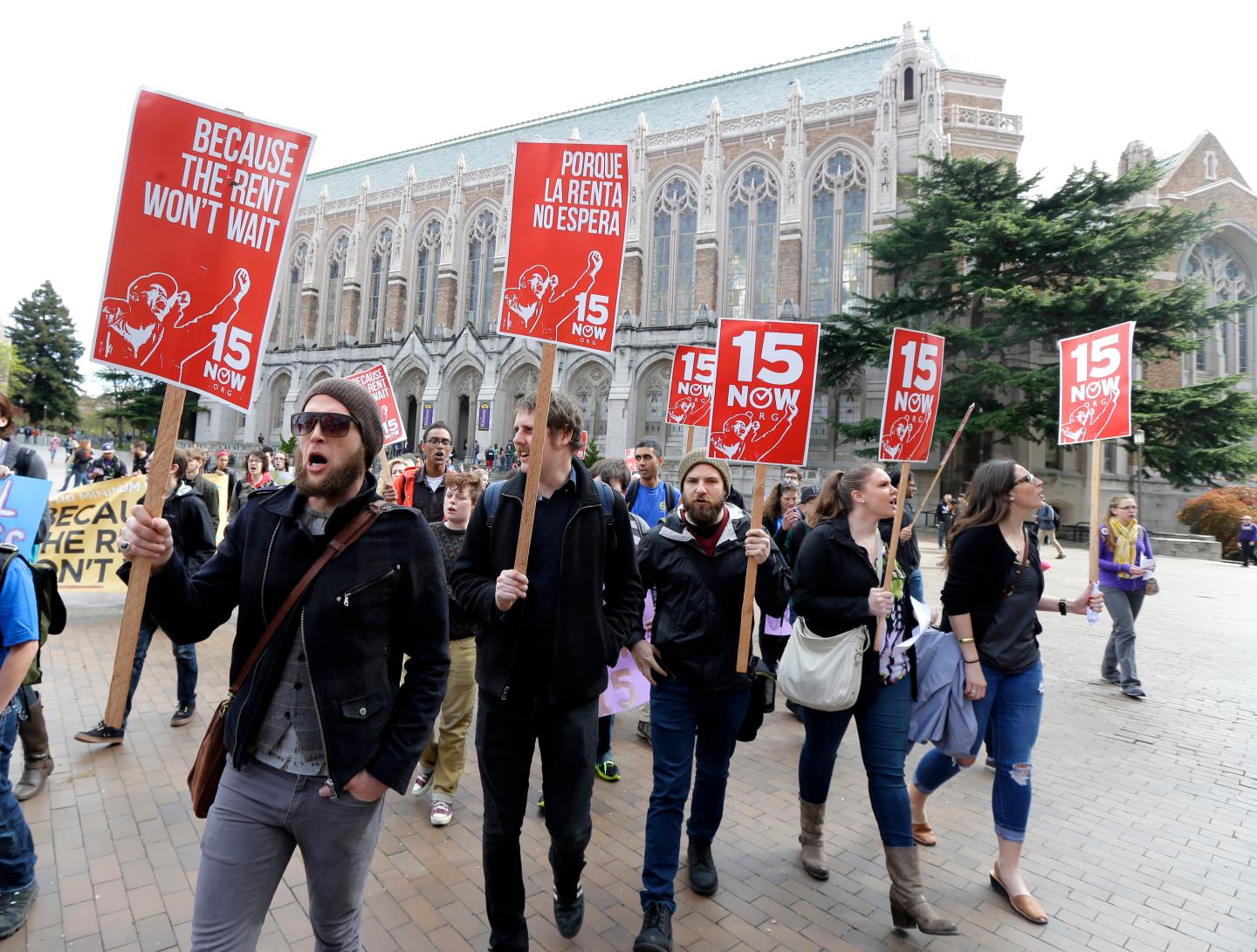
Seattle Minimum Wage
Students and other supporters protest, Wednesday, April 1, 2015, on the University of Washington campus in Seattle, in support of raising the minimum wage for campus workers to $15 an hour. (AP Photo/Ted S. Warren)Photograph by Ted S. Warren — AP
Add Fortune on Google for similar content.

In an op-ed in The Wall Street Journal last week, billionaire investor Warren Buffett argued that any plan to increase the minimum wage “would almost certainly reduce employment in a major way.” Given his past support of average Americans, his statement should not be viewed as a stand against better wages; rather, it underscores the fact that the average American worker faces multiple challenges beyond today’s debate over the minimum wage. Here are three big ones:

Corporate power is growing

For starters, corporations today have disproportionate influence over U.S. workers. Employees can be hired or fired for almost any reason as the U.S. operates under an employment-at-will system. At the same time, the power of labor unions is declining, with only 11.1% of workers belonging to a union in 2014 compared to 20% in 1983, according to the Bureau of Labor Statistics.

In this landscape, major corporations can set wage levels by virtue of being the largest employers. The more people a company hires, the more of the labor market it controls, and the greater its power to bring down the average wage for any particular job. This distortion of market forces by large players can be seen widely in industries like fast food and retail.

Workers are competing with machines

As sophisticated new technologies emerge to automate human tasks, the employment potential for future workers is bound to decline. As Microsoft founder Bill Gates stated in an interview last year, many existing jobs might disappear within two decades due to technology, and an Oxford University study concluded that 47% of U.S. jobs could be at risk within 10 years due to advances in robotics.

Researchers at MIT have also painted a bleak picture for the American workforce, and not just for blue-collar jobs. The availability of cheaper computing power and storage capacity as well as the emergence of artificial intelligence and big data analytics could turn even professional services in white-collar industries, such as banking and law, into technical commodities – easily and cheaply provided by machines instead of people.

Income inequality

Of course, new technologies can also open up new avenues of employment, but mainly for specialized skills. Here, too, most low-wage workers face an uphill struggle. They often have to work multiple jobs just to make ends meet, which leaves little time or resources to gain higher education. Their children, too, face daunting challenges due to substandard education and the inability to secure ‘gateway’ college degrees, which could secure them high paying jobs in the future. Income inequality exacerbates this problem, leaving the majority of workers stuck in a vicious cycle.

Combine this with a shrinking pool of jobs and you have a recipe for disaster.

All this could have a strong negative impact on the U.S. economy, as unemployment is a serious drain on national resources. The more people out of work, the greater the pressures on unemployment benefits, food stamps, and other welfare programs, which then necessitates higher taxes and hampers prosperity for all.

An even bigger problem is that 70% of the U.S. economy stems from consumption, which is correlated to employment and wages. The higher the unemployment or lower the wages, the less the money available for spending, especially in the low-income bracket. While the increasing wealth of business owners, who benefit by paying lower wages or hiring fewer workers, could have a counterbalancing effect, research has shown that wealthier citizens also have a lower marginal propensity to consume (in other words, they save more) than low-wage workers. Therefore, total consumption would still fall.

Buffett’s suggestion is to increase the earned income tax credit, through which the government pads the income of low-wage workers. This can increase their ability to survive and enhance their skills. It’s a good idea, but it still doesn’t address long-term job obsolescence or growing inequality.
[fortune-brightcove videoid=4212382473001]

In this context, a higher minimum wage would certainly be a good thing. But as Buffett points out, if it reduces employment, it won’t help anyone, so the correct solution is not necessarily a simple government mandate but a dynamic public-private partnership that brings the private sector into the conversation and fosters a national commitment to protecting the American worker.

It’s true that companies like Wal-mart (WMT) and McDonalds (MCD), who have been criticized in the past for not paying people enough, are finally taking steps to increase wages, but this is mainly in response to a temporarily tight labor market. That situation could reverse itself quickly, as pointed out by TheStreet.com. We need to do better than that.

Our most powerful companies need to recognize how their choices impact workers, and therefore the economy, and act cooperatively to raise market wage levels so that the government doesn’t have to. Buffett is right that we need to preserve the integrity of the free market, but the system also needs to take care of the people who make the free market possible.

Kumar has worked in technology, media, and telecom investment banking. He has evaluated mergers and acquisitions in these sectors and provided strategic consulting to media companies and hedge funds.


About the Author
By S. Kumar
See full bioRight Arrow Button Icon
Add Fortune on Google for similar content.

Latest in Commentary

Finance
Lorem ipsum dolor sit amet, consectetur adipiscing elit, sed do eiusmod tempor incididunt ut labore et dolore magna aliqua. Ut enim ad minim veniam
By Fortune Editors
October 20, 2025
Finance
Lorem ipsum dolor sit amet, consectetur adipiscing elit, sed do eiusmod tempor incididunt ut labore et dolore magna aliqua. Ut enim ad minim veniam
By Fortune Editors
October 20, 2025
Finance
Lorem ipsum dolor sit amet, consectetur adipiscing elit, sed do eiusmod tempor incididunt ut labore et dolore magna aliqua. Ut enim ad minim veniam
By Fortune Editors
October 20, 2025
Finance
Lorem ipsum dolor sit amet, consectetur adipiscing elit, sed do eiusmod tempor incididunt ut labore et dolore magna aliqua. Ut enim ad minim veniam
By Fortune Editors
October 20, 2025
Finance
Lorem ipsum dolor sit amet, consectetur adipiscing elit, sed do eiusmod tempor incididunt ut labore et dolore magna aliqua. Ut enim ad minim veniam
By Fortune Editors
October 20, 2025
Finance
Lorem ipsum dolor sit amet, consectetur adipiscing elit, sed do eiusmod tempor incididunt ut labore et dolore magna aliqua. Ut enim ad minim veniam
By Fortune Editors
October 20, 2025

Most Popular

Finance
Lorem ipsum dolor sit amet, consectetur adipiscing elit, sed do eiusmod tempor incididunt ut labore et dolore magna aliqua. Ut enim ad minim veniam
By Fortune Editors
October 20, 2025
Finance
Lorem ipsum dolor sit amet, consectetur adipiscing elit, sed do eiusmod tempor incididunt ut labore et dolore magna aliqua. Ut enim ad minim veniam
By Fortune Editors
October 20, 2025
Finance
Lorem ipsum dolor sit amet, consectetur adipiscing elit, sed do eiusmod tempor incididunt ut labore et dolore magna aliqua. Ut enim ad minim veniam
By Fortune Editors
October 20, 2025
Finance
Lorem ipsum dolor sit amet, consectetur adipiscing elit, sed do eiusmod tempor incididunt ut labore et dolore magna aliqua. Ut enim ad minim veniam
By Fortune Editors
October 20, 2025
Finance
Lorem ipsum dolor sit amet, consectetur adipiscing elit, sed do eiusmod tempor incididunt ut labore et dolore magna aliqua. Ut enim ad minim veniam
By Fortune Editors
October 20, 2025
Finance
Lorem ipsum dolor sit amet, consectetur adipiscing elit, sed do eiusmod tempor incididunt ut labore et dolore magna aliqua. Ut enim ad minim veniam
By Fortune Editors
October 20, 2025
Fortune Secondary Logo
Rankings
  • 100 Best Companies
  • Fortune 500
  • Global 500
  • Fortune 500 Europe
  • Most Powerful Women
  • World's Most Admired Companies
  • See All Rankings
  • Lists Calendar
Sections
  • Finance
  • Fortune Crypto
  • Features
  • Leadership
  • Health
  • Commentary
  • Success
  • Retail
  • Mpw
  • Tech
  • Lifestyle
  • CEO Initiative
  • Asia
  • Politics
  • Conferences
  • Europe
  • Newsletters
  • Personal Finance
  • Environment
  • Magazine
  • Education
Customer Support
  • Frequently Asked Questions
  • Customer Service Portal
  • Privacy Policy
  • Terms Of Use
  • Single Issues For Purchase
  • International Print
Commercial Services
  • Advertising
  • Fortune Brand Studio
  • Fortune Analytics
  • Fortune Conferences
  • Business Development
  • Group Subscriptions
About Us
  • About Us
  • Press Center
  • Work At Fortune
  • Terms And Conditions
  • Site Map
  • About Us
  • Press Center
  • Work At Fortune
  • Terms And Conditions
  • Site Map
  • Facebook icon
  • Twitter icon
  • LinkedIn icon
  • Instagram icon
  • Pinterest icon

Latest in Commentary

Asia’s defense boom is rewiring the global arms supply chain
Commentaryarms, weapons, and defense
Asia’s defense boom is rewiring the global arms supply chain
By Chris OberoiJune 24, 2026
14 hours ago
steve
Commentary250 Years of Innovation
Steve Case: America was built by entrepreneurs. Here’s how we keep that edge for the next 250 years
By Steve CaseJune 24, 2026
22 hours ago
t
CommentaryWhite House
Trump mistakes the bully pulpit for bullying leadership — history’s villains were never heroes
By Jeffrey Sonnenfeld and Steven TianJune 24, 2026
23 hours ago
mg
CommentaryHealth
The ‘tech neck’ time bomb: why 43 million young Americans could cripple U.S. health care within a generation
By Michael GerlingJune 24, 2026
23 hours ago
sb
Commentaryclimate change
The climate policy triangle: why leaders can no longer choose between growth, security and sustainability
By Sebastian BuckupJune 23, 2026
2 days ago
brett
CommentaryManagement
Middle managers aren’t going extinct—they’re evolving into something more powerful
By Brett HurtJune 23, 2026
2 days ago

Most Popular

Now worth $200 million, Sarah Jessica Parker credits being ‘one of eight kids that struggled financially’ for her hunger, ambition, and work ethic
Success
Now worth $200 million, Sarah Jessica Parker credits being ‘one of eight kids that struggled financially’ for her hunger, ambition, and work ethic
By Orianna Rosa RoyleJune 24, 2026
1 day ago
The Pentagon said Iran War costs $29 billion, but the real cost is closer to $200 billion—and counting
Economy
The Pentagon said Iran War costs $29 billion, but the real cost is closer to $200 billion—and counting
By Jacqueline MunisJune 24, 2026
1 day ago
Amazon's record Prime Day masks a darker truth: Americans are spending more and getting less
Retail
Amazon's record Prime Day masks a darker truth: Americans are spending more and getting less
By Nick LichtenbergJune 24, 2026
20 hours ago
After forcing workers back to the office, Goldman Sachs and JPMorgan Chase are now letting their staff work remotely—but only for the World Cup
Success
After forcing workers back to the office, Goldman Sachs and JPMorgan Chase are now letting their staff work remotely—but only for the World Cup
By Orianna Rosa RoyleJune 23, 2026
2 days ago
Ray Dalio just finished a 10-day trip to China. He says global leaders know America ‘doesn’t have what it takes to fight to maintain its empire’
Asia
Ray Dalio just finished a 10-day trip to China. He says global leaders know America ‘doesn’t have what it takes to fight to maintain its empire’
By Nick LichtenbergJune 24, 2026
22 hours ago
Trump’s international student crackdown kicked off a domino effect that could shave nearly $500 billion off the economy
Economy
Trump’s international student crackdown kicked off a domino effect that could shave nearly $500 billion off the economy
By Tristan BoveJune 24, 2026
17 hours ago

© 2026 Fortune Media IP Limited. All Rights Reserved. Use of this site constitutes acceptance of our Terms of Use and Privacy Policy | CA Notice at Collection and Privacy Notice | Do Not Sell/Share My Personal Information
FORTUNE is a trademark of Fortune Media IP Limited, registered in the U.S. and other countries. FORTUNE may receive compensation for some links to products and services on this website. Offers may be subject to change without notice.