• Home
  • Latest
  • Fortune 500
  • Finance
  • Tech
  • Leadership
  • Lifestyle
  • Rankings
  • Multimedia
FinanceEconomics

Ben Bernanke’s second life as just another blogger

By
Chris Matthews
Chris Matthews
Down Arrow Button Icon
By
Chris Matthews
Chris Matthews
Down Arrow Button Icon
April 1, 2015, 4:46 PM ET
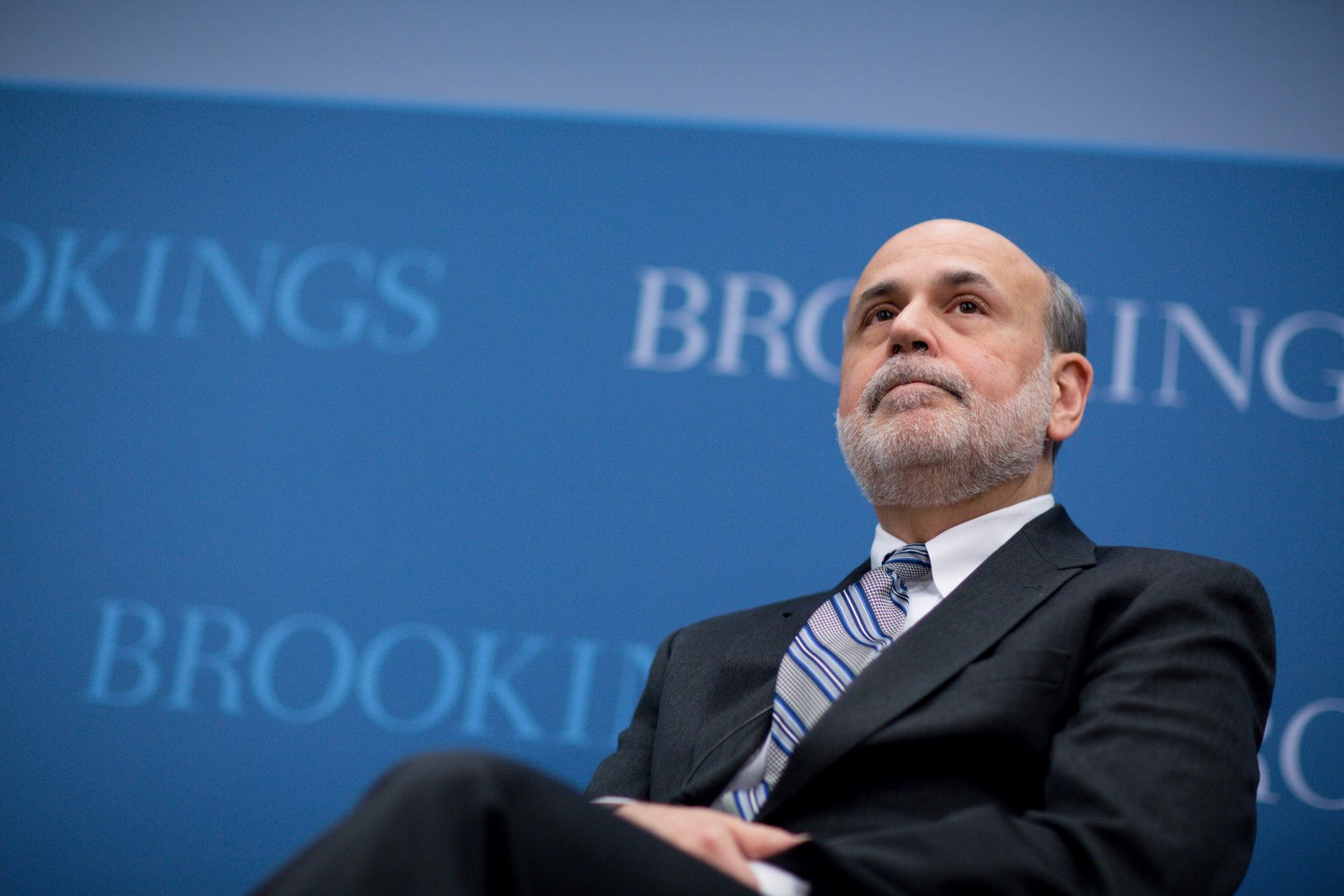
Federal Reserve Chairman Bernanke Speaks At The Brookings Institution
Ben S. Bernanke, chairman of the U.S. Federal Reserve, listens to a question during a discussion at the Brookings Institution in Washington, D.C., U.S., on Thursday, Jan. 16, 2014. Bernanke defended quantitative easing, saying it has helped the economy while posing little risk of inflation. Photographer: Andrew Harrer/Bloomberg via Getty ImagesPhotograph by Andrew Harrer — Bloomberg/Getty Images

This week, Ben Bernanke made the transition from being the most powerful man in the global economy — Chairman of the Federal Reserve — to one of the most feckless: an economics blogger. Welcome, Ben! Come on in, the water is lukewarm and crowded.

I kid, sort of. After all, as a world renowned economist and former Fed Chair, Bernanke’s words are more influential than your average finance writer’s. He’s already engaged another famous economist, Larry Summers, in a debate over the concept of “secular stagnation,” which has garnered a lot of attention on the Internet.

Secular stagnation is a concept that was first introduced by economist Alvin Hanlin toward the end of the Great Depression to describe an economy that was permanently depressed due to a lack of demand for investment. Larry Summers resurrected this term in a 2013 speech, and the idea has been discussed thoroughly by economists who are beginning to believe that slow growth in the U.S. and other advanced economies shows that we “might be suffering from more than the hangover from a financial crisis,” as Berkley University economist Barry Eichengreen put it.

Economists don’t agree whether we’re experiencing a period of secular stagnation (Bernanke is in the there’s-no-stagnation camp), and those who do differ on the causes. Some blame the lack of productivity enhancing technological developments or the fact that we’ve already reaped the benefits of trends like women entering the workforce and universal education. Others blame the increase in life expectancy in the developed world, which has increased demand for safe assets and lowered demand for risky but high-yielding ventures.

The merits of each argument aside, it’s probably a nice change of pace for Ben Bernanke to return to an academic debate after so many years in which his decisions would have real effects on so many across the world. But the term “academic” doesn’t just refer to the setting of the debate. It also means, “theoretical or hypothetical; not practical, realistic, or directly useful.”

The arguments Summers and Bernanke are having simply won’t affect public policy because even if they do end up coming to a conclusion, they’d have to convince the public to go along with their prescriptions. If somehow Summers and Bernanke were able to agree that we’re experiencing secular stagnation, the chances are that they’d be able to convince the public and Congress to accept the sort of debt-funded infrastructure-spending binge that would be the proper policy response are less than remote.

The track record of the economics community in moving public opinion isn’t great. From carbon taxes to the eliminating the mortgage interest rate deduction, the list of issues that the economics community nearly universally supports, but the public does not, is long.

One reason for this is that what makes economic sense is often policies that require short-term pain for long-term gain. Voters usually don’t like policies that result in any sort of pain. But another reason economists have trouble capturing the public’s imagination is because they speak in esoteric language and are very humble about what they know and what they don’t.

There are a few economists, however, that have abandoned the sort of comportment that the economics community favors for the sort of rhetoric that motivates voters. Paul Krugman won a Nobel Prize for his work in international trade theory, but is better known as a liberal firebrand who spends his days getting under the skin of small-government conservatives from his post as columnist for the New York Times. In 2013, he admitted during an episode of Morning Joe that in his many years of writing and trying to convince actual politicians to execute what he believes is the correct path, he’s had to abandoned nuance. As he said back in 2013, referring to his plan for promoting a more robust recovery:

“Ideally I’d say let’s have a plan to reduce the budget deficit five years from now, ten years from now while at the same time doing stimulus for the economy. [But] Washington doesn’t work that way. If you spend a lot of your time talking about how debt and entitlements are a problem, the message that we need to promote jobs right now gets lost.”

In other words, he assumes that politicians, and voters, don’t walk and chew gum at the same time. Keep it simple. Get to the point, and try not to confuse.

That’s how an economist gets 1.33 million Twitter followers and becomes a household name. Ben Bernanke is about 1 million followers behind his former Princeton colleague, and he’ll have to dispense with the cordiality and nuance if he hopes to catch up.

Watch more business news from Fortune:

About the Author
By Chris Matthews
See full bioRight Arrow Button Icon

Latest in Finance

Finance
Lorem ipsum dolor sit amet, consectetur adipiscing elit, sed do eiusmod tempor incididunt ut labore et dolore magna aliqua. Ut enim ad minim veniam
By Fortune Editors
October 20, 2025
Finance
Lorem ipsum dolor sit amet, consectetur adipiscing elit, sed do eiusmod tempor incididunt ut labore et dolore magna aliqua. Ut enim ad minim veniam
By Fortune Editors
October 20, 2025
Finance
Lorem ipsum dolor sit amet, consectetur adipiscing elit, sed do eiusmod tempor incididunt ut labore et dolore magna aliqua. Ut enim ad minim veniam
By Fortune Editors
October 20, 2025
Finance
Lorem ipsum dolor sit amet, consectetur adipiscing elit, sed do eiusmod tempor incididunt ut labore et dolore magna aliqua. Ut enim ad minim veniam
By Fortune Editors
October 20, 2025
Finance
Lorem ipsum dolor sit amet, consectetur adipiscing elit, sed do eiusmod tempor incididunt ut labore et dolore magna aliqua. Ut enim ad minim veniam
By Fortune Editors
October 20, 2025
Finance
Lorem ipsum dolor sit amet, consectetur adipiscing elit, sed do eiusmod tempor incididunt ut labore et dolore magna aliqua. Ut enim ad minim veniam
By Fortune Editors
October 20, 2025

Most Popular

Finance
Lorem ipsum dolor sit amet, consectetur adipiscing elit, sed do eiusmod tempor incididunt ut labore et dolore magna aliqua. Ut enim ad minim veniam
By Fortune Editors
October 20, 2025
Finance
Lorem ipsum dolor sit amet, consectetur adipiscing elit, sed do eiusmod tempor incididunt ut labore et dolore magna aliqua. Ut enim ad minim veniam
By Fortune Editors
October 20, 2025
Finance
Lorem ipsum dolor sit amet, consectetur adipiscing elit, sed do eiusmod tempor incididunt ut labore et dolore magna aliqua. Ut enim ad minim veniam
By Fortune Editors
October 20, 2025
Finance
Lorem ipsum dolor sit amet, consectetur adipiscing elit, sed do eiusmod tempor incididunt ut labore et dolore magna aliqua. Ut enim ad minim veniam
By Fortune Editors
October 20, 2025
Finance
Lorem ipsum dolor sit amet, consectetur adipiscing elit, sed do eiusmod tempor incididunt ut labore et dolore magna aliqua. Ut enim ad minim veniam
By Fortune Editors
October 20, 2025
Finance
Lorem ipsum dolor sit amet, consectetur adipiscing elit, sed do eiusmod tempor incididunt ut labore et dolore magna aliqua. Ut enim ad minim veniam
By Fortune Editors
October 20, 2025
Fortune Secondary Logo
Rankings
  • 100 Best Companies
  • Fortune 500
  • Global 500
  • Fortune 500 Europe
  • Most Powerful Women
  • Future 50
  • World’s Most Admired Companies
  • See All Rankings
Sections
  • Finance
  • Fortune Crypto
  • Features
  • Leadership
  • Health
  • Commentary
  • Success
  • Retail
  • Mpw
  • Tech
  • Lifestyle
  • CEO Initiative
  • Asia
  • Politics
  • Conferences
  • Europe
  • Newsletters
  • Personal Finance
  • Environment
  • Magazine
  • Education
Customer Support
  • Frequently Asked Questions
  • Customer Service Portal
  • Privacy Policy
  • Terms Of Use
  • Single Issues For Purchase
  • International Print
Commercial Services
  • Advertising
  • Fortune Brand Studio
  • Fortune Analytics
  • Fortune Conferences
  • Business Development
  • Group Subscriptions
About Us
  • About Us
  • Editorial Calendar
  • Press Center
  • Work At Fortune
  • Diversity And Inclusion
  • Terms And Conditions
  • Site Map
  • About Us
  • Editorial Calendar
  • Press Center
  • Work At Fortune
  • Diversity And Inclusion
  • Terms And Conditions
  • Site Map
  • Facebook icon
  • Twitter icon
  • LinkedIn icon
  • Instagram icon
  • Pinterest icon

Latest in Finance

Warner gestures
AIAmerican Politics
New college grad unemployment will spike to 35% in 2 years, senator warns, forcing ‘Dario, Sam’ to quit AI fear-mongering
By Jacqueline MunisMarch 25, 2026
53 minutes ago
Pete Hegseth speaks behind a podium as Donald Trump watches behind him.
EconomyRecession
Mark Zandi warns recession odds are creeping toward 50%, and the Iran war could launch us into economic turmoil by midyear
By Sasha RogelbergMarch 25, 2026
1 hour ago
People on a breakwater backdropped by commercial vessels anchored in the Gulf, near the Strait of Hormuz, on March 22, 2026 in Ajman, United Arab Emirates.
EnergyIran
Trump wrote the tariff playbook. Now Iran is using it on the world’s most important oil route.
By Eva RoytburgMarch 25, 2026
1 hour ago
jeremy wacksman
Real EstateHousing
The median first-time homebuyer is now 40. Zillow’s CEO says don’t expect that to change anytime soon
By Jake AngeloMarch 25, 2026
2 hours ago
EuropeLetter from London
Rishi Sunak is giving advice to CEOs on AI. Here are his golden rules
By Kamal AhmedMarch 25, 2026
3 hours ago
LawFood and drink
‘I want everybody to have enough food’: the scientist who made your packaged food safer just won the world’s most prestigious food prize
By The Associated Press and Hannah FingerhutMarch 25, 2026
3 hours ago

Most Popular

Magazine
The youngest-ever female CEO of a Fortune 500 company is fighting Trump's cuts to keep Medicaid strong
By Fortune EditorsMarch 24, 2026
1 day ago
Commentary
The Treasury just declared the U.S. insolvent. The media missed it
By Fortune EditorsMarch 23, 2026
2 days ago
Success
Palantir’s billionaire CEO says only two kinds of people will succeed in the AI era: trade workers — ‘or you’re neurodivergent’
By Fortune EditorsMarch 24, 2026
1 day ago
Energy
Nobel laureate Paul Krugman calls it 'treason': $580 million in suspicious oil futures traded minutes before Trump's Iran reversal
By Fortune EditorsMarch 24, 2026
1 day ago
Success
JPMorgan has started monitoring the keystrokes, video calls, and meetings of its junior investment bankers—and they say it's for employee well-being
By Fortune EditorsMarch 24, 2026
1 day ago
Personal Finance
Current price of oil as of March 24, 2026
By Fortune EditorsMarch 24, 2026
1 day ago

© 2026 Fortune Media IP Limited. All Rights Reserved. Use of this site constitutes acceptance of our Terms of Use and Privacy Policy | CA Notice at Collection and Privacy Notice | Do Not Sell/Share My Personal Information
FORTUNE is a trademark of Fortune Media IP Limited, registered in the U.S. and other countries. FORTUNE may receive compensation for some links to products and services on this website. Offers may be subject to change without notice.