• Home
  • Latest
  • Fortune 500
  • Finance
  • Tech
  • Leadership
  • Lifestyle
  • Rankings
  • Multimedia
Commentary

How the U.S. can strengthen economic and military ties with India

By
John Yoo
John Yoo
and
Riddhi Dasgupta
Riddhi Dasgupta
Down Arrow Button Icon
By
John Yoo
John Yoo
and
Riddhi Dasgupta
Riddhi Dasgupta
Down Arrow Button Icon
March 21, 2015, 12:00 PM ET
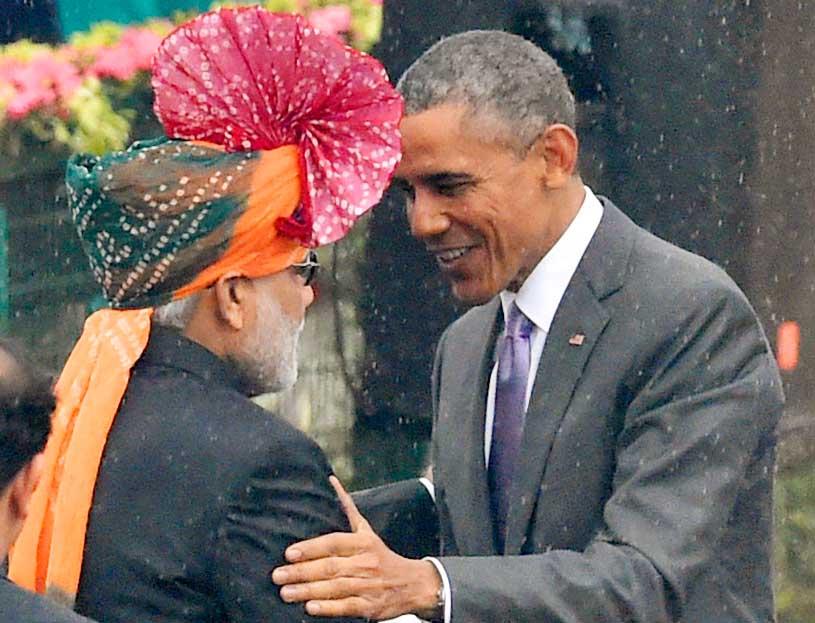
India Celebrates 66th Republic Day
NEW DELHI, INDIA - JANUARY 26: President of United States of America (USA) Barack Obama and Prime Minister of India Narendra Modi during the ceremony of 66th Republic day of India, at Rajpath, on January 26, 2015 in New Delhi, India. Photograph by Sonu Mehta — Hindustan Times via Getty Images

President Barack Obama has finally resumed progress toward one of the most important strategic goals in American foreign policy: strengthening America’s alliance with India. President Obama’s visit to New Delhi in January as the chief guest of India’s Republic Day celebrations followed Prime Minister Narendra Modi’s September state visit to the United States. For the Obama administration and its successor, allying with the world’s largest democracy will represent a welcome seismic shift in the balance of power.

Washington and New Delhi share common interests. The United States and India are the world’s two largest democracies with a similar commitment to the Anglo-American rule of law. Economic exchange between the nations is booming. Bilateral U.S.-India trade has increased five-fold since 2001 to nearly $100 billion. President Obama and Modi pledged to raise it another five-fold. The Indian economy presently produces $1.876 trillion a year, making it an attractive venue for American investors. Economic interdependence has also laid the foundations for closer military cooperation. Last year, India imported approximately $2 billion in military equipment from the United States, a significant increase from $237 million in 2009. The U.S. recently surpassed Russia as India’s primary arms supplier. Today, the U.S. is the Indian Army’s most frequent partner for military exercises.

America and India’s economies and political systems benefit from free trade and regional stability. China’s rise, and the expansion of its military and territorial aims, poses a threat to both. China’s border with India has sparked war before. Beijing’s aggressive claims to islands in the South China Seas reveal Beijing’s territorial ambitions have grown alongside its economy. China seeks to replace the United States as the leading power in Asia. India is pulling out of nonalignment just as the reality of disorder has begun to intrude. Since Pakistan is concerned about its nuclear-armed neighbor and depends on American aid dollars to the tune of $20 billion over just the past decade, necessity will temper its displeasure.

But the U.S. and India need to do more to secure regional stability and temper China’s ambitions. A defense pact could become the first step in a broader Asian alliance that would guarantee each nation’s security, build their economic ties, and commit them to protect the territorial status quo. An Asian defense and economic network would cement India’s recent turn away from Moscow and recognize its leading role in the region. It would keep the U.S. committed to the region at a time of shrinking defense budgets and rising global commitments.

India, the U.S., and their regional allies could form a Concert of Asia. These nations already share a commitment to free markets and democracy. It will have as its focus the moderation of China’s rise, which threatens to disrupt the decades of stability that have unwritten the economic miracles in Japan, Korea, Taiwan, Hong Kong, Singapore, and now even China itself. It will also help contain other threats to regional stability: Pakistan’s religious extremism, terrorist networks, military overlords, and Russian aggression. This partnership has obvious economic and security advantages. In 2013, just the export-driven Asian Tiger (excluding Hong Kong, now part of China) and Tiger Cub economies had a combined GDP of almost $4 trillion. To export-oriented nations, military defense is of paramount importance.

A new Concert of Asia for the 21st Century could mark the way for closer economic ties. An encouraging sign is the upswing in U.S. investment in ASEAN countries to $204 billion in 2013, a rise of 9.1% from 2012. The extant seven-member Asia-Pacific Trade Agreement (APTA) is simply inadequate to take advantage of this momentum. Primarily, it has no defense component. Moreover, not only does it lack a key player like the U.S. to help balance this trade configuration, it also contains nations like Mongolia whose inclusion in the APTA has led to special concessions to less developed countries. Yet even the APTA’s signatories have recognized that without an effective and equal investor-state dispute settlement mechanism which protects foreign investors’ rights, any such agreement is a doomed non-starter. The South Asian Free Trade Area, which deals primarily with reducing customs duties, is also flawed. A stronger model is the Comprehensive Trade and Economic Agreement (CETA) between Canada and the EU, a treaty projected to buoy trade, fortify economic relations among signatories and create jobs as well as to increase $13.6 billion for European GDP.

Many of the Concert’s prospective signatories who are not Tigers or Tiger Cubs are parties to the Association of South East Asian Nations (ASEAN), which traded goods and services with America totaling $241.7 billion in 2013. But China, Japan and the EU are the leading trade partners to ASEAN and the European Union is miles ahead as the largest investor in ASEAN nations. ASEAN is being held back by the reputational deficit of legal and militaristic instability, particularly with the frequency of coups and martial law in Thailand, Cambodia and Myanmar. An alliance with India and the United States, which are stable and secure democracies with both serious military capability and the rule of law on their side, will diminish these complications.

A Concert of Asia will signal to the world markets and to diplomatic friends and foes alike that India and the United States, not to mention their other allies, will help secure the stability necessary for further economic growth. The high military spending by Asian countries reflects the deficiency of trust in the region, which this concert will help alleviate. The United States, India and their Asian trade partners are in it together.

John Yoo is the Heller Professor of Law at the University of California at Berkeley and former Deputy Assistant U.S. Attorney General. Riddhi Dasgupta is an international law expert and author of ​​ International Interplay. Views expressed are their own.

Watch more business news from Fortune:

About the Authors
By John Yoo
See full bioRight Arrow Button Icon
By Riddhi Dasgupta
See full bioRight Arrow Button Icon

Latest in Commentary

Finance
Lorem ipsum dolor sit amet, consectetur adipiscing elit, sed do eiusmod tempor incididunt ut labore et dolore magna aliqua. Ut enim ad minim veniam
By Fortune Editors
October 20, 2025
Finance
Lorem ipsum dolor sit amet, consectetur adipiscing elit, sed do eiusmod tempor incididunt ut labore et dolore magna aliqua. Ut enim ad minim veniam
By Fortune Editors
October 20, 2025
Finance
Lorem ipsum dolor sit amet, consectetur adipiscing elit, sed do eiusmod tempor incididunt ut labore et dolore magna aliqua. Ut enim ad minim veniam
By Fortune Editors
October 20, 2025
Finance
Lorem ipsum dolor sit amet, consectetur adipiscing elit, sed do eiusmod tempor incididunt ut labore et dolore magna aliqua. Ut enim ad minim veniam
By Fortune Editors
October 20, 2025
Finance
Lorem ipsum dolor sit amet, consectetur adipiscing elit, sed do eiusmod tempor incididunt ut labore et dolore magna aliqua. Ut enim ad minim veniam
By Fortune Editors
October 20, 2025
Finance
Lorem ipsum dolor sit amet, consectetur adipiscing elit, sed do eiusmod tempor incididunt ut labore et dolore magna aliqua. Ut enim ad minim veniam
By Fortune Editors
October 20, 2025

Most Popular

Finance
Lorem ipsum dolor sit amet, consectetur adipiscing elit, sed do eiusmod tempor incididunt ut labore et dolore magna aliqua. Ut enim ad minim veniam
By Fortune Editors
October 20, 2025
Finance
Lorem ipsum dolor sit amet, consectetur adipiscing elit, sed do eiusmod tempor incididunt ut labore et dolore magna aliqua. Ut enim ad minim veniam
By Fortune Editors
October 20, 2025
Finance
Lorem ipsum dolor sit amet, consectetur adipiscing elit, sed do eiusmod tempor incididunt ut labore et dolore magna aliqua. Ut enim ad minim veniam
By Fortune Editors
October 20, 2025
Finance
Lorem ipsum dolor sit amet, consectetur adipiscing elit, sed do eiusmod tempor incididunt ut labore et dolore magna aliqua. Ut enim ad minim veniam
By Fortune Editors
October 20, 2025
Finance
Lorem ipsum dolor sit amet, consectetur adipiscing elit, sed do eiusmod tempor incididunt ut labore et dolore magna aliqua. Ut enim ad minim veniam
By Fortune Editors
October 20, 2025
Finance
Lorem ipsum dolor sit amet, consectetur adipiscing elit, sed do eiusmod tempor incididunt ut labore et dolore magna aliqua. Ut enim ad minim veniam
By Fortune Editors
October 20, 2025
Fortune Secondary Logo
Rankings
  • 100 Best Companies
  • Fortune 500
  • Global 500
  • Fortune 500 Europe
  • Most Powerful Women
  • World's Most Admired Companies
  • See All Rankings
  • Lists Calendar
Sections
  • Finance
  • Fortune Crypto
  • Features
  • Leadership
  • Health
  • Commentary
  • Success
  • Retail
  • Mpw
  • Tech
  • Lifestyle
  • CEO Initiative
  • Asia
  • Politics
  • Conferences
  • Europe
  • Newsletters
  • Personal Finance
  • Environment
  • Magazine
  • Education
Customer Support
  • Frequently Asked Questions
  • Customer Service Portal
  • Privacy Policy
  • Terms Of Use
  • Single Issues For Purchase
  • International Print
Commercial Services
  • Advertising
  • Fortune Brand Studio
  • Fortune Analytics
  • Fortune Conferences
  • Business Development
  • Group Subscriptions
About Us
  • About Us
  • Press Center
  • Work At Fortune
  • Terms And Conditions
  • Site Map
  • About Us
  • Press Center
  • Work At Fortune
  • Terms And Conditions
  • Site Map
  • Facebook icon
  • Twitter icon
  • LinkedIn icon
  • Instagram icon
  • Pinterest icon

Latest in Commentary

joaquin
Commentary250 Years of Innovation
Johnson & Johnson CEO: America’s innovation advantage starts with health 
By Joaquin DuatoMay 9, 2026
9 hours ago
reed
CommentaryRetirement
Tim Cook and Reed Hastings just showed every CEO how to leave gracefully
By Paul HardartMay 9, 2026
11 hours ago
golf
Commentarybooks
How playing golf alone can make you better at your job
By Gary BelskyMay 8, 2026
1 day ago
naomi
Commentarymental health
Naomi Osaka: the things I didn’t do to succeed
By Naomi OsakaMay 8, 2026
1 day ago
amanda
Commentarybatteries
Why energy storage is moving beyond the capex debate
By Amanda SimonianMay 7, 2026
2 days ago
trump
CommentaryMedicare
Auto-enrollment in Medicare Advantage isn’t a nudge. It’s a trap
By Brian KeyserMay 7, 2026
2 days ago

Most Popular

California farmers must destroy 420,000 peach trees after Del Monte closes its canneries and cancels more than $550 million in long-term contracts
North America
California farmers must destroy 420,000 peach trees after Del Monte closes its canneries and cancels more than $550 million in long-term contracts
By Sasha RogelbergMay 7, 2026
2 days ago
A Michigan farm town voted down plans for a giant OpenAI-Oracle data center. Weeks later, construction began
Magazine
A Michigan farm town voted down plans for a giant OpenAI-Oracle data center. Weeks later, construction began
By Sharon GoldmanMay 6, 2026
4 days ago
The CEO of Maersk, which ships 14% of everything you buy, said the Iran war is adding $500 million in monthly costs it's trying not to pass down
Energy
The CEO of Maersk, which ships 14% of everything you buy, said the Iran war is adding $500 million in monthly costs it's trying not to pass down
By Sasha RogelbergMay 8, 2026
1 day ago
Current price of oil as of May 8, 2026
Personal Finance
Current price of oil as of May 8, 2026
By Joseph HostetlerMay 8, 2026
1 day ago
'Blue dot fever' plagues musicians like Post Malone, Meghan Trainor, and Zayn as a growing list of artists cancel tours due to lagging ticket sales
Arts & Entertainment
'Blue dot fever' plagues musicians like Post Malone, Meghan Trainor, and Zayn as a growing list of artists cancel tours due to lagging ticket sales
By Dave Lozo and Morning BrewMay 7, 2026
2 days ago
You're probably safe from the Hantavirus outbreak, but here's what you absolutely must not do, experts say
Politics
You're probably safe from the Hantavirus outbreak, but here's what you absolutely must not do, experts say
By Catherina GioinoMay 8, 2026
24 hours ago

© 2026 Fortune Media IP Limited. All Rights Reserved. Use of this site constitutes acceptance of our Terms of Use and Privacy Policy | CA Notice at Collection and Privacy Notice | Do Not Sell/Share My Personal Information
FORTUNE is a trademark of Fortune Media IP Limited, registered in the U.S. and other countries. FORTUNE may receive compensation for some links to products and services on this website. Offers may be subject to change without notice.