• Home
  • Latest
  • Fortune 500
  • Finance
  • Tech
  • Leadership
  • Lifestyle
  • Rankings
  • Multimedia
CommentaryIndia

Why the U.S. should aim for bigger economic plans with India

By
Alyssa Ayres
Alyssa Ayres
Down Arrow Button Icon
By
Alyssa Ayres
Alyssa Ayres
Down Arrow Button Icon
January 26, 2015, 2:43 PM ET
INDIA-US-DIPLOMACY
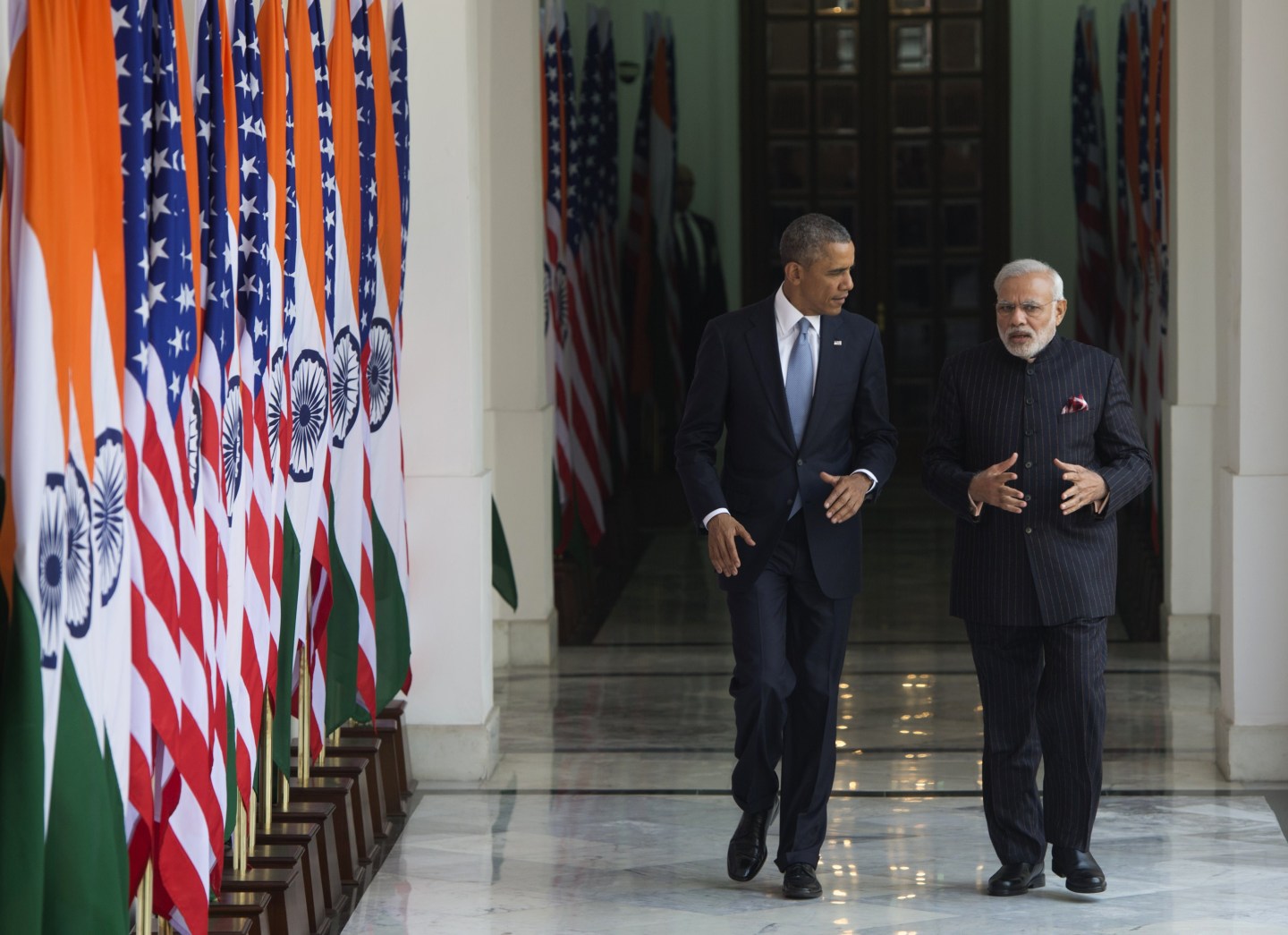
Indian Prime Minister Narendra Modi (R) and US President Barack Obama walk prior to meetings at Hyderabad House in New Delhi, India, January 25, 2015. US President Barack Obama began a landmark visit to India on January 25 with a bear hug from Prime Minister Narendra Modi, signalling a new warmth in a sometimes strained relationship. AFP PHOTO / SAUL LOEB (Photo credit should read SAUL LOEB/AFP/Getty Images)SAUL LOEB AFP/Getty Images

Over the weekend, President Barack Obama and Indian Prime Minister Narendra Modi turned a corner for the United States and India. The two leaders resolved issues in a long-stalled nuclear deal that for years kept U.S. nuclear power companies from doing business in India. Modi also hailed economics as “vital for the success of our strategic partnership.” In Modi, it appears that Washington has at last found a prime minister prepared to transform India’s economic relationship with America and officials should seize the chance to work with a leader focused on economic reform and trade. Washington should respond by hustling to secure India’s membership in the Asia-Pacific Economic Cooperation forum (APEC) and by developing a path for Indian membership in the Trans-Pacific Partnership (TPP) — a move that could potentially increase trade between the two nations.

Narendra Modi was elected prime minister last May on the promise to deliver rapid economic growth to his country’s 1.2 billion citizens. Growth has indeed begun to pick up from below 5% in 2013. Given Modi’s determination—a striking contrast with his most recent predecessor — Obama should make trade and economics a much higher priority. Unlike before, the U.S. may finally have found a partner in India who is able to convince his party and the opposition to enact long-delayed reforms that will benefit India and make it easier to do business in the world’s largest democracy.

In the U.S.-India joint statement released on Sunday, Obama took an important step by “welcoming India’s interest in joining” APEC. This statement ended a long period of inexplicable U.S. silence about an anomaly in the trade group—the absence of India, a major Asian economy. Now, Washington should get moving to convince all the other APEC members to back India before the annual summit in November. By doing so, India would join the U.S., China and 19 other nations in crafting action plans to reduce trade barriers. It’s a low risk gamble on India’s growth and importance to the Asia-Pacific economy.

The president should also signal that if India continues down the path of reform, the United States would welcome the Asian giant to negotiations for the TPP, America’s most important trade initiative in the region. Washington has a clear vision for economic cooperation with the 11 Asia-Pacific countries in the TPP, a sweeping trade agreement representing some 40 % of global GDP, but India is not among them.

Instead, India is participating in an alternative Asian trade negotiation, the Regional Comprehensive Economic Partnership agreement promoted by China that also includes seven TPP participants. India is already a $2 trillion economy, and by some estimates, is on track to become the world’s third largest economy by 2025. The U.S. strategy to further ties with Asia, the center of growth and prosperity this century, surely cannot be complete without more closely integrating U.S. markets with India’s and to deliver growth for both countries. President Obama should commit to India that U.S. and Indian negotiators will develop a roadmap for India’s possible membership in the TPP. In return, Modi will need to pledge more openness to U.S. trade and investment.

To be sure, trade and economics have been components of the U.S.-India conversation for years. But the pace of two-way trade has slowed in recent years to a near-standstill. Two-way trade has hovered below $100 billion since 2012, no longer growing by the leaps of previous years. That makes the $500 billion vision suggested by President Obama and Vice President Biden appear like a mirage on a distant horizon.

It’s true New Delhi can be famously tough in trade negotiations, and that will not likely change. But the U.S. cannot get to the next level of economic ties with India without a plan. Modi wants to accelerate his country’s economic growth and deliver his people from poverty. He sees the U.S. as a country uniquely capable of supporting India’s domestic transformation.

Obama, coming out of this symbolic and important visit to India, should demonstrate that Washington will do its part for India’s future by integrating India into economic regimes focused on delivering growth. That would be an ambitious agenda worth pursuing.

Alyssa Ayres is senior fellow for India, Pakistan, and South Asia at the Council on Foreign Relations. She served as U.S. deputy assistant secretary of state for South Asia from 2010 to 2013.

About the Author
By Alyssa Ayres
See full bioRight Arrow Button Icon

Latest in Commentary

Finance
Lorem ipsum dolor sit amet, consectetur adipiscing elit, sed do eiusmod tempor incididunt ut labore et dolore magna aliqua. Ut enim ad minim veniam
By Fortune Editors
October 20, 2025
Finance
Lorem ipsum dolor sit amet, consectetur adipiscing elit, sed do eiusmod tempor incididunt ut labore et dolore magna aliqua. Ut enim ad minim veniam
By Fortune Editors
October 20, 2025
Finance
Lorem ipsum dolor sit amet, consectetur adipiscing elit, sed do eiusmod tempor incididunt ut labore et dolore magna aliqua. Ut enim ad minim veniam
By Fortune Editors
October 20, 2025
Finance
Lorem ipsum dolor sit amet, consectetur adipiscing elit, sed do eiusmod tempor incididunt ut labore et dolore magna aliqua. Ut enim ad minim veniam
By Fortune Editors
October 20, 2025
Finance
Lorem ipsum dolor sit amet, consectetur adipiscing elit, sed do eiusmod tempor incididunt ut labore et dolore magna aliqua. Ut enim ad minim veniam
By Fortune Editors
October 20, 2025
Finance
Lorem ipsum dolor sit amet, consectetur adipiscing elit, sed do eiusmod tempor incididunt ut labore et dolore magna aliqua. Ut enim ad minim veniam
By Fortune Editors
October 20, 2025

Most Popular

Finance
Lorem ipsum dolor sit amet, consectetur adipiscing elit, sed do eiusmod tempor incididunt ut labore et dolore magna aliqua. Ut enim ad minim veniam
By Fortune Editors
October 20, 2025
Finance
Lorem ipsum dolor sit amet, consectetur adipiscing elit, sed do eiusmod tempor incididunt ut labore et dolore magna aliqua. Ut enim ad minim veniam
By Fortune Editors
October 20, 2025
Finance
Lorem ipsum dolor sit amet, consectetur adipiscing elit, sed do eiusmod tempor incididunt ut labore et dolore magna aliqua. Ut enim ad minim veniam
By Fortune Editors
October 20, 2025
Finance
Lorem ipsum dolor sit amet, consectetur adipiscing elit, sed do eiusmod tempor incididunt ut labore et dolore magna aliqua. Ut enim ad minim veniam
By Fortune Editors
October 20, 2025
Finance
Lorem ipsum dolor sit amet, consectetur adipiscing elit, sed do eiusmod tempor incididunt ut labore et dolore magna aliqua. Ut enim ad minim veniam
By Fortune Editors
October 20, 2025
Finance
Lorem ipsum dolor sit amet, consectetur adipiscing elit, sed do eiusmod tempor incididunt ut labore et dolore magna aliqua. Ut enim ad minim veniam
By Fortune Editors
October 20, 2025
Fortune Secondary Logo
Rankings
  • 100 Best Companies
  • Fortune 500
  • Global 500
  • Fortune 500 Europe
  • Most Powerful Women
  • Future 50
  • World’s Most Admired Companies
  • See All Rankings
Sections
  • Finance
  • Fortune Crypto
  • Features
  • Leadership
  • Health
  • Commentary
  • Success
  • Retail
  • Mpw
  • Tech
  • Lifestyle
  • CEO Initiative
  • Asia
  • Politics
  • Conferences
  • Europe
  • Newsletters
  • Personal Finance
  • Environment
  • Magazine
  • Education
Customer Support
  • Frequently Asked Questions
  • Customer Service Portal
  • Privacy Policy
  • Terms Of Use
  • Single Issues For Purchase
  • International Print
Commercial Services
  • Advertising
  • Fortune Brand Studio
  • Fortune Analytics
  • Fortune Conferences
  • Business Development
  • Group Subscriptions
About Us
  • About Us
  • Editorial Calendar
  • Press Center
  • Work At Fortune
  • Diversity And Inclusion
  • Terms And Conditions
  • Site Map
  • About Us
  • Editorial Calendar
  • Press Center
  • Work At Fortune
  • Diversity And Inclusion
  • Terms And Conditions
  • Site Map
  • Facebook icon
  • Twitter icon
  • LinkedIn icon
  • Instagram icon
  • Pinterest icon

Latest in Commentary

EuropeLetter from London
Rishi Sunak is giving advice to CEOs on AI. Here are his golden rules
By Kamal AhmedMarch 25, 2026
11 hours ago
retirement
CommentaryRetirement
Our retirement system gets a C-plus; policymakers have an opportunity to make it A grade
By Chris MahoneyMarch 25, 2026
19 hours ago
david-f
CommentaryVenture Capital
Europe has survived 3 energy shocks in 4 years. The only way out is to stop buying power from its enemies
By David FrykmanMarch 25, 2026
20 hours ago
fauci
CommentaryCOVID-19 vaccines
How COVID turned America against science — and what it will take to win it back
By David Blumenthal and James A. MoroneMarch 24, 2026
2 days ago
alex
Commentarydisruption
AI’s disruption is a choice, not a forecast
By Alex StephanyMarch 24, 2026
2 days ago
trump
Commentarynational debt
The Treasury just declared the U.S. insolvent. The media missed it
By Steve H. Hanke and David M. WalkerMarch 23, 2026
3 days ago

Most Popular

Magazine
The youngest-ever female CEO of a Fortune 500 company is fighting Trump's cuts to keep Medicaid strong
By Fortune EditorsMarch 24, 2026
2 days ago
Commentary
The Treasury just declared the U.S. insolvent. The media missed it
By Fortune EditorsMarch 23, 2026
3 days ago
Success
Palantir’s billionaire CEO says only two kinds of people will succeed in the AI era: trade workers — ‘or you’re neurodivergent’
By Fortune EditorsMarch 24, 2026
2 days ago
Success
The job market is so bad that ‘reverse recruiters’ are charging $1,500 a month just to help people look for jobs
By Fortune EditorsMarch 25, 2026
20 hours ago
Success
JPMorgan’s Jamie Dimon says remote work breeds ‘rope-a-dope politics’ and stunts young workers’ growth
By Fortune EditorsMarch 25, 2026
12 hours ago
Success
JPMorgan has started monitoring the keystrokes, video calls, and meetings of its junior investment bankers—and they say it's for employee well-being
By Fortune EditorsMarch 24, 2026
2 days ago

© 2026 Fortune Media IP Limited. All Rights Reserved. Use of this site constitutes acceptance of our Terms of Use and Privacy Policy | CA Notice at Collection and Privacy Notice | Do Not Sell/Share My Personal Information
FORTUNE is a trademark of Fortune Media IP Limited, registered in the U.S. and other countries. FORTUNE may receive compensation for some links to products and services on this website. Offers may be subject to change without notice.