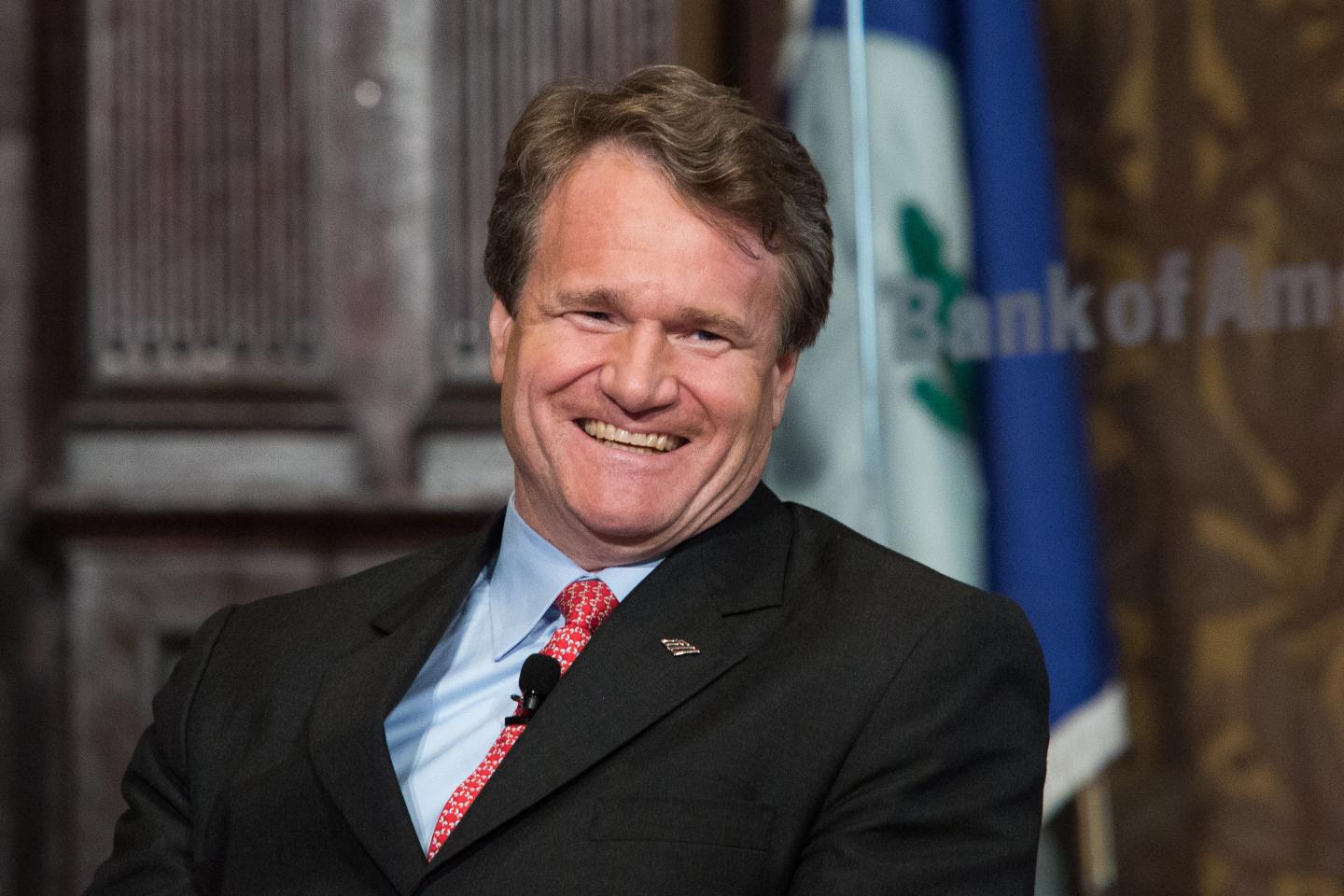
Take a moment to dream about tomorrow’s action heroes in banking. Imagine a CEO with Jamie Dimon’s rare managerial ability—somebody who has the clear strategic vision of JP Morgan Chase’s (JPM) chief along with the gritty operational skills required to achieve it. Now take away Dimon’s charisma. And his celebrity good looks. And while you’re at it, lose the engaging rap, the reputation as an empire builder, and the adulation of a boatload of sell-side analysts. What have you got? Brian Moynihan—the plodding, unglamorous, widely underestimated CEO of Bank of America (BAC).
It’s time for Wall Street to accord Moynihan the Dimon-sized respect. He’s just taken his biggest step yet towards the goal so seemingly implausible that most of the investment community dismissed it long ago: making BofA one of the world’s most profitable companies. This may sound like an odd thing to say in the wake of what many described as a monster government sanction. (On Aug. 21, the bank reached a $16.65 billion settlement with the U.S. Department of Justice, the SEC, and the attorneys general of six states, including New York and California, for abuses in originating, securitizing, and selling residential mortgages during in the run-up to the financial crisis.) But that’s precisely why I’m saying it.
The settlement––the largest ever reached between the U.S. government and an individual company––represents a landmark for Moynihan. It’s the last of the big mortgage-related fines and penalties, totaling over $70 billion, that have pounded BofA’s earnings since he took charge at the start of 2011. (Most of the bad loans were written or packaged by Countrywide, which BofA acquired in 2009, about two years before Moynihan became CEO.) BofA’s litigation reserves don’t fully cover the new settlement, so the bank will record a loss of around $1.4 billion in the third quarter, erasing a previously-forecast profit of $3.4 billion.
That’s a dark cloud, certainly. But it’s also a dark cloud that has lifted. Moynihan pledges that BofA’s tremendous earnings power will finally emerge. He’s running a collection of good businesses, consisting of top-tier franchises in consumer banking, investment banking and wealth management under Merrill Lynch. Excluding the drag from mortgages, they’re all profitable.
The question to ask is how well BofA will fare as the economy improves. Skeptics, and there are many, think that it will bump along as a moderately profitable laggard, trailing leaders JP Morgan and Wells Fargo (WFC).
Sure, Moynihan’s detractors credit him with rescuing BofA, but they doubt he can guide it to robust growth in good times. A major criticism is that he’s prone to unforced errors that keep hurting its reputation with consumers and investors. “I’m conflicted about his performance,” says independent banking analyst Nancy Bush of NAB Research. “He was dealt a very bad hand, and he’s played it okay. But he keeps making errors where I say, ‘You couldn’t do better than that?’”
Bush is referring to a number of missteps BofA has made under Moynihan’s watch—capped by one doozy of error in April: in a Federal Reserve stress that month, it was revealed that the bank had overstated its capital reserves by $4 billion. BofA fixed the error right away, but the mistake forced the bank to temporarily suspend its plan to repurchase shares and increase its dividend, resulting in embarrassing headlines and a steep, if short-lived, decline in its stock price. CLSA Americas analyst Mike Mayo expressed doubts in a recent research note that BofA has the profit potential Moynihan keeps touting, and forecasts that the stock will drop from its current level of $16.33 to around $15.
But don’t count this guy out. In his first few months as CEO, Moynihan established stunningly ambitious goals. He’s more or less sticking by them. If he can meet those targets, BofA will match, if not surpass, JP Morgan and Wells Fargo in profitability. That would confound the skeptics, and mark one of the most astounding comebacks in banking history.
Moynihan set those goals, and first unveiled his highly original philosophy of banking, at an investor conference in March 2011. During that event at the baroque ballroom of the Plaza Hotel in Manhattan, Moynihan extolled a model that’s a throwback to the conservative practices of the 1950s. He stated that the problem with banks is that they make tons of money in good years, and give it all back in credit losses when times get tough. The problem, he said, is that in a heady market, banks make far too many risky mortgage, credit card, and commercial real estate loans in a headlong drive for growth.
Moynihan’s view, then as now, is that BofA should expand with the overall economy, and no faster, and grow by getting more business from its existing customers instead of chasing new ones. The idea is that banking is intrinsically one of the world’s most profitable businesses—if you don’t screw it up.
By following that “back to the future” model, Moynihan declared, BofA would post consistently strong profits. In the 2011 presentation, he forecast that once the economy recovered, and once the mortgage settlements were past, the bank should earn between $35 and $40 billion in pre-tax income. That amounts to $23 to $26 billion in net earnings.
Moynihan didn’t give a precise timetable for the surge in profits. Indeed, BofA hasn’t come close to achieving them so far. From 2011 to 2013, it earned just $19 billion in total, less than what Moynihan claims it should eventually book in a single year. No question about it: It’s taking far longer than Moynihan expected to realize BofA’s potential. But one can reasonably argue that it is special factors, not BofA’s sound strategy, that have held it back. The mortgage settlements, and costs of servicing delinquent loans, far exceeded Moynihan’s (as well as most observers’) expectations—and until the big settlement was negotiated in August, hung like the sword of Damocles over the bank.
An even bigger obstacle has been the economic environment, one that has made growth extremely difficult. The problem has been two-fold, slow growth in demand for loans and years of ultra-low interest rates. “Loan growth has not come back to the extent of recoveries from prior recessions,” says John McDonald, an analyst with Sanford C. Bernstein & Co. “The main challenge has been low rates. The biggest factor in reviving growth would be a rise in rates.”
The good news for BofA? That tough economic environment may well be changing. Moynihan, for his part, is sticking close to his original targets. He now predicts that the bank should earn 1% on assets, or around $22 billion, and grow steadily from there, once the economy, and interest rates, return to historic norms. Such numbers would make BofA one of the most profitable companies on earth. With the exceptions of government-controlled Fannie Mae and Freddie Mac, the only companies in the Fortune 500 that earned significantly more than $22 billion last year were Exxon Mobil and Apple. Wall Street clearly doubts Moynihan will get there: BofA’s market cap now stands at $172 billion, meaning investors anticipate profits far below the $20-odd billion goal.
Wall Street, however, is wrong. Moynihan stands a good chance of meeting his current goals, if not quite those of 2011. His progress in curbing BofA’s once-bloated expenses is remarkable, and gives credence to his pledge that a modest rise in future revenues will yield outsize gains in earnings. Since the start of 2011, its headcount has dropped from 288,000 at the start of 2011 to 233,000. All told, the bank has lowered its operating cost base of employees, systems, buildings and the like—excluding litigation and the servicing of delinquent loans—by almost $8 billion a year, to around $53 billion. That’s a reduction of over 12%. By paying down long-term debt, Moynihan has lowered annual interest payments on those borrowings from $11.8 to $6.8 billion in three years. He’s also replaced risky second mortgage and student loans with far less volatile, higher-yielding credit card loans and first mortgages.
With operating costs still on the decline, BofA should get a big lift from two factors. The first is the eventual return of interest rates to, or near, their historic averages. And herein lies the real reason the bank has a highly profitable future: its abundant, extremely low-cost deposits. Today, BofA leads all banks in domestic deposits, boasting a total of $1.14 trillion in its combined checking, savings, money market, CDs and Merrill Lynch brokerage accounts. That’s $174 billion more than the comparable figure for Wells Fargo, and $195 billion more than JP Morgan. Almost $400 billion of that money sits in checking accounts that pay its depositors zero interest. Overall, BofA pays out an astoundingly modest $1.4 billion a year in interest, or 0.12%, on that trillion-plus in deposits. Again, that’s about one-eighth of one percent. Twelve basis points. If banking were golf, that would count as a gimme’.
BofA supports its entire $900 billion book of credit card, mortgage and corporate loans with those cheap deposits—and, importantly, those loans, even at today’s low rates, yield an average of 4%.
Naturally, the interest on those loans, along with fees, also support the bank’s prodigious branch network. Even there, though, Moynihan has found major efficiencies. By concentrating on fewer, bigger branches in highly-populated areas, he has lowered the total branch count since 2011, from 5805 to 5095. The average branch now holds around $110 million in deposits. According to a common yardstick, branches with around $40 million in deposits tend to cover their costs.
As rates rise, the extra revenue on the loan portfolios goes overwhelmingly to profit. Most of BofA’s loans are indexed to LIBOR, so rates rise instantaneously with the overall market. The cost of funds increases far more slowly, in part because those $400 billion in checking accounts, where folks deposit their paychecks, will continue to pay no interest at all. “We’re heavily leveraged to any increase in interest rates,” said Moynihan at a recent investor conference. If the ten-year rate rises from the current 2.5% to around 4.0%, BofA would book an additional $5 billion or so in pre-tax income.
The windfall from rates is inevitable, though the timing is still unpredictable. The second factor bound to boost profits is a steep decline in the extraordinary costs of servicing delinquent loans. At the peak, the expense of foreclosures, modifications, and renovating and selling repossessed homes stood at $3.1 billion a quarter. Now, it’s running at around $1.4 billion. That’s still a lot higher than the figure Moynihan was predicting at this stage. Eventually, he predicts that servicing costs will drop to around $2 billion a year (or $500 million a quarter). “He should get to the $2 billion a year goal by 2016 or 2017,” says McDonald.
So let’s establish an earnings model for BofA in the new-post settlement era. Right now, revenues are running at $90 billion, without adding any growth from a rise in rates. Operating expenses, as I said up top, are $53 billion. To that number, we’ll add $4 billion in extraordinary servicing costs, though that number will keep shrinking. That takes us up to $57 billion in non-interest costs. Which leaves $33 billion in pre-tax income ($90 billion minus $57 billion). After taxes, that profit would—at least in theory—come to $21.5 billion.
Keep in mind that BofA also pays $1.1 billion a year in dividends on preferred stock owned by Berkshire Hathaway. So that takes a down a nudge to $20.4 billion for common shareholders. (Warren is anything but common.)
If we add in just a one-point rise in overall interest rates, BofA could even exceed Moynihan’s $22 billion profit goal. And that’s not including the inevitable decline in servicing costs.
Getting back to the CEO’s presentation at the Plaza, the most remarkable feature of his model is his claim that BofA can pay out 100% of its profits, and still keep growing. Unlike most companies, Moynihan declared, his bank doesn’t require any new capital to expand revenues with the economy (or even grow a trifle faster than the economy). If costs grow at a slower pace, profits could wax in the 6-7% range.
So what does that mean for investors? Well, add together that profit growth rate, a big dividend yield and plenty of cash left over for buybacks—and imagine this scenario lasts for quite a number of years. Yeah—that’s a triple threat. “I think he’ll eventually reach those big goals,” says McDonald. In today’s world, the future of banking may belong to the plodders.