• Home
  • Latest
  • Fortune 500
  • Finance
  • Tech
  • Leadership
  • Lifestyle
  • Rankings
  • Multimedia

Tesla’s Future Depends on Other People’s Money

Shawn Tully
By
Shawn Tully
Shawn Tully
Senior Editor-at-Large
Down Arrow Button Icon
Shawn Tully
By
Shawn Tully
Shawn Tully
Senior Editor-at-Large
Down Arrow Button Icon
March 7, 2019, 3:00 PM ET

Elon Musk is a genius at using other people’s money.

The Tesla founder is notorious for erratic driving, whether it’s changing forecasts for vehicle production, tweeting then retreating about going private, or veering from showroom to web-focused selling. But Musk has stayed perfectly on course in pursuing a golden prize: raising cost-free funding. Musk is getting a huge portion of the cash that Tesla uses to produce cars and batteries not from lenders and shareholders, but from its own fanatically loyal customers in everything from wait-in-line deposits to pre-paid warranties to advances for self-driving software.

Those billions are a stealth advantage for Tesla. The overriding question is whether Musk will be able to keep deploying OPM (other people’s money) at anything like the current rate in the years to come, and if not, whether the necessity of actually “paying” for many billions in new capital will sink any chance for future profitability.

WHERE TESLA STANDS NOW

One of the best measures of Tesla’s true profitability is EVA, or economic value added. The yardstick applies a “capital charge” for the equity that shareholders have invested in the business, a fee equivalent to what they’d gain from equally risky stocks or bonds. Tesla is much criticized for piling on capital to ramp up production, in part to compensate for an creaky network of plants and suppliers. EVA––the methodology is now owned by governance advisory firm ISS––sets a simple benchmark for success: To reward shareholders, Tesla must generate profits over and above the minimum capital charge that sets the dividing line between creating and destroying shareholder value.

In 2018, Tesla posted after-tax operating profits, using the EVA formula, of $225 million. But after assessing a capital charge, its economic earnings for shareholders, its EVA, dropped to a negative $988 million, or -4.7% of sales. Among the world’s 11 largest carmakers, Tesla placed a poor 9th in EVA margin. It’s a tough business: The only manufacturer that delivered positive EVA was Subaru of Japan.

WHAT TESLA MUST DO TO REWARD SHAREHOLDERS

The EVA system forecasts sales, margins and other key numbers for future years, based on analysts’ consensus projections. Let’s look at what Wall Street expects Tesla to achieve by year-end 2021, then layer on the crucial, mostly overlooked element: How much capital it will have to effectively pay for versus the hoard it will keep getting for “free.” The investment community is expecting heroic gains over the next three years. For 2021, the consensus calls for sales to jump 90% to $40.8 billion.

If Tesla hits that mark, it’s likely that costs per vehicle will drop substantially. For carmakers, raising profits is all about driving ever larger volumes through a high fixed cost asset base. Last year, Tesla’s cost-of-goods ballooned from 66% to 72% of sales as it cast caution to the speedway shoulder in a frantic campaign to swell production of the Model 3. “Tesla’s cars accelerate smoothly, its business does not,” says Bennett Stewart, a senior advisor to ISS who pioneered the EVA concept.

Analysts predict that COGS will fall to 67% of revenues by 2021. If sales do reach $40 billion, and Tesla can work out the kinks in its unwieldy supply chain, it stands a decent chance getting there. Another plus: Tesla’s done a good job on overhead, lowering SG&A from 20% to 13% of revenues in the past year. Tesla also generates loads of excitement from free press coverage, so it gets away with spending a minuscule $50 million a year on advertising and promotion.

TESLA’S PROFITABILITY WILL DEPEND ON HOW MUCH FREE FUNDING IT MAINTAINS

Tesla’s EVA numbers would look much worse without a gigantic contribution from what’s called “trade funding.” Tesla is amassing the cash from customers and other sources in half-a-dozen categories, mainly for future services or purchases. Tesla has collected $2.4 billion in deposits from folks waiting in line for their made-to-order vehicles, a tribute to the hotness of the brand. Cash is also flowing in from upfront payments for such to-be-delivered services as software updates, Autopilot features, and access to the supercharger network. Tesla also collects warranty fees built into the price of the car today for repairs due in the future. Another fount: its guaranteed car repurchase program. Tesla estimates what the buybacks will cost in future years, and takes those amounts as an expense on its income statement. For now, it doesn’t have to lay out the cash, so it can channel the funds to buy robots or finance inventories.

All told, Tesla used $8 billion of OPM last year, amounting to around one-third of the entire $24.4 billion in working capital, plants, equipment and that capitalized research spending that EVA puts on the books, used to produce its cars. Had Tesla raised that extra $8 billion from shareholders and creditors, its EVA last year would have been 60% worse at a negative $1.6 billion, or -7.4% of sales.

“Tesla’s future profitability depends on how much OPM it keeps getting to use,” says Stewart. Looking forward to 2021, if Tesla manages to hold the share of total capital constant at around 30%, it would be assessed an EVA charge on only $22.6 billion of its forecast total capital of $32.3 billion. In that instance, Tesla would generate positive EVA of around $600 million, equivalent to 1.5% of sales.

TESLA’S PATH TO PROFITABILITY IS NARROW

Even reaching that modest number will be a stretch. It’s unlikely that Tesla will continue attracting that share of its total capital free of charge. Advances from customers, as well as other sources, are already falling, shrinking from $10 billion in 2015. Still, Tesla is now collecting much more in warrantee fees, service packages for future delivery, and pre-expensed warrantee costs than its putting out in cash. But each year, that gap will shrink as the carmaker lays of funds for repairs and repurchases of cars. If trade funding falls to 10% of total capital, that trend alone would reduce EVA to zero in 2021.

The second big risk is that Tesla fails to keep sales on the ultra-fast track, so that the economies needed to lower costs per vehicle don’t materialize. Consider that shareholders are shrugging off these unknowns by awarding Tesla a market cap of $50 billion. Few on Wall Street recognize that Musk’s skill at using OPM accounts for a big part of that valuation. It’s the supercharger that may not last.



About the Author
Shawn Tully
By Shawn TullySenior Editor-at-Large

Shawn Tully is a senior editor-at-large at Fortune, covering the biggest trends in business, aviation, politics, and leadership.

See full bioRight Arrow Button Icon

Latest in

Finance
Lorem ipsum dolor sit amet, consectetur adipiscing elit, sed do eiusmod tempor incididunt ut labore et dolore magna aliqua. Ut enim ad minim veniam
By Fortune Editors
October 20, 2025
Finance
Lorem ipsum dolor sit amet, consectetur adipiscing elit, sed do eiusmod tempor incididunt ut labore et dolore magna aliqua. Ut enim ad minim veniam
By Fortune Editors
October 20, 2025
Finance
Lorem ipsum dolor sit amet, consectetur adipiscing elit, sed do eiusmod tempor incididunt ut labore et dolore magna aliqua. Ut enim ad minim veniam
By Fortune Editors
October 20, 2025
Finance
Lorem ipsum dolor sit amet, consectetur adipiscing elit, sed do eiusmod tempor incididunt ut labore et dolore magna aliqua. Ut enim ad minim veniam
By Fortune Editors
October 20, 2025
Finance
Lorem ipsum dolor sit amet, consectetur adipiscing elit, sed do eiusmod tempor incididunt ut labore et dolore magna aliqua. Ut enim ad minim veniam
By Fortune Editors
October 20, 2025
Finance
Lorem ipsum dolor sit amet, consectetur adipiscing elit, sed do eiusmod tempor incididunt ut labore et dolore magna aliqua. Ut enim ad minim veniam
By Fortune Editors
October 20, 2025

Most Popular

Finance
Lorem ipsum dolor sit amet, consectetur adipiscing elit, sed do eiusmod tempor incididunt ut labore et dolore magna aliqua. Ut enim ad minim veniam
By Fortune Editors
October 20, 2025
Finance
Lorem ipsum dolor sit amet, consectetur adipiscing elit, sed do eiusmod tempor incididunt ut labore et dolore magna aliqua. Ut enim ad minim veniam
By Fortune Editors
October 20, 2025
Finance
Lorem ipsum dolor sit amet, consectetur adipiscing elit, sed do eiusmod tempor incididunt ut labore et dolore magna aliqua. Ut enim ad minim veniam
By Fortune Editors
October 20, 2025
Finance
Lorem ipsum dolor sit amet, consectetur adipiscing elit, sed do eiusmod tempor incididunt ut labore et dolore magna aliqua. Ut enim ad minim veniam
By Fortune Editors
October 20, 2025
Finance
Lorem ipsum dolor sit amet, consectetur adipiscing elit, sed do eiusmod tempor incididunt ut labore et dolore magna aliqua. Ut enim ad minim veniam
By Fortune Editors
October 20, 2025
Finance
Lorem ipsum dolor sit amet, consectetur adipiscing elit, sed do eiusmod tempor incididunt ut labore et dolore magna aliqua. Ut enim ad minim veniam
By Fortune Editors
October 20, 2025
Rankings
  • 100 Best Companies
  • Fortune 500
  • Global 500
  • Fortune 500 Europe
  • Most Powerful Women
  • Future 50
  • World’s Most Admired Companies
  • See All Rankings
Sections
  • Finance
  • Leadership
  • Success
  • Tech
  • Asia
  • Europe
  • Environment
  • Fortune Crypto
  • Health
  • Retail
  • Lifestyle
  • Politics
  • Newsletters
  • Magazine
  • Features
  • Commentary
  • Mpw
  • CEO Initiative
  • Conferences
  • Personal Finance
  • Education
Customer Support
  • Frequently Asked Questions
  • Customer Service Portal
  • Privacy Policy
  • Terms Of Use
  • Single Issues For Purchase
  • International Print
Commercial Services
  • Advertising
  • Fortune Brand Studio
  • Fortune Analytics
  • Fortune Conferences
  • Business Development
About Us
  • About Us
  • Editorial Calendar
  • Press Center
  • Work At Fortune
  • Diversity And Inclusion
  • Terms And Conditions
  • Site Map
  • Facebook icon
  • Twitter icon
  • LinkedIn icon
  • Instagram icon
  • Pinterest icon

Latest in

NewslettersCEO Daily
American Airlines CEO’s crisis grows as flight attendant union calls for him to step down
By Diane BradyFebruary 10, 2026
34 minutes ago
InvestingMarkets
Why that $2 trillion software stock wipeout didn’t derail the AI bull market
By Jim EdwardsFebruary 10, 2026
35 minutes ago
EconomyEconomic growth
Asia’s young, tech-savvy population will power the region’s growth: AIIB chief investment officer Kim-See Lim
By Angelica AngFebruary 10, 2026
2 hours ago
AIOpenAI
Panicked about losing GPT-4o, some ChatGPT users are building DIY versions. A psychologist explains why ‘feel-good hormones’ make it hard to let go
By Marco Quiroz-GutierrezFebruary 10, 2026
2 hours ago
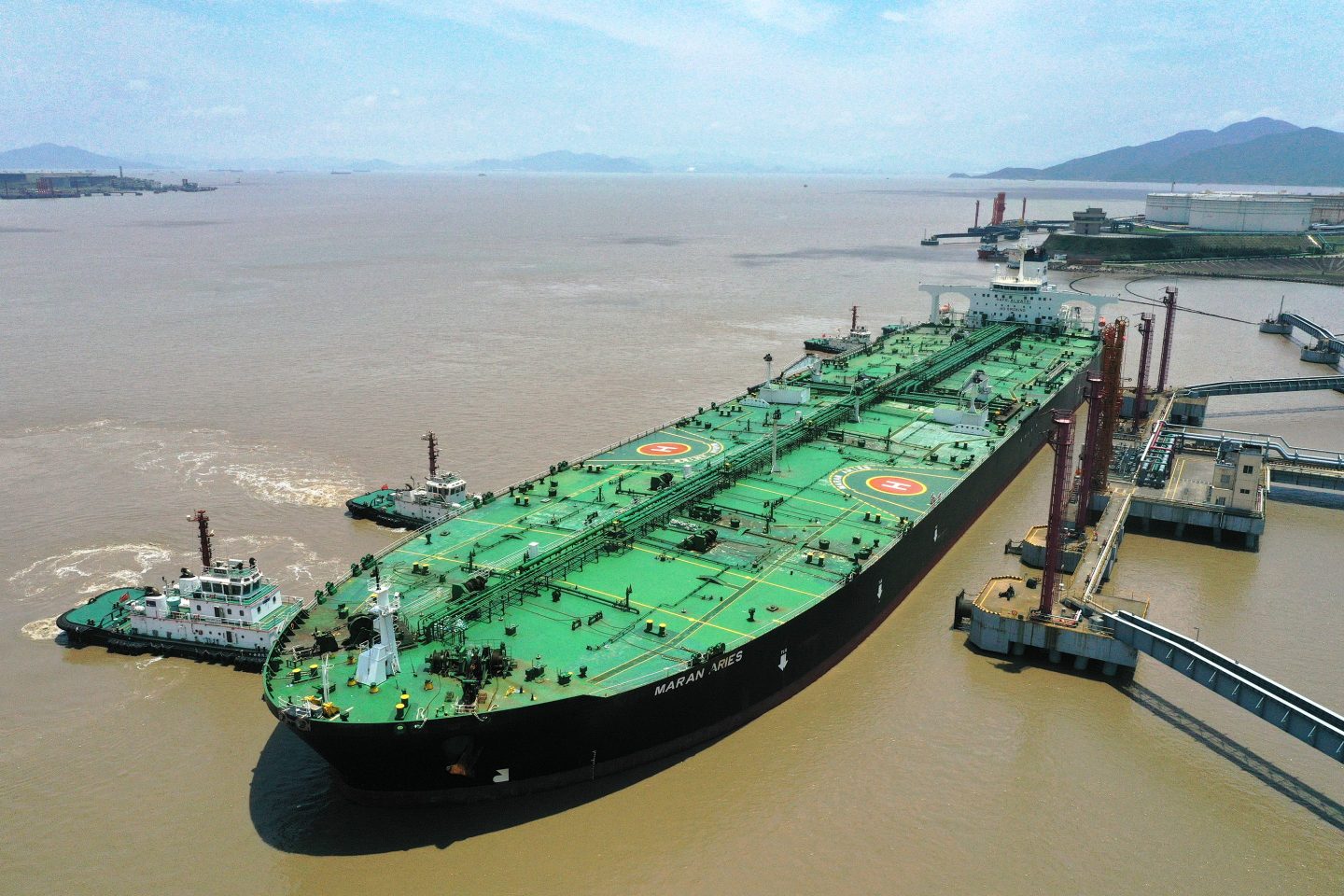
A Very Large Crude Carrier from Greece unloads in China in 2020.
Energycrude oil
The Trump administration is touting approvals for oil-exporting hubs in the Gulf of Mexico—but no one seems to want to build them
By Jordan BlumFebruary 10, 2026
3 hours ago
Personal FinanceReal Estate
Current ARM mortgage rates report for Feb. 10, 2026
By Glen Luke FlanaganFebruary 10, 2026
3 hours ago

Most Popular

placeholder alt text
C-Suite
Meet Jody Allen, the billionaire owner of the Seattle Seahawks, who plans to sell the team and donate the proceeds to charity
By Jake AngeloFebruary 9, 2026
16 hours ago
placeholder alt text
AI
As billionaires bail, Mark Zuckerberg doubles down on California with $50 million donation
By Sydney LakeFebruary 9, 2026
18 hours ago
placeholder alt text
Economy
China might be beginning to back away from U.S. debt as investors get nervous about overexposure to American assets
By Eleanor PringleFebruary 9, 2026
23 hours ago
placeholder alt text
Economy
Elon Musk warns the U.S. is '1,000% going to go bankrupt' unless AI and robotics save the economy from crushing debt
By Jason MaFebruary 7, 2026
3 days ago
placeholder alt text
Commentary
America marks its 250th birthday with a fading dream—the first time that younger generations will make less than their parents
By Mark Robert Rank and The ConversationFebruary 8, 2026
2 days ago
placeholder alt text
Economy
Russian officials are warning Putin that a financial crisis could arrive this summer, report says, while his war on Ukraine becomes too big to fail
By Jason MaFebruary 8, 2026
2 days ago

© 2026 Fortune Media IP Limited. All Rights Reserved. Use of this site constitutes acceptance of our Terms of Use and Privacy Policy | CA Notice at Collection and Privacy Notice | Do Not Sell/Share My Personal Information
FORTUNE is a trademark of Fortune Media IP Limited, registered in the U.S. and other countries. FORTUNE may receive compensation for some links to products and services on this website. Offers may be subject to change without notice.