• Home
  • Latest
  • Fortune 500
  • Finance
  • Tech
  • Leadership
  • Lifestyle
  • Rankings
  • Multimedia
Leadership

Marriott to hotel guests: Please pay our maids for us

Claire Zillman
By
Claire Zillman
Claire Zillman
Editor, Leadership
Down Arrow Button Icon
Claire Zillman
By
Claire Zillman
Claire Zillman
Editor, Leadership
Down Arrow Button Icon
September 16, 2014, 10:10 AM ET
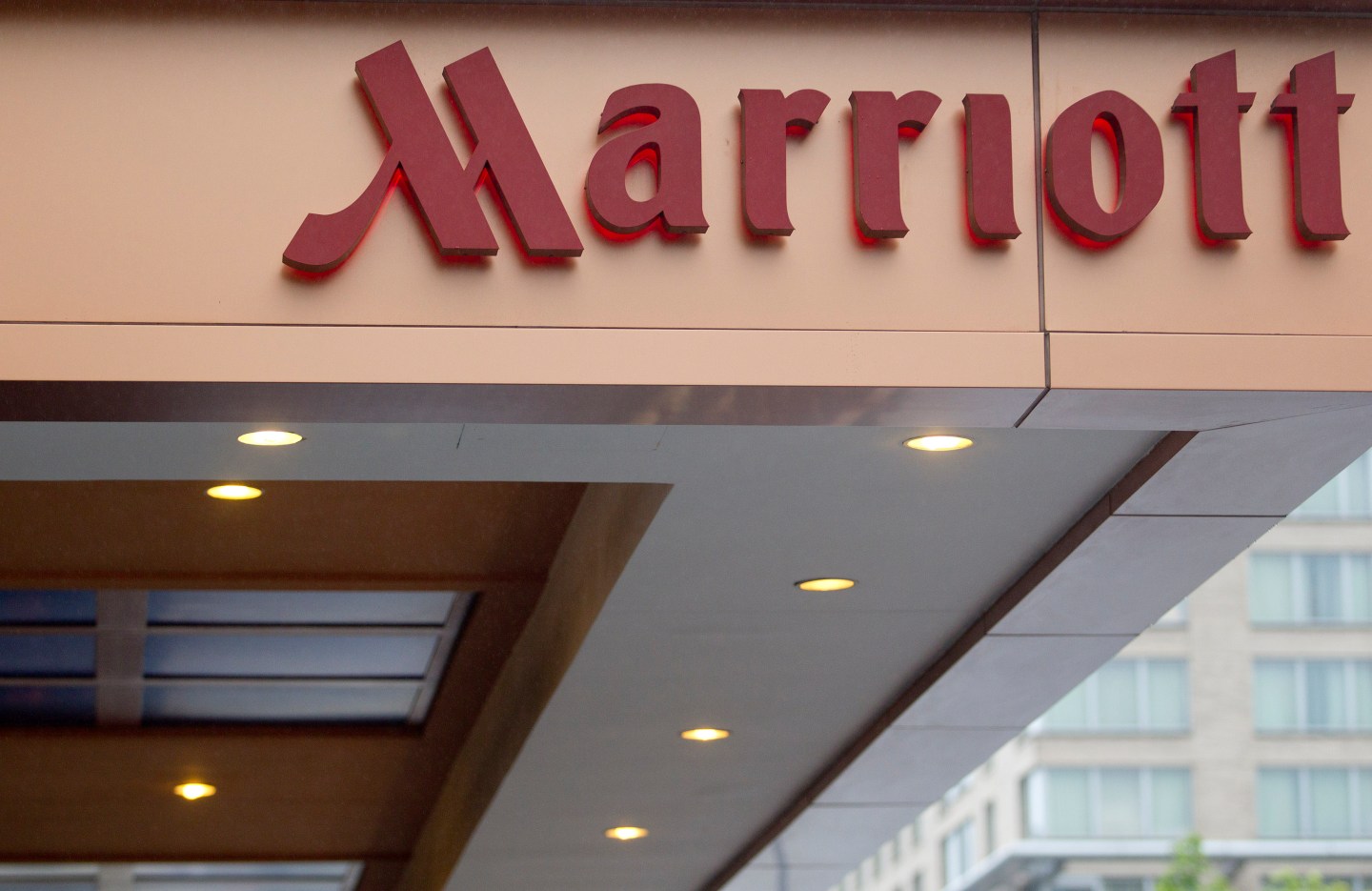
Marriott International Inc. Reports Second Quarter Earnings
A Marriott sign hangs at a hotel in Washington, D.C., U.S. on Wednesday, July 14, 2010. Marriott International Inc. is expected to release their second quarter earnings after the closing of the trading day today. Photographer: Andrew Harrer/Bloomberg via Getty ImagesPhoto by Andrew Harrer—Bloomberg—Getty Images

The United States imported the concept of tipping service workers from Europe, but that hasn’t stopped America from making the practice its own. Americans tip more than any other nations’ citizens, according to tipping expert Michael Lynn of Cornell University’s School of Hotel Administration. “We’re on the top of the heap in terms of who we tip and how much we tip.”

Marriott International, it seems, is angling to get its workers a piece of that American generosity.

On Monday, the hotel chain announced that it would start placing tip envelopes in its hotel rooms to encourage guests to “express their gratitude by leaving tips and notes of thanks” for hotel room attendants.

The initiative is part of “The Envelope Please,” a project by A Woman’s Nation, a nonprofit organization founded by former California first lady Maria Shriver that advocates for the recognition and respect of women at home and in the workplace. The idea behind the tip envelopes, which will appear in 160,000 guest rooms at participating Marriotts this week, is to give hotel guests the opportunity to acknowledge the “behind-the-scenes” work of housekeepers, which often goes unnoticed and unappreciated because room attendants are not as visible as front-of-the-house employees, according to a release.

Shriver told Fortune on Monday that The Envelope Please is a “person-to-person” initiative that will be combined with business and government programs, constituting a three-pronged approach to fight poverty among women. (She has also called for a higher minimum wage and better access to higher paying jobs.)

Karl Fischer, Marriott’s chief human resources officer for the Americas, told Fortune that the hotel “takes seriously the need to pay [the housekeepers] competitively.” The tip envelopes encourage “a voluntary action on behalf of customers…based on their experience as guests,” he says.

But to a fatigued public living in an economic environment where corporate profits are at their highest level in at least 85 years and employee compensation is at its lowest level in 65 years, Marriott’s well-intentioned tip envelopes seem like yet another case in which a corporation is relying on consumers to pay workers’ wages instead of investing in employees directly.

The biggest culprit of this trend is the restaurant industry, where tipped workers have been paid a minimum wage of $2.13 per hour for 23 years. In theory, all workers make the regular minimum wage—at least $7.25 federally—but employers of tipped workers catch a break in that they’re only required to pay their workers $2.13 per hour based on federal law, while consumers’ tips make up the $5.12 difference. That means as the minimum wage has increased over the years—from $4.25 in 1991, to $5.15 in 1997, to $6.55 in 2008, and $7.25 a year later—the tipped minimum wage has been stagnant, and customers have directly contributed more and more of the take-home pay of waitresses, bartenders, and casino workers.

Meanwhile, fast-food companies’ refusal to raise their restaurant workers’ wages has led to a dismal scenario in which 52% of fast-food employees’ rely on public programs to make ends meet, costing taxpayers approximately $7 billion per year.

Marriott’s initiative is somewhat different from the restaurant and fast-food examples. For one, its workers aren’t subject to the tipped minimum wage, so the gratuity they receive will serve as extra income. (Maids and housekeepers earned a median annual salary of $19,570, or approximately $9.41 per hour, in 2012, according to the U.S. Bureau of Labor Statistics.) And unlike the fast-food industry, which has expressed little concern over its workers’ livelihoods, Marriott seems to care—or at least it has said it does publicly.

Nevertheless, if what Marriott really does want—as CEO Arne Sorenson said in Monday’s release—to “shine a light on the excellent behind-the-scenes work our room attendants do,” why not offer an across-the-board hourly wage increase, like Ikea and The Gap, instead of leaving it to the whims of hotel guests?

Lynn of Cornell pointed to an often-used rationale: if wages go up, so will the cost of a hotel room, which would lead to a competitive disadvantage. Indeed, Fischer told Fortune that “Marriott’s focus is on being competitive.” (It should be noted that in the second quarter of this year Marriott International reported $192 million in profits, a 7.3% increase from the same period a year ago.)

Sylvia Allegretto, research economist at the Institute of Research on Labor & Employment at the University of California, Berkeley, argues that such explanations “ignore the positive benefits of giving workers higher wages.” A 2013 Berkeley study compared the experiences of businesses located in neighboring counties but different states. The firms located in the states that had raised their minimum wage saw less employee turnover than their lower-paying counterparts. Workers in the higher paying states were also less likely to leave their jobs and managers avoided the costs of recruiting and training new employees.

Encouraging an employee pay structure that depends on tips is flirting with danger, argues David Cooper of the Economic Policy Institute. “We know that … workers in industries where tips are the dominant form of income … that sort of structure creates extremely erratic income flows for those workers. It’s hard to budget and plan because income can vary widely week to week,” he says. “This is an example of a large professional corporation trying to shift some of their compensation costs onto consumers as opposed to paying good wages that workers can rely on.”

Editor’s note: This story has been updated with comments from Marriott.

About the Author
Claire Zillman
By Claire ZillmanEditor, Leadership
LinkedIn iconTwitter icon

Claire Zillman is a senior editor at Fortune, overseeing leadership stories. 

See full bioRight Arrow Button Icon

Latest in Leadership

Finance
Lorem ipsum dolor sit amet, consectetur adipiscing elit, sed do eiusmod tempor incididunt ut labore et dolore magna aliqua. Ut enim ad minim veniam
By Fortune Editors
October 20, 2025
Finance
Lorem ipsum dolor sit amet, consectetur adipiscing elit, sed do eiusmod tempor incididunt ut labore et dolore magna aliqua. Ut enim ad minim veniam
By Fortune Editors
October 20, 2025
Finance
Lorem ipsum dolor sit amet, consectetur adipiscing elit, sed do eiusmod tempor incididunt ut labore et dolore magna aliqua. Ut enim ad minim veniam
By Fortune Editors
October 20, 2025
Finance
Lorem ipsum dolor sit amet, consectetur adipiscing elit, sed do eiusmod tempor incididunt ut labore et dolore magna aliqua. Ut enim ad minim veniam
By Fortune Editors
October 20, 2025
Finance
Lorem ipsum dolor sit amet, consectetur adipiscing elit, sed do eiusmod tempor incididunt ut labore et dolore magna aliqua. Ut enim ad minim veniam
By Fortune Editors
October 20, 2025
Finance
Lorem ipsum dolor sit amet, consectetur adipiscing elit, sed do eiusmod tempor incididunt ut labore et dolore magna aliqua. Ut enim ad minim veniam
By Fortune Editors
October 20, 2025

Most Popular

Finance
Lorem ipsum dolor sit amet, consectetur adipiscing elit, sed do eiusmod tempor incididunt ut labore et dolore magna aliqua. Ut enim ad minim veniam
By Fortune Editors
October 20, 2025
Finance
Lorem ipsum dolor sit amet, consectetur adipiscing elit, sed do eiusmod tempor incididunt ut labore et dolore magna aliqua. Ut enim ad minim veniam
By Fortune Editors
October 20, 2025
Finance
Lorem ipsum dolor sit amet, consectetur adipiscing elit, sed do eiusmod tempor incididunt ut labore et dolore magna aliqua. Ut enim ad minim veniam
By Fortune Editors
October 20, 2025
Finance
Lorem ipsum dolor sit amet, consectetur adipiscing elit, sed do eiusmod tempor incididunt ut labore et dolore magna aliqua. Ut enim ad minim veniam
By Fortune Editors
October 20, 2025
Finance
Lorem ipsum dolor sit amet, consectetur adipiscing elit, sed do eiusmod tempor incididunt ut labore et dolore magna aliqua. Ut enim ad minim veniam
By Fortune Editors
October 20, 2025
Finance
Lorem ipsum dolor sit amet, consectetur adipiscing elit, sed do eiusmod tempor incididunt ut labore et dolore magna aliqua. Ut enim ad minim veniam
By Fortune Editors
October 20, 2025
Rankings
  • 100 Best Companies
  • Fortune 500
  • Global 500
  • Fortune 500 Europe
  • Most Powerful Women
  • Future 50
  • World’s Most Admired Companies
  • See All Rankings
Sections
  • Finance
  • Leadership
  • Success
  • Tech
  • Asia
  • Europe
  • Environment
  • Fortune Crypto
  • Health
  • Retail
  • Lifestyle
  • Politics
  • Newsletters
  • Magazine
  • Features
  • Commentary
  • Mpw
  • CEO Initiative
  • Conferences
  • Personal Finance
  • Education
Customer Support
  • Frequently Asked Questions
  • Customer Service Portal
  • Privacy Policy
  • Terms Of Use
  • Single Issues For Purchase
  • International Print
Commercial Services
  • Advertising
  • Fortune Brand Studio
  • Fortune Analytics
  • Fortune Conferences
  • Business Development
About Us
  • About Us
  • Editorial Calendar
  • Press Center
  • Work At Fortune
  • Diversity And Inclusion
  • Terms And Conditions
  • Site Map
  • Facebook icon
  • Twitter icon
  • LinkedIn icon
  • Instagram icon
  • Pinterest icon

Most Popular

placeholder alt text
Commentary
Yes, you're getting a bigger tax refund. Your kids won't thank you for the $3 trillion it's adding to the deficit
By Daniel BunnJanuary 26, 2026
2 days ago
placeholder alt text
Success
Despite running $75 billion automaker General Motors, CEO Mary Barra still responds to ‘every single letter’ she gets by hand
By Preston ForeJanuary 26, 2026
2 days ago
placeholder alt text
Economy
An unusual Fed ‘rate check’ triggered a free fall in the U.S. dollar and investors are fleeing into gold
By Jim EdwardsJanuary 26, 2026
2 days ago
placeholder alt text
Personal Finance
Current price of silver as of Monday, January 26, 2026
By Joseph HostetlerJanuary 26, 2026
2 days ago
placeholder alt text
Personal Finance
Current price of silver as of Tuesday, January 27, 2026
By Joseph HostetlerJanuary 27, 2026
20 hours ago
placeholder alt text
Success
'The Bermuda Triangle of Talent': 27-year-old Oxford grad turned down McKinsey and Morgan Stanley to find out why Gen Z’s smartest keep selling out
By Eva RoytburgJanuary 25, 2026
3 days ago

© 2026 Fortune Media IP Limited. All Rights Reserved. Use of this site constitutes acceptance of our Terms of Use and Privacy Policy | CA Notice at Collection and Privacy Notice | Do Not Sell/Share My Personal Information
FORTUNE is a trademark of Fortune Media IP Limited, registered in the U.S. and other countries. FORTUNE may receive compensation for some links to products and services on this website. Offers may be subject to change without notice.


Latest in Leadership

C-Suitechief executive officer (CEO)
Fortune 500 CEOs are no longer giving employees an A for effort. Now they want proof of impact
By Claire ZillmanJanuary 28, 2026
2 hours ago
People walk outside of a WeWork office building in London.
Future of WorkOffice Culture
Amazon and JPMorgan led the Fortune 500 in returning to the office 5 days a week. Now they’re leading a coworking comeback
By Jacqueline MunisJanuary 27, 2026
12 hours ago
Anthropic CEO Dario Amodei
AIEye on AI
At Davos, CEOs said AI isn’t coming for jobs as fast as Anthropic CEO Dario Amodei thinks
By Jeremy KahnJanuary 27, 2026
12 hours ago
Photo of Howard Buffett
C-Suitephilanthropy
Warren Buffett’s son signals a huge change for philanthropy as he prepares to give away $150 billion
By Jake AngeloJanuary 27, 2026
15 hours ago
Anthropic CEO Dario Amodei
AIDario Amodei
Anthropic CEO Dario Amodei’s 20,000-word essay on how AI ‘will test’ humanity is a must-read—but more for his remedies than his warnings
By Jeremy KahnJanuary 27, 2026
15 hours ago
AITech
‘Country of geniuses in a data center’: Every AI cluster will have the brainpower of 50 million Nobel Prize winners, Anthropic CEO says
By Marco Quiroz-GutierrezJanuary 27, 2026
16 hours ago